Chicken Run Ideas: Size, Roof, Ground and Mesh
Coopgauge is reader-supported. When you buy through links on this page, we may earn a commission.
Give each standard hen 8 sq ft of run, or 4 sq ft for a bantam. Wrap the sides in ½ in hardware cloth, bury it 12 in, and cover the top. Then add shade, a dry corner and something to scratch in.
Run ideas at a glance
| Idea | Hens | Run area | Roof | Best for |
|---|---|---|---|---|
| Attached kit run | 2–4 | 16–32 sq ft | mesh or solid | Small yards |
| Walk-in run | 5–6 | 40–48 sq ft | mesh plus a solid end | Easy cleaning |
| Large framed run | 10–12 | 80–96 sq ft | mesh or netting | Big flocks |
| Run beside a garden | any | 8 sq ft each | mesh | Keepers with beds to clear |
| Covered winter run | any | 8 sq ft each | solid roof, clear panels | Snow and rain |
| Bantam run | 3–6 | 4 sq ft each | mesh | Tiny yards |
Penn State gives 8 sq ft of outside run per laying hen and 4 sq ft per bantam. Six hens need 48 sq ft, a run 6 × 8 ft. Twelve hens need 96 sq ft. More room is always welcome. A bigger run stays cleaner, because the hens spread out.
The coop and the run work together. Hens sleep and lay in the coop, and spend the day in the run. Our coop size calculator gives both numbers for any flock.
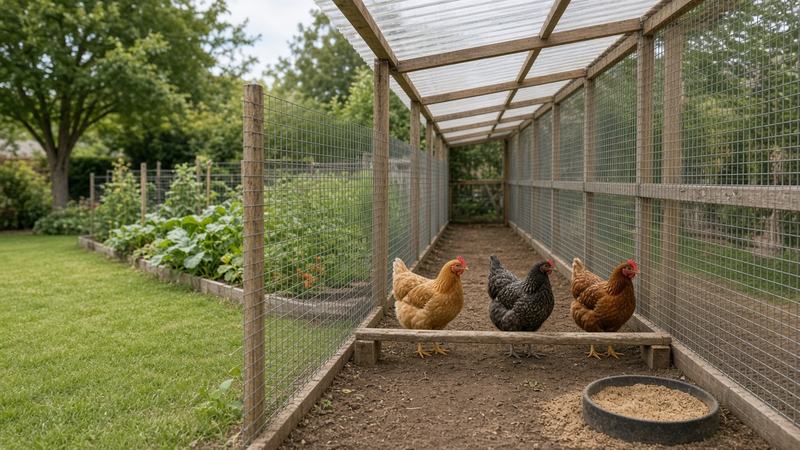
Walls and mesh
Chicken wire keeps hens in. It does not keep predators out. Kentucky Extension notes that a raccoon will reach through chicken wire. Use ½ in welded hardware cloth on the walls. Oregon State allows 1 × 2 in mesh fencing for the run walls; the smaller mesh is safer low down.
Bury the bottom edge. Penn State says to bury the wire at least 12 in deep and toe it outward about 6 in. Oregon State gives 6 in to 1 ft. Animals dig at the base of a fence, and the buried apron turns them away.
Roof ideas
Penn State says to cover outside runs with mesh wire or netting to stop hawks and owls. Oregon State also suggests netting or wire over the top. A mesh roof lets in light and rain. A solid roof over one end keeps a dry patch. Use it for dust baths and feed.
Netting is cheap and light. It suits wide runs. Hardware cloth is stronger and stops climbing raccoons too. For a run attached to the coop, a mix works well: hardware cloth near the coop and netting over the far end.
Penn State notes that a grid of wire or twine, 3 to 4 ft apart, woven over the pen gives good protection from flying predators. That is a cheap start for a big run. Close it in with mesh later if raccoons visit.
TRYKERPET lists the unit above as a large wooden coop with a nest box. Most of it is mesh under a removable cover, so it works as a tall covered run. It covers 47.3 sq ft and stands 71 in tall. At 8 sq ft per standard hen, that suits 5 hens. You can stand inside to clean and refill, which makes daily care quick. Add a solid panel over one end for rain.
Ground and mud
Bare dirt turns to mud in a wet spell. Penn State says to build on high, well-drained ground. Put the run on the highest spot you can. Slope the ground so water runs away from the coop.
Cover the ground with something the hens can scratch. Wood chips, coarse sand and leaves all work. Add a few inches over the wet spots. Rake the run every week or two, and add fresh material as it breaks down.
Penn State also suggests tall leafy cover, such as millet, broomcorn or sorghum, planted near the run, so birds have somewhere to hide. Low shrubs give shade too. Oregon State warns against large plants right around the coop, since they shelter predators, so keep big shrubs a few steps back.
Shade and shelter
Hens need shade in summer. Put the run on the north or east side of a building or tree. Or add a shade cloth over part of the roof. A solid roof over one corner gives both shade and a dry spot.
In winter, wind matters more than cold. A clear panel or a tarp on the windward side keeps snow out and lets light in. Leave the rest open for airflow. Keep water from freezing, and clear snow from the door.
Run ideas in detail
An attached kit run is the simplest idea. It bolts to a small coop and goes up in an afternoon. Measure the run floor and divide by 8 for standard hens. Most kit runs suit two to four hens. Add hardware cloth over any chicken wire that comes with it.
A run beside the garden puts the hens to work. Fence the run along one side of the beds. In fall, open a gate and let the hens clear the spent plants. Close it again in spring before you plant. The hens dig, scratch and leave the beds ready for compost.
A covered winter run keeps hens outside in snow. Use a solid roof with clear panels, and close the windward side. Leave the other sides open for air. The hens get daylight and exercise, and the coop stays cleaner through the winter.
A bantam run can be small and low. At 4 sq ft per bird, six bantams need 24 sq ft. Bantams fly well, so a full roof is a must. Use ½ in hardware cloth everywhere, since small birds slip through larger gaps.
A large framed run suits ten or more hens. Build it from 2 × 4s with posts at each corner and along the long sides. Make it tall enough to walk in. A wide door lets a wheelbarrow in for cleaning. Plan a path from the coop door to the run gate, so you are not walking through mud.
Build steps
- Mark out the run at 8 sq ft per hen, on high, dry ground.
- Set corner posts and a top frame of 2 × 4s.
- Dig a trench 12 in deep around the edge.
- Fix ½ in hardware cloth to the frame, down into the trench, and turn it out 6 in.
- Backfill the trench and pack the soil.
- Cover the top with mesh or netting, and add a solid panel over one end.
- Fit a door with a latch that takes two motions to open.
Extras the hens enjoy
A dust bath corner is the best extra. Fill a low box with dry sand or fine soil, under the solid part of the roof. A log or a low stump gives hens a place to perch by day. A few hanging greens give them something to peck.
Scatter a little scratch grain in the morning. The hens dig for it and turn the ground for you. University of Maine suggests no more than the flock clears in 20 to 30 minutes.
Daily care
Walk the run each morning when you let the hens out. Check the mesh, the door latch and the ground along the edge. A new hole means something tried to dig in. Fill it and add a stone or a strip of mesh.
Rake out wet spots and add fresh chips. Refill water in the shade. Close the hens in the coop at dusk, even inside a covered run. Those few minutes keep the flock safe and the run in good shape.
Once a season, walk the whole fence line slowly. Look for loose staples, sagging netting and rust. Fix small problems right away. A run that gets a little care each week lasts for years. It also keeps the hens calm, because nothing new gets in to scare them. That calm shows up in the egg basket. Keep a few spare clips and a small roll of mesh in the shed for quick repairs.
Common Questions
How big should a chicken run be?
8 sq ft per standard hen and 4 sq ft per bantam, by Penn State.
Does a chicken run need a roof?
Penn State and Oregon State both suggest mesh or netting over the top to stop hawks and owls.
How deep should run fencing be buried?
At least 12 in, with the bottom turned outward about 6 in, by Penn State.
What is the best ground cover for a chicken run?
Wood chips, coarse sand or leaves over well-drained ground.
Read next
Sources
- Penn State Extension, Small Scale Poultry Housing (updated 2026): extension.psu.edu (8 sq ft run per laying hen, 4 per bantam; bury 12 in, toe out 6 in; animals dig at the fence base; mesh or netting over runs for hawks and owls; tall leafy cover such as millet, broomcorn, sorghum; low shrubs; wire or twine grid 3 to 4 ft over the pen; high, well-drained site)
- Oregon State University Extension, EC 1644 Backyard chicken coop design (2014, reviewed 2023): extension.oregonstate.edu (1 × 2 in mesh fencing; netting or wire over the top; bury 6 in to 1 ft; avoid large plants near the coop)
- University of Kentucky, ID-245 Predator Management for Small-scale Poultry Enterprises: publications.mgcafe.uky.edu (raccoons reach through chicken wire; ½ in hardware cloth)
- University of Maine Cooperative Extension, Bulletin #2222 Nutrition for Backyard Chicken Flocks in Maine: extension.umaine.edu (scratch cleaned up in 20 to 30 minutes)
- Run area and size: maker listing on Amazon, ASIN B0DPWWNN64, read 2026-10-12
How we pick and check numbers: How we research.