Chicken Coops: Sizes, Materials and What to Check on the Label
Coopgauge is reader-supported. When you buy through links on this page, we may earn a commission.
For 4 to 6 standard hens, look for 16 to 24 sq ft of house floor. That is 4 sq ft per hen, the middle of the Minnesota Extension range. Most kit coops list more hens than that floor holds, so read the square feet, not the hen count.
The hen count on a coop box is a sales number. The floor area is the real one. Each box below shows both, along with the count that fits at 4 sq ft per standard hen. Where a maker gives only the outside size, measure the house when it arrives.
Every figure in the spec rows below comes from the maker listing. Prices move from week to week, and so do the colors on offer. The floor does not change, and the floor decides how many hens you can keep.
Body size changes the answer more than most buyers expect. A floor that holds 2 standard hens holds 4 bantams, but only 1 large Orpington or Brahma at 5 sq ft each. Know which hens you plan to keep before you compare coops, and divide by the right number.
Coop specs side by side
| Coop | Hens on label | House floor | Run | Fits at 4 sq ft | Moves |
|---|---|---|---|---|---|
| PawHut 68 in | 1–2 | 6.57 sq ft | 10.76 sq ft | 1 hen (3 bantams) | No |
| Petsfit 3-box | 4–6 | 6.07 sq ft | 12.56 sq ft | 1 hen (3 bantams) | No |
| Garvee 80 in | 4–6 | not listed | not listed | measure first | No |
| TRYKERPET large | 10–12 | mostly mesh | 47.3 sq ft | 5 hens of run | No |
| MEDEHOO mobile | 4–6 | not listed | not listed | measure first | Yes |
The gap between the label and the math is the whole story here. The Petsfit coop lists 4 to 6 hens on 6.07 sq ft of house. At 4 sq ft each, that floor fits 1 standard hen. The maker does say the count is for small hens or bantams, and bantams need about 2 sq ft each.
Where a listing gives only the outside size, measure the house when it arrives. The overall length includes the run, the ramp and the roof overhang.
Small coops: 1 to 3 hens
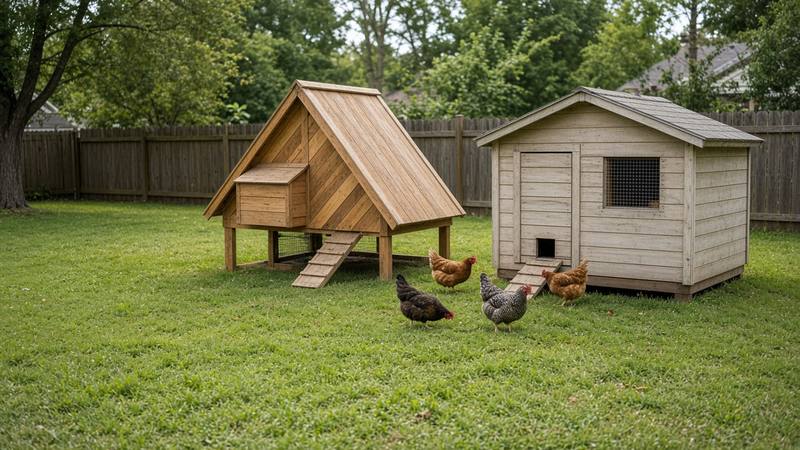
Small kit coops suit a trio of bantams or one or two standard hens. The PawHut model has a 6.57 sq ft house and a 10.76 sq ft run. That house holds 1 standard hen at 4 sq ft, or 3 bantams at 2 sq ft each.
Check the door hardware on any small kit. A knob or a single hook can be pushed open. Plan to add a spring-loaded bolt.
Small kits are also the easiest to move by hand. Two people can lift most of them, which helps if you want to shift the coop to fresh ground. Set it on level pavers so the frame stays square and the doors keep closing.
Small kits also suit keepers who are not sure yet. Two bantams in a small kit are an easy first season. If you love it, the kit becomes a broody pen or a spare house later. Nothing about it goes to waste.
The weak point on most small kits is the roof. Thin felt over thin boards can leak by the second winter. Check the seams each fall, and add a sheet of metal roofing over the top if water gets in.
Read the assembly notes before you order. Some kits ship in two boxes that arrive on different days. Most need two people, a drill and a free afternoon, so plan the day before the boxes land on the porch. Lay every panel out on the lawn first and check the parts list, so a missing piece shows up before you are halfway done.
Set any coop on firm, level ground. Pavers under each corner keep the frame off wet soil. They also stop the doors from binding as the ground shifts through the seasons. Check the level again after the first heavy rain, and shim any corner that has dropped.
Coops sold for 4 to 6 hens
This is the most common label and the least honest one. The Petsfit coop has 6.07 sq ft inside and 12.56 sq ft of run. Read as standard hens, that is 1 bird inside. Read as bantams, it is 3.
For real 4 to 6 hen capacity you need 16 to 24 sq ft of house. Few kits reach that. A built coop from our 4 × 4 ft plan gives 16 sq ft.
Big kits that do reach 16 sq ft are rare, and they are heavy to ship. If you find one, check the roost length too. Four standard hens need 32 in of bar at 8 in each. Many kits fit one short bar under 24 in.
Look for a coop that opens wide for cleaning. A full-width rear door or a lift-off roof saves time every week. A pull-out floor tray helps on small kits, since you cannot reach every corner from one door.
Nest boxes are the other place kits pad the count. Oregon State gives one box for about every four birds. A coop with 3 boxes is built for 12 hens by that rule, far more than its floor holds.
Coops with an attached run
The Garvee coop is 80.7 × 35 in overall, with a ramp and a nest box. The listing does not give the house floor. Measure it on arrival and divide by 4. Then measure the run and divide by 8, the Penn State run figure per laying hen.
Keep the smaller of the two answers. A big run does not make up for a small house, because hens sleep and lay inside.
Look at how the run joins the house. A ramp that drops straight from the pop door is easy for most hens. For Silkies and other bantams that do not jump well, a gentle slope with cross slats helps.
Check the mesh on the run panels. Many kits use thin twisted wire that keeps hens in but does little against a raccoon. Plan to wrap the run in ½ in hardware cloth, or set the kit inside a stronger pen.
Finally, look at the floor of the run. Most kits have no floor, which is good for scratching. It also means a digger can come up from below. A skirt of mesh laid flat around the edge, about 12 in wide, stops most attempts.
Large mesh coops
TRYKERPET sells this as a large wooden coop with a nest box. Most of it is mesh under a removable cover, so we count it as run. It covers 47.3 sq ft and stands 71 in tall, so you can stand up to clean it. At 8 sq ft of run per hen, that area suits 5 standard hens.
Pair it with a separate house. The listed 10 to 12 hens need 40 to 48 sq ft of house floor on top of the run.
Walk-in runs also make a good roof over a kit coop. Set the kit inside the run, and the run walls become the outer guard. Bury or skirt the run edge, because the frame alone sits on top of the soil.
Portable coops
A mobile coop rolls to fresh grass. The MEDEHOO model is 82.4 in long and 25.8 in wide on two wheels. Its footprint is about 14.8 sq ft, house and run together, so plan on 2 to 3 standard hens if they also range outside.
Narrow tractors suit flat lawns. On a slope, the low side lifts and leaves a gap under the frame. Move a chicken tractor to fresh grass often, and fit a mesh skirt along the bottom edge.
Mobile coops work best for small flocks. Moving a heavier frame every day gets old fast. Check the wheel size before you buy: small wheels sink in soft lawn, and larger ones roll over tufts.
What to check on the label
- House floor in square feet. Divide by 4 for standard hens, 2 for bantams, 5 for large breeds.
- Run area in square feet. Divide by 8 for standard hens.
- Roost length in inches. Divide by 8 for standard hens. Two short bars of 20 in hold 5 hens.
- Nest boxes. One per 4 hens, each about 12 in on every side, per Oregon State.
- Mesh type. Welded mesh or hardware cloth, not twisted chicken wire.
- Latches. A bolt or two-step latch, not a single hook or knob.
- Floor height. Oregon State suggests at least 1 ft off the ground.
Write the floor number on the listing before you compare price. Two coops at the same price can differ by 2 or 3 hens of real space. The calculator turns any hen count into the four numbers above.
Then think about the next two years. Many keepers add a few hens after the first season. If the coop you like is just big enough today, the next size up is often the better buy. Our coop size calculator shows the numbers for any count.
Kit coops are made of thin softwood, so plan on a coat of exterior paint or stain once a year. Store the hardware bag that comes with the kit. Spare screws and hinges are hard to match later.
If you build instead, our coop plans give a 16 sq ft house for 4 hens. That is more floor than most kits sold for 6 hens. It takes a weekend and basic tools.
Read next
Sources
- University of Minnesota Extension, Raising chickens for eggs (reviewed 2025): extension.umn.edu (3 to 5 sq ft indoor per bird)
- Penn State Extension, Small Scale Poultry Housing (updated 2026): extension.psu.edu (8 sq ft run per laying hen; bantams 1 sq ft against 2 for large chickens)
- Oregon State University Extension, EC 1644 Backyard chicken coop design (2014, reviewed 2023): extension.oregonstate.edu (box 12 × 12 × 12 in; 1 box per 4 birds; raise at least 1 ft)
- PawHut house 6.57 sq ft, run 10.76 sq ft, 1 to 2 chickens: maker listing on Amazon, ASIN B0C4KDTJY5, read 2026-10-12
- Petsfit 6.07 sq ft house, 12.56 sq ft run, 4 to 6 small hens: maker listing on Amazon, ASIN B0H4TQ9X6F, read 2026-10-12
- Garvee 80.7 × 35 × 54 in, 4 to 6 chickens: maker listing on Amazon, ASIN B0H83FSTDR, read 2026-10-12
- TRYKERPET 96.1 × 71 × 71 in, 47.3 sq ft, 10 to 12 chickens: maker listing on Amazon, ASIN B0DPWWNN64, read 2026-10-12
- MEDEHOO 82.4 × 25.8 × 44.1 in, 4 to 6 hens, 2 wheels: maker listing on Amazon, ASIN B0DPQK9Z6Y, read 2026-10-12
How we pick and check numbers: How we research.