Nesting Boxes for Chickens: How Many, How Big, How High
Coopgauge is reader-supported. When you buy through links on this page, we may earn a commission.
Build 1 nesting box for every 4 hens, each about 12 × 12 × 12 in. Set the boxes off the ground and away from the roost. Penn State is a little more generous for small flocks: 2 boxes for the first 4 hens, then 1 more for every 4.
- Boxes per hens
- 1 per 4 (Oregon State); 2 for the first 4 (Penn State)
- Box size (in)
- 12 × 12 × 12 for standard hens
- Height off floor
- at least 2 ft off the ground; not lower than the roost
- Bedding
- 2 in of clean, dry pine shavings
- Front lip
- 3 to 4 in
- Placement
- dim, quiet, away from roosts
Count and size: Oregon State EC 1644 and Penn State. Height, bedding, lip and placement: Penn State. Not lower than roosts: Oregon State.
A nesting box is a small, dim room where a hen feels safe to lay. Hens like company in the coop but privacy in the box. Give them enough boxes, sized right and placed in a quiet corner, and the eggs land where you want them.
The two extension guides we use agree on size and differ a little on count. Oregon State gives one box for about every four birds. Penn State starts with two boxes for the first four hens, then adds one for every four more. For a big flock the gap is small. For three or four hens, it is one box.
Either way, the method is simple. Count your hens. Read the row. Build the boxes. Then put them in the darkest corner you have.
By flock size
| Hens | Boxes (Oregon State) | Boxes (Penn State) | Wall length, Oregon count | Wall length, Penn count |
|---|---|---|---|---|
| 3 | 1 | 2 | 12 in | 24 in |
| 4 | 1 | 2 | 12 in | 24 in |
| 6 | 2 | 3 | 24 in | 36 in |
| 8 | 2 | 3 | 24 in | 36 in |
| 10 | 3 | 4 | 36 in | 48 in |
| 12 | 3 | 4 | 36 in | 48 in |
| 16 | 4 | 5 | 48 in | 60 in |
| 20 | 5 | 6 | 60 in | 72 in |
Read your row. Pick the higher number if you have the wall space. A spare box costs little and gives a hen a choice when another is sitting. Hens often all want the same box anyway, so more boxes do not always mean more use.
That is normal. Do not worry if one box sits empty. It still earns its place on the day two hens want to lay at once.
The wall length column helps you plan. Twelve hens need 3 boxes by the Oregon State count, or 4 by Penn State. That is 36 to 48 in of wall. A row of boxes can also stack in two levels if the wall is short, as long as both rows stay at least 2 ft off the ground.
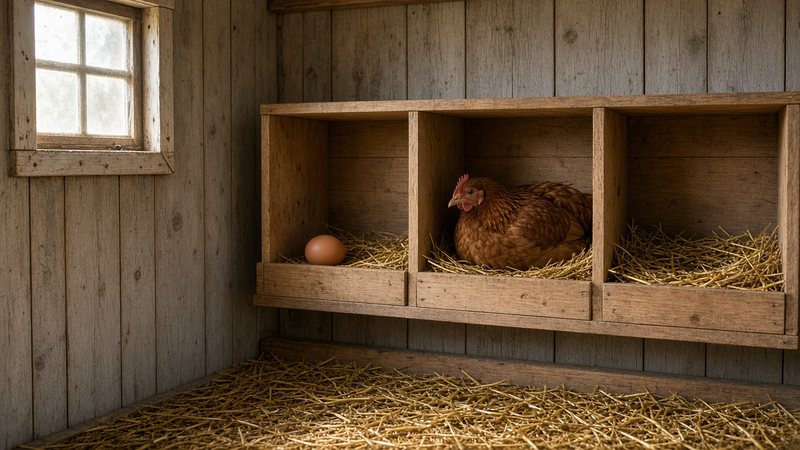
A ready-made box saves building time. Look at the inside size of each compartment, not the outside. The box above has compartments of 12 × 12 in, 11 to 15 in tall, which matches the extension size for standard hens. Three compartments suit 12 hens by the Oregon State count.
Wood, metal and plastic boxes all work. Wood is quiet. It stays dark inside. Metal lasts and hoses clean. Plastic is light and easy to lift out. Pick the one you will keep clean, since a clean box gets used.
Our assumptions
| Figure | Value | Source |
|---|---|---|
| Boxes per hens | 1 per about 4 birds | Oregon State EC 1644 |
| Boxes, small flock | 2 for the first 4 hens, then 1 per 4 more | Penn State |
| Box size | about 12 × 12 × 12 in | Oregon State; Penn State says at least 12 × 12 in |
| Height | at least 2 ft off the ground | Penn State |
| Relative to roost | not on the ground, not lower than roosts | Oregon State |
| Distance from roost | at least 4 ft | Penn State |
| Front lip | 3 to 4 in | Penn State |
| Bedding | 2 in clean, dry pine shavings | Penn State |
| Roof | sloped at 45 degrees | Oregon State |
Each number above comes straight from the guide named beside it. We round box counts up, because half a box is not a thing you can build. Where the two guides differ, we show both and let you pick.
Penn State adds one caution about size. A box that is too large invites two hens at once, and that leads to broken eggs. Keep standard boxes near 12 in on each side, and go larger only for large breeds.
Height has two parts. Penn State says nests should sit at least 2 ft off the ground. Oregon State says boxes should not sit on the ground or lower than the roosting poles, which keeps them cleaner. In a raised coop, both rules are easy, since the floor itself is already up.
Placement matters as much as height. Penn State asks for a darker, quiet spot, away from bright windows and busy doors. It also says to keep nests at least 4 ft from the roosts, so hens do not sleep in them. In a small coop, put the boxes on the wall opposite the roost.
In our 4 × 4 ft coop plan, that means the roost runs along the back wall and the box sits on the far side at 24 in. A walk-in coop has more room, so a row of boxes along one side wall and the roost along the other meets both guides with space to spare.
Bantam, standard and large hens
| Body size | Box size | Example breeds | Notes |
|---|---|---|---|
| Bantam | 12 × 12 in works | Silkie, bantam Cochin | Keep the box low enough to reach |
| Standard | 12 × 12 × 12 in | Barred Rock, Easter Egger | The extension size |
| Large | larger than 12 in | Orpington, Brahma | Penn State: increase the nesting space for larger birds |
Large breeds need more room than the standard box gives. Penn State says to increase the nesting space for larger birds, so the hen can enter and sit comfortably. Add a couple of inches each way for Orpingtons and Brahmas, and test the fit with your own hen. Check that the opening is wide enough for the hen to walk in, not squeeze.
Bantams use standard boxes without trouble. Many keepers fit a 12 in box anyway, so the boxes work for every hen in a mixed flock. Silkies do not fly well, so keep their boxes low enough to reach with a short hop, while still off the floor.
Bedding is the last detail. Penn State asks for 2 in of clean, dry nesting material at all times, with pine shavings preferred, and a front lip of 3 to 4 in to hold it in. Top up the shavings each week and change them when they pack down or get damp.
A sloped roof on top keeps hens from sitting on the box. Oregon State suggests a 45 degree slope. Add a short landing bar in front of raised boxes, so a hen can hop up and step in.
Collect eggs at least once a day. A full box tempts a hen to sit. Fresh shavings and empty boxes keep the routine easy for her and for you.
If hens start laying on the floor, look at the boxes first. Are they dark enough? Is the bedding fresh? Is there a box for every four hens? One small change usually brings them back.
Common Questions
How many nesting boxes for 6 chickens?
Two by the Oregon State count of one per four hens, or three by Penn State, which starts with two for the first four. Build two if space is tight and three if you can.
What size should a chicken nesting box be?
About 12 × 12 × 12 in for standard hens, per Oregon State. Penn State says at least 12 × 12 in, and larger for big breeds such as Orpingtons.
How high should nesting boxes be off the ground?
At least 2 ft off the ground, per Penn State, and not lower than the roost, per Oregon State. In a raised coop, the floor height usually covers this.
What should I put in a nesting box?
About 2 in of clean, dry pine shavings, which Penn State prefers. A 3 to 4 in lip at the front keeps it in the box.
Read next
Sources
- Oregon State University Extension, EC 1644 Backyard chicken coop design (2014, reviewed 2023): extension.oregonstate.edu (1 box per about 4 birds; 12 × 12 × 12 in; not on the ground or lower than roosting poles; 45 degree roof; landing pole)
- Penn State Extension, Small Scale Poultry Housing (updated 2026): extension.psu.edu (at least 12 × 12 in, larger for larger birds; 2 nests for the first 4 hens, then 1 per 4; at least 2 ft off the ground and 4 ft from roosts; 3 to 4 in lip; 2 in of pine shavings; dim, quiet spot)
- Compartment size, count and material: maker listing on Amazon, ASIN B0GHR4ZQWM, read 2026-10-12
How we pick and check numbers: How we research.