Chick Starter Feed: Protein, Amounts and When to Switch
Coopgauge is reader-supported. When you buy through links on this page, we may earn a commission.
Feed chicks a complete starter feed from the first day. Light breeds need 20 to 22% protein, and dual-purpose breeds 18 to 19%. Plan about 2 lb of feed per chick for the first 6 weeks. Then move to grower, and to layer feed at the first egg.
Feed checklist by age
| Age | Feed | Protein, light breeds | Protein, dual-purpose |
|---|---|---|---|
| Hatch to 4–6 weeks | Starter | 20 to 22% | 18 to 19% (to 4 weeks) |
| 6 to 14 weeks | Grower | 16 to 18% | 17 to 18% (4 to 12 weeks) |
| 14 to 20–22 weeks | Developer | 14 to 16% | 15 to 16% (12 to 22 weeks) |
| First egg on | Layer | by label | 14 to 16% |
University of Maine Extension sets the numbers. Light-breed chicks, such as Leghorns, get a starter of 20 to 22% protein until 6 weeks. Dual-purpose chicks get 18 to 19% until 4 weeks. Growing birds need more protein than adults, so the figures step down as they grow.
Most farm stores sell a starter-grower that covers both stages, often at 18% protein. That fits dual-purpose breeds well and is simple for a mixed box of chicks. Read the label for the age range the maker gives.
- Protein
- 18 to 22% by breed type
- Amount, first 6 weeks
- about 2 lb per chick
- Form
- crumbles or mash
- Feeder space
- 1 in per chick to 4 weeks
- Grit
- pullet-size granite grit from 6 weeks
- Switch to layer
- at first egg, not more than 2 weeks early
Protein, amount, grit and switch: University of Maine Bulletin #2222. Feeder space: University of Maine Bulletin #2219.
How much to buy
| Chicks | Feed, about | Typical bag sizes |
|---|---|---|
| 3 | 6 lb | one small bag |
| 6 | 12 lb | one 25 lb bag, with room to spare |
| 12 | 24 lb | one 25 lb bag |
| 25 | 50 lb | one 50 lb bag |
University of Maine allows 200 lb of feed per 100 birds for the first 6 weeks. That is about 2 lb per chick. Six chicks need about 12 lb, so one 25 lb bag carries them well past 6 weeks. Buy fresh feed and use it within a month or two.
University of Maine says to store feed off concrete, in a non-metal container, for about 1 month in summer and 2 months in winter. A tight lid keeps out mice. Buy the bag size you can finish in that time.
The feed above is an 18% starter-grower crumble. Its maker says to feed it as the only ration from hatch, and to switch layer pullets to layer feed at 16 weeks. That suits a backyard box of dual-purpose chicks.
Setting up the feeder
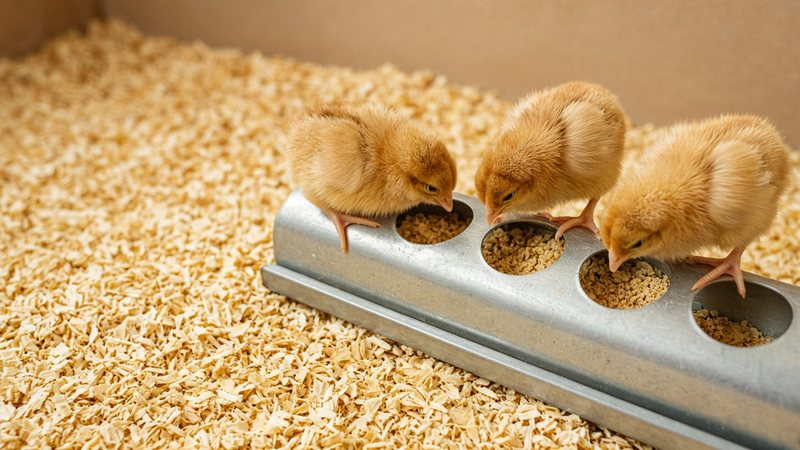
- Fill a chick feeder before the chicks arrive, next to the waterer but not under the heat.
- Give 1 in of feeder space per chick for the first 4 weeks.
- Sprinkle a little feed on a paper towel on day one so chicks find it fast.
- Raise the feeder as they grow, so the lip sits at back height.
- Keep it about half full to cut waste.
- Add pullet-size grit at 6 weeks if they get anything besides complete feed.
University of Maine Bulletin #2219 gives 1 in of feeder space per chick to 4 weeks. Bulletin #2222 says to keep the feeder lip at the birds' back height and the feeder about half full, which cuts waste a lot. A chick feeder with small holes stops chicks from scratching feed out.
Crumbles suit small beaks. Mash works too, but it can be dusty. University of Maine notes that birds cannot pick out ingredients from crumbles or pellets, so every bite is balanced.
When to switch feeds
Switch from starter to grower at about 4 to 6 weeks, by breed type. University of Maine gives grower feeds of 16 to 18% protein for light breeds from 6 to 14 weeks. A starter-grower can run all the way through this stage.
Move to layer feed when the first eggs appear, and not more than 2 weeks early, as University of Maine advises. Layer feed carries much more calcium than starter. University of Maine lists about 3.0 to 3.4% calcium for layer feed, against 0.85 to 1.0% for starter. Young birds should stay on starter or grower until they lay.
The first egg is easy to miss. Look for a small egg in a nest box or on the floor. Some keepers switch when the first pullet lays. Others wait until about half the flock is laying. Either way works, as long as nobody goes without the right feed for long.
Give oyster shell in a separate dish once the hens are laying, not before. Treats and scraps wait until the birds are older, and then only a small amount. University of Maine says scratch grain is only about 10% protein, so it is a snack, not a meal. A chick that fills up on treats eats less of the complete feed it needs.
Reading the bag
Every bag of chick feed has a tag. Look for three things. First, the protein figure. Second, the age range the maker gives. Third, the form, such as crumble or mash. Those three tell you whether the bag fits your chicks.
Check the date on the tag, too. Fresh feed is best, and University of Maine notes that nutrients break down in long storage. Pick the bag with the newest date on the shelf.
Some bags are sold as starter only, some as starter-grower, and some as all-flock. A starter-grower is the easy pick for a small backyard flock. An all-flock feed suits mixed flocks once the young birds are past the starter stage.
Common mistakes
The first mistake is starting chicks on layer feed because it is already in the shed. Keep a separate bag for the brooder. The second is running out on a weekend. Buy the next bag when the first one is half gone.
The third is a feeder set too low. Chicks scratch litter into it, and feed is wasted. Raise it a little each week. The last mistake is filling up on treats. Hold off on extras until the birds are older, and keep them small.
Mixed flocks and mixed ages
A mixed box of chicks is common. Light and heavy breeds can share one starter-grower. An 18% feed suits dual-purpose chicks and works well enough for light breeds in a backyard flock. Keep it simple: one bag, one feeder.
Mixed ages are harder. When young birds join laying hens, the whole flock can eat grower feed, with oyster shell in a separate dish for the layers. The hens take the calcium they need, and the young birds skip it. Switch everyone to layer feed once the young birds start to lay.
Bantam chicks eat the same starter as large chicks. They just eat less of it. Use a feeder with small openings, so tiny beaks reach the feed and tiny feet stay out of it.
A simple feeding routine
Check the feeder morning and evening. Top it up to about half full. Tap it gently to settle the crumbles, and clear out any litter that the chicks kicked in. Wet or caked feed goes in the compost, not back in the bag.
Watch how fast the bag goes down. By week 4, chicks eat noticeably more than in week 1. Write the date on each new bag. If a bag lasts past the storage window, buy smaller bags next time.
Keep the feed bin by the brooder, with a scoop inside. A small routine like this takes two minutes a day. It also gives you a daily look at every chick.
Water comes first
Chicks need water as much as feed. University of Maine Bulletin #2219 gives one 1-quart waterer per 16 chicks. Set it on a small block so litter stays out, and refill it with fresh, room-temperature water each day.
The drinker above holds 1.5 gallons and hangs by a metal handle. That is 6 quart jars, by our math. It is more than a week-1 brooder needs.
Use the 1-quart jar for the first week, or for up to 16 chicks. Move to the larger drinker when the chicks are older, or when the batch is bigger than 16.
Place the feeder and waterer apart, so chicks walk between them. Our brooder setup guide shows the layout, with heat at one end and food and water at the cool edge.
Common Questions
What protein should chick starter have?
18 to 22%. Light breeds 20 to 22%, dual-purpose breeds 18 to 19%, by University of Maine.
How much starter feed per chick?
About 2 lb per chick for the first 6 weeks, by University of Maine.
When do chicks switch to layer feed?
At the first egg, not more than 2 weeks early.
Can chicks eat layer feed?
No. Layer feed has too much calcium for growing birds. Keep them on starter or grower until they lay.
Read next
Sources
- University of Maine Cooperative Extension, Bulletin #2222 Nutrition for Backyard Chicken Flocks in Maine: extension.umaine.edu (Table 1 protein and calcium by age; 200 lb per 100 birds for 6 weeks; grit at 6 weeks; feeder height and fill; storage times; layer feed at first egg; scratch 10% protein; storage loss)
- University of Maine Cooperative Extension, Bulletin #2219 Giving Chicks a Good Start: extension.umaine.edu (feeder 1 in per chick to 4 weeks; 1 quart jar per 16 chicks)
- Protein, form and maker directions: maker listing on Amazon, ASIN B0FNLQTYRP, read 2026-10-12
- Capacity and metal handle: maker listing on Amazon, ASIN B0C95GBGYP, read 2026-10-12
How we pick and check numbers: How we research.