Chicken Feeders: Capacity, Ports and How Long a Fill Lasts
Coopgauge is reader-supported. When you buy through links on this page, we may earn a commission.
A 6 lb hen eats about 3 lb of feed a week, so six hens empty a 25 lb feeder in about 10 days. Match the feeder to your flock, give 3 to 4 in of feeder space per hen, and set the lip at back height.
Minnesota Extension gives the feed figure: about 3 lb a week for a 6 lb hen. From that, any feeder size turns into days. Each box below lists the capacity and the ports from the maker listing, plus how long one fill lasts by our math.
Bigger is not always better. University of Maine says feed keeps about 1 month in summer and 2 months in winter. A feeder that holds more than your flock eats in that time leaves old feed at the bottom.
Feeders side by side
| Feeder | Capacity | Ports | Days per fill, 4 hens | Days per fill, 6 hens | Days per fill, 12 hens |
|---|---|---|---|---|---|
| RentACoop treadle | 25 lb | treadle | 15 | 10 | 5 |
| VEVOR treadle | 40 lb | treadle | 23 | 16 | 8 |
| KOL metal | 50 lb | 16 | 29 | 19 | 10 |
| ZenxyHoC on legs | 3.6 gal | 4 | by weight | by weight | by weight |
| 6-port bucket kit | your bucket | 6 | by bucket | by bucket | by bucket |
For six hens, a 25 lb feeder lasts about 10 days and a 50 lb feeder about 19 days. Both fit inside the summer storage window. For twelve hens, the 50 lb feeder lasts about 10 days, so it suits the bigger flock best.
Most backyard flocks of four to eight do best with 25 to 40 lb. That is one or two bags per fill and a refill every week or two. Fresh feed goes in often, and the feeder never sits half-empty for weeks.
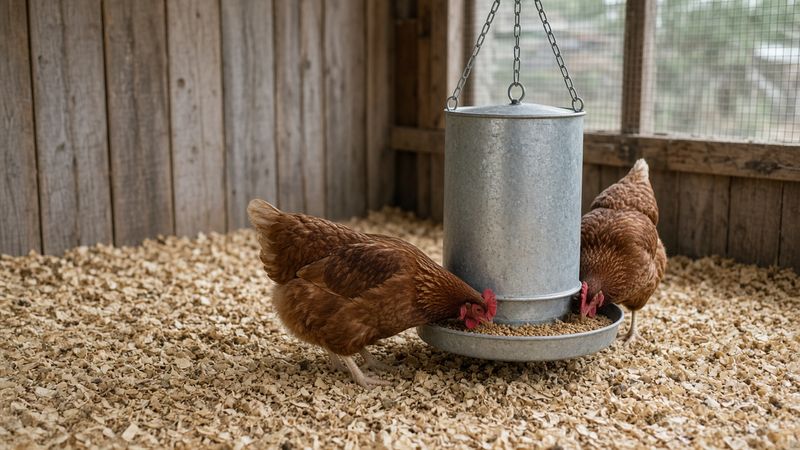
Feeder space per hen
Penn State gives 3 to 4 linear inches of feeder space per large bird, and 1 in for bantams. On a port feeder, count each port as one hen at a time. Six ports serve six hens at once, which is plenty for a flock of eight to ten, since hens take turns.
University of Maine says to keep the feeder lip at the birds' back height and the feeder about half full. Both cut waste. A hen flicks feed out with her beak when the trough is deep and full.
Small flocks: 4 to 8 hens
The ZenxyHoC feeder holds 3.6 gal and stands on folding legs with three heights. Four ports serve a small flock, and each port has a cover for the night. A cone lid keeps hens from perching on top. You can see the feed level through the bucket.
If you have a spare bucket or bin, a port kit is the cheapest route. The kit below has six ports with 3.15 in openings, a rain cover and the hole saw to fit them. A 5 gallon bucket with a lid makes a fine feeder. Capacity depends on the container you choose.
Mid-size flocks: 6 to 10 hens
The VEVOR treadle feeder holds 40 lb. By our math, that is about 16 days for six hens and about 8 days for twelve. The step opens for birds of 500 g or more, by the maker, and the height adjusts from 18.5 to 20.7 in. Galvanized steel suits an open run.
Keeping out wild birds and rats
A treadle feeder has a cover that opens only when a hen steps on the plate. Small wild birds and rats are too light to lift it, in most cases. The RentACoop treadle feeder below holds 25 lb and has a removable rain hood.
Kentucky Extension says to leave no feed in the run at night, because it draws predators. A treadle feeder helps, and so does bringing the feeder inside at dusk. Hens need a week or so to learn the step plate; prop it open at first.
Large flocks: 12 or more
KOL lists 50 lb and 16 ports on its metal feeder. For twelve hens, that is about 10 days of feed, well inside the summer storage window. Sixteen ports let a big flock eat at once, so a bossy hen cannot guard the only opening.
Setting up any feeder
- Set the feeder on a level block or hang it, so the lip sits at back height.
- Fill it about half full the first time, and watch how fast it goes down.
- Let the hens empty it about once a week, so old feed does not cake at the bottom.
- Store spare feed off concrete in a sealed, non-metal bin.
- Bring it in at night if rats are a problem.
University of Maine says to store feed off concrete, in non-metal containers. A sealed lid keeps mice out. Write the date on each bag, and use the oldest first.
Keep oyster shell in a separate small dish, not mixed into the main feeder. Hens take what they need. Scratch grain goes on the ground in the morning, a handful the flock clears in 20 to 30 minutes.
Hanging or standing?
University of Maine notes that hanging feeders cut waste and keep the area cleaner. You can raise it with a chain as the birds grow, so the lip always sits at back height. It also keeps the feed off the floor, away from bedding and droppings.
A standing feeder is simpler. It sits on a block or its own legs. It suits runs with no beam to hang from. Set it on a paver or a flat stone so it does not sink into mud. Check it is level, so feed flows evenly to every port.
Inside or outside the coop?
Inside the coop, feed stays dry, and wild birds cannot reach it. The trade-off is floor space. A large feeder takes up room the hens need, so count it against the 4 sq ft per hen.
Outside in a covered run, the feeder is easy to reach and fill. Pick a weatherproof model, or put it under the solid part of the roof. In an open run, bring it in at night, as Kentucky Extension advises for feed in general.
Feeders for chicks and bantams
Chicks need a small feeder with narrow openings. University of Maine gives 1 in of feeder space per chick to 4 weeks. Port feeders made for adult hens are often too high and too wide for chicks, who climb in and scratch feed out.
Bantams are in between. Penn State gives them 1 in of feeder space each. Many port feeders work for bantams if you set them low. Watch the first day, and lower the feeder if the smallest birds stretch to reach.
Cutting waste
Waste is the hidden cost of a feeder. Hens flick feed with their beaks to find the bits they like best. Ports, lips and a half-full trough all cut that down. University of Maine notes that pellets and crumbles stop birds picking out single ingredients, which also helps.
Look under the feeder after a week. A thin scatter of feed is normal. A pile means the feeder is too low, too full or the wrong design. Raise it a little, fill it less, and check again.
Rats and wild birds are the other leak. A treadle lid, a feeder brought in at night and a sealed bin for spare feed close most of the gaps. Clean up spills under the feeder each week.
Here is the waste math for a flock of six. They eat about 18 lb a week. If a feeder spills just a tenth of that, you lose almost 2 lb a week, or about 94 lb a year. That is close to four 25 lb bags. A better feeder often pays for itself in one season.
Use the same math for your own flock. Weigh a bag, note the date and see how long it lasts. If it runs out much sooner than 3 lb per hen per week predicts, the feeder or the rats are taking a share.
Cleaning the feeder
Empty the feeder fully every week or two. Brush out the dust and any caked feed from the bottom and the ports. Let it dry before you refill. Wet feed spoils and smells, and hens will not eat it.
Once a season, wash the feeder with warm water and let it dry in the sun. Check the ports and the lid for cracks. A cracked lid lets rain in, and a bent port leaks feed. Replace small parts early. Ask the maker about spare lids and ports before you buy. A feeder with spare parts on offer can keep working for many seasons, long after a cheap one has cracked.
What to check on the listing
Read four things on any feeder listing. The capacity in pounds, not in quarts. The number of ports or the trough length. The material and the lid. And the height of the feed openings from the ground.
Plastic is light and cheap. Galvanized steel lasts longer in sun and is harder for rats to chew. A rain cap or a lid keeps feed dry. Feet or a stand keep the openings at the right height.
Think about refills too. A feeder with a wide top opening is easier to fill from a bag. A heavy feeder full of feed is hard to move, so put it where you can reach it with a full bag in your arms. Our feeding guide covers how much to give and what goes in it.
Common Questions
How much feed does a chicken eat a week?
About 3 lb for a 6 lb hen, by Minnesota Extension.
How big a feeder for 6 chickens?
About 25 to 40 lb. A 25 lb fill lasts six hens about 10 days.
How much feeder space per chicken?
3 to 4 linear inches per large hen, and 1 in per bantam, by Penn State.
How high should a chicken feeder be?
Lip at the hens’ back height, by University of Maine.
Read next
Sources
- University of Minnesota Extension, Raising chickens for eggs (reviewed 2025): extension.umn.edu (6 lb hen eats about 3 lb of feed a week)
- Penn State Extension, Small Scale Poultry Housing (updated 2026): extension.psu.edu (3 to 4 linear in of feeder space per large bird, 1 in for bantams)
- University of Maine Cooperative Extension, Bulletin #2222 Nutrition for Backyard Chicken Flocks in Maine: extension.umaine.edu (feeder at back height, half full; storage 1 month summer, 2 months winter; off concrete, non-metal; scratch cleaned up in 20 to 30 minutes; oyster shell free choice)
- University of Kentucky, ID-245 Predator Management for Small-scale Poultry Enterprises: publications.mgcafe.uky.edu (no feed left in the run at night)
- University of Maine Cooperative Extension, Bulletin #2214 A Quick Guide to Raising Pastured Broilers in Maine: extension.umaine.edu (hanging feeders reduce wastage, keep area cleaner)
- University of Maine Cooperative Extension, Bulletin #2219 Giving Chicks a Good Start: extension.umaine.edu (feeder 1 in per chick to 4 weeks)
- Capacity, treadle, rain hood: maker listing on Amazon, ASIN B07MQW8MQK, read 2026-10-12
- Ports, opening size, kit contents: maker listing on Amazon, ASIN B0BH2QQT9K, read 2026-10-12
- Capacity, step weight, height: maker listing on Amazon, ASIN B0G6GD9K3F, read 2026-10-12
- Capacity, ports, legs: maker listing on Amazon, ASIN B0FW4YT9LF, read 2026-10-12
- Capacity, ports: maker listing on Amazon, ASIN B0FN71G3X4, read 2026-10-12
How we pick and check numbers: How we research.