Heated Chicken Waterers: Watts, Gallons and Cold Ratings
Coopgauge is reader-supported. When you buy through links on this page, we may earn a commission.
Heated chicken waterers draw 60 to 125 watts and hold 2 to 3 gallons. In cool weather six hens drink about 0.33 gallon a day, so a 3 gallon unit lasts them about 9 days. Pick by flock size first, then by how cold your winters get.
Water freezes at 32°F, and hens cannot drink ice. A heated waterer keeps a little warmth in the base so the water stays liquid. Every model below has a thermostat, so the heater runs only when it is cold.
The University of Kentucky lists 5.55 gallons per 100 laying hens a day at 68°F. We use that figure for winter, about 0.06 gallon per hen. Each box below lists the watts, the gallons and any cold rating, all from the maker listing.
Heated waterers side by side
| Waterer | Capacity | Heater | Cold rating | Drinkers | Days per fill, 6 hens |
|---|---|---|---|---|---|
| K&H Thermo-Poultry | 2.5 gal | 60 W | not listed | trough | 8 |
| Farm Innovators heated fount | 3 gal | 100 W | to 0°F | trough | 9 |
| Premier 1 all-season | 3 gal | 100 W | not listed | trough | 9 |
| Farm Innovators HB-60P | 2 gal | 60 W | not listed | 3 nipples | 6 |
| Farm Innovators 125 W base | your fount | 125 W | to 10°F | your fount | by fount size |
Watts set the most power a unit can draw. A 60 W heater running all day uses at most 1.44 kWh. A 100 W heater uses at most 2.4 kWh. The thermostat switches the heater off when the water is warm enough, so real use is lower on mild days.
More watts help in hard cold. The Farm Innovators fount lists a rating to 0°F, and the 125 W base lists 10°F. For winters that stay near freezing, 60 W is often enough. Where nights drop well below zero, pick a higher-watt unit and put it out of the wind.
Small flocks: 4 to 8 hens
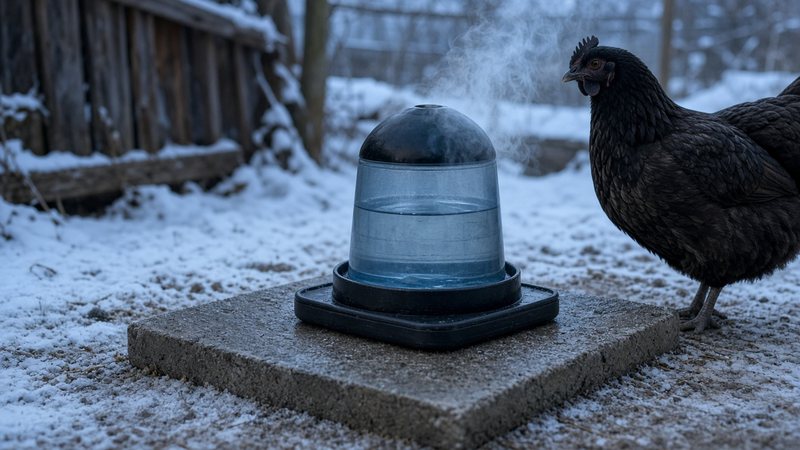
The K&H Thermo-Poultry waterer holds 2.5 gallons and draws 60 W. For six hens, one fill lasts about 8 cool days. The top is shaped so hens cannot perch on it, which keeps droppings out of the water.
The HB-60P drinker holds 2 gallons and also draws 60 W. It has 3 nipples instead of an open trough. Nipples keep water clean, since no bedding falls in. Hens need a day or two to learn them, so set it up in fall, before the first freeze.
Mid-size flocks and hard winters
The Farm Innovators heated fount holds 3 gallons, draws 100 W and lists a rating to 0°F. For six hens, one fill lasts about 9 cool days. It can hang or sit on a flat surface, which helps you set the trough at the hens' back height.
The Premier 1 all-season waterer also holds 3 gallons and draws 100 W, with a built-in thermostat. You can leave it in place all year. In summer, unplug it and use it as a plain waterer. That saves buying and storing a second unit, and the hens never have to learn a new drinker when the seasons change.
Already have a metal fount?
If you already own a double-wall metal fount, a heated base may be all you need. The Farm Innovators heated base draws 125 W, turns on below 35°F and lists a rating to 10°F. Set the fount on top and plug it in.
Use the base only with a metal fount, as the maker lists. Never set a plastic waterer on a heated base unless the maker says it is safe. Check the fount for rust before winter, since a leak over a heater is a problem.
Power and safety
A heated waterer needs power at the coop. Use an outdoor-rated outlet with a ground-fault breaker, and an outdoor-rated cord if you need one. Keep the cord out of reach of pecking beaks, along a wall or inside a conduit.
Missouri Extension, writing about brooder lamps, reminds keepers to follow load limits for receptacles and circuits. The same rule applies to heaters. Do not run a heated waterer, a heat lamp and a light on one thin cord.
Set the waterer on a level block, off the bedding. Dry bedding under a heated base is a fire risk if anything goes wrong, so a paver or a concrete block is safer. Check the cord and plug each week for wear. A cracked cord or a warm plug means it is time to replace it, before the next cold night.
Winter routine
- Set up the heated waterer before the first freeze.
- Fill it with fresh water and check that the heater warms the base.
- Check the level and the trough each morning.
- Clear any ice at the rim on very cold nights.
- Rinse and refill once a week, or sooner if bedding gets in.
Hens drink less in cold weather than in heat, but they still need water every day. The Kentucky table is our guide: about 0.06 gallon per hen on a mild day.
Put the waterer where hens reach it first thing in the morning. A coop with a covered run can hold the waterer in the run, under the roof, with the cord running to the coop.
Without power
No power at the coop? Rotate two plain waterers. Bring one inside at night and swap them each morning. Flexible rubber pans are easy to knock ice out of. It is more work, but it costs nothing.
A solar or battery heater may suit some coops, but check the cold rating and the capacity carefully. Our waterers page covers plain models and how to size them.
Sizing by flock
| Hens | Water a day, cool | Days from 2 gal | Days from 3 gal |
|---|---|---|---|
| 3 | 0.17 gal | 12 | 18 |
| 6 | 0.33 gal | 6 | 9 |
| 10 | 0.56 gal | 4 | 5 |
| 15 | 0.83 gal | 2 | 4 |
For three to six hens, a 2 or 2.5 gallon heated waterer is plenty. It lasts about a week between fills. For ten to fifteen hens, step up to 3 gallons, or run two units. Two waterers also help when one hen guards the drink.
Winter fills are easier when the tank lasts several days. Carrying water through snow is no fun. A 3 gallon unit full of water weighs about 25 lb, so put it close to the coop door. Fill it in place with a jug if that is easier than carrying it full.
Placement in the coop
Inside the coop, a heated waterer keeps the water warmest, out of the wind. The trade-off is moisture. Spills raise the damp in the bedding, and Oregon State says good ventilation removes moisture from coops. Set the waterer on a tray, and keep the vents open above head height.
In a covered run, the waterer stays out of the coop, so the bedding stays dry. Put it under the solid part of the roof, out of the wind. Run the cord along a wall, high enough that hens cannot peck it.
Either way, keep it away from the roost. Hens sleep above the floor, and droppings land below. A waterer under the roost fills with droppings overnight.
Think ahead to snow. Drifts pile up at doors and along the windward wall, and a waterer buried in a drift is no use to anyone, so pick a spot you can reach with a shovel on the worst morning of the year. Test it. Walk the path in boots. Then fix the spot.
Bantams and mixed flocks
Bantams drink less, but they still need a trough they can reach. Set the unit low enough for the smallest bird. Penn State gives bantams 1 in of water space each, and large birds 3 to 4 in. One trough waterer covers a small mixed flock.
Nipple drinkers like the HB-60P work for bantams once they learn. Hang the drinker so the nipples sit just above the shortest hen's head, and watch the first day.
Cleaning in winter
Winter is no excuse to skip cleaning. Unplug the heater before you rinse it. Empty the tank, wipe the trough and refill with fresh water. Let the outside of the base dry before you plug it back in.
Check the trough for cracks each fall. A small crack leaks water onto the heater and the bedding. Check the listing to see whether the tank and the base are sold apart. If not, a cracked tank means a new waterer.
Common mistakes
The first mistake is waiting for the first freeze to set up. Hens need a few days to learn a new waterer, especially a nipple model. Set it up in fall. The second is a cheap indoor extension cord. Use an outdoor-rated cord, or better, an outlet at the coop. Ask an electrician if you are unsure.
The third mistake is putting a heated unit on bedding. Set it on a block or a paver. The last mistake is forgetting the summer. Unplug the heater in spring, and switch back to a plain waterer, or leave an all-season model unplugged.
What to check on the listing
Read five things on any heated waterer listing. The capacity in gallons. The heater watts. The cold rating, if the maker gives one. Whether it has a thermostat. And the drinker type: trough, cup or nipple.
Check the cord length and whether the unit hangs or sits. A short cord means an extension, which adds risk. A unit that hangs is easier to set at back height.
Common Questions
How many watts does a heated chicken waterer use?
The models here draw 60 to 125 W, by the maker listings. Thermostats cut real use.
Do chickens need a heated waterer?
Where water freezes, yes, or you must swap waterers through the day.
What size heated waterer for 6 chickens?
About 2.5 to 3 gallons, which lasts six hens 8 to 9 cool days.
Can I put a plastic waterer on a heated base?
Only if the maker says so. The 125 W base is listed for metal founts.
Read next
Sources
- University of Kentucky, Poultry Production Manual, Chapter 12 Introduction (Table 12.1 water consumption): afs.mgcafe.uky.edu (layer hens 5.55 gal per 100 birds a day at 68°F)
- University of Missouri Extension, G8351 Brooding and Growing Chicks: extension.missouri.edu (follow lamp load limits for receptacles and circuits)
- Penn State Extension, Small Scale Poultry Housing (updated 2026): extension.psu.edu (water space 1 in for bantams, 3 to 4 in for large birds)
- Oregon State University Extension, EC 1644 Backyard chicken coop design (2014, reviewed 2023): extension.oregonstate.edu (ventilation removes moisture)
- Capacity, 60 W, thermostat, no-roost top: maker listing on Amazon, ASIN B015IYDANQ, read 2026-10-12
- Capacity, 100 W, thermostat, to 0°F: maker listing on Amazon, ASIN B001CCSJCQ, read 2026-10-12
- Capacity, 100 W, thermostat: maker listing on Amazon, ASIN B07KRLX1MJ, read 2026-10-12
- Capacity, 60 W, nipples: maker listing on Amazon, ASIN B005BV1WLE, read 2026-10-12
- 125 W, on below 35°F, to 10°F, metal founts: maker listing on Amazon, ASIN B000HHQDPM, read 2026-10-12
How we pick and check numbers: How we research.