Chick Heat Lamps and Heat Plates: Chicks per Unit, Watts and Height
Coopgauge is reader-supported. When you buy through links on this page, we may earn a commission.
One 250 W heat lamp warms 50 to 75 chicks, hung 1 to 1.5 ft above them, by Missouri Extension. For a small batch, a heat plate is simpler: a 10 × 10 in plate suits about 15 chicks and a 12 × 12 in plate about 20, by the makers.
Chicks need about 95°F at chick level in week 1, then 5°F less each week until about 70°F, by University of Maine. A lamp or a plate supplies that heat. Each box below lists the size, the watts and the chick count from the maker listing.
Lamps heat the air and the floor below them. Plates heat from above, like a hen, and chicks walk under them to warm up. Plates draw far less power. Lamps cover more chicks per unit. The right choice depends on the size of your batch.
Lamps and plates side by side
| Heat source | Size | Power | Chicks | Height |
|---|---|---|---|---|
| 10 × 10 in plate | 10 × 10 in | 15 W | up to 15 | adjustable legs |
| RentACoop plate | 12 × 12 in | 22 W | up to 20 | adjustable legs |
| Premier 1 plate | 12 × 12 in | 22 W | up to 20 | legs, 1.5 to 6 in |
| Clamp lamp + 250 W bulb | 10.5 in reflector | 250 W | 50 to 75 (Missouri) | 1 to 1.5 ft above chicks |
A 250 W lamp running all day uses 6 kWh. A 15 W plate uses 0.36 kWh. Over six weeks, that is about 252 kWh for the lamp and 15 kWh for the plate, at full draw. For a small batch, the plate saves a lot of power.
For 50 or more chicks, a lamp is still the simple tool. Missouri Extension gives one 250 W lamp per 50 to 75 chicks. Plates for that many birds get large, or you need several.
Heat plates for small batches
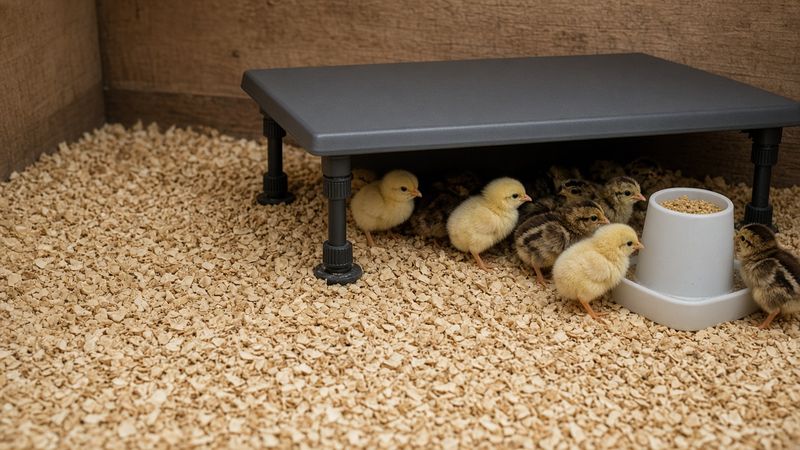
Most backyard keepers start with six to fifteen chicks. A 10 × 10 in plate covers up to 15, by its maker. It draws 15 W. The legs adjust, so you raise the plate as the chicks grow. Set it so chicks just touch the plate with their backs.
For up to 20 chicks, step up to 12 × 12 in. Both 12 × 12 in plates below draw 22 W, by their makers. The RentACoop plate comes with an anti-roost cone that sits on top, so chicks do not perch on the plate and soil it. The Premier 1 listing is a single plate with no cover; its legs adjust from 1.5 to 6 in. Premier sells a cover apart if you want one.
Heat lamps for large batches
Missouri Extension says to use a lamp with a porcelain socket and a lamp guard, adequately wired. The Little Giant brooder lamp has a ceramic socket rated for bulbs up to 250 W. It has a 10.5 in reflector and a double wire guard. The bulb is sold apart.
Fit a 250 W bulb made for brooders. Red and clear bulbs both give heat; red gives a softer light at night. The bulb below is a 250 W red bulb with a standard E26 base. Its maker says to use it only in a good ceramic holder.
Setting the height
Missouri Extension hangs the lamp 1 to 1.5 ft above the chicks, about 18 in in week 1, and raises it about 3 in a week. Check the temperature at chick level with a thermometer and adjust from there.
A plate starts low. Set the legs so the plate sits just above the chicks' backs. Raise it a notch each week, or whenever the chicks have to crouch. Tilt the front up a little, so small chicks can walk in.
Read the chicks
University of Maine says chicks tell you if the heat is right. If they huddle together under the heat, they are cold. If they spread evenly under and around it, they are comfortable. If they stay away from it, they are probably too warm.
Missouri Extension notes that chicks feather better with a cool place to move around. Keep the heat at one end of the brooder, and food and water at the cool edge. That gives the chicks a choice. A chick that is too warm moves to the cool edge on its own. A chick that is cold walks back under the heat. Give them room to do both, and they sort it out for themselves.
Safety with heat lamps
- Use a lamp with a porcelain socket and a bulb guard, as Missouri Extension advises.
- Hang it from a chain or a hook, and add a second tie so it cannot fall.
- Keep it clear of walls, bedding and anything that can burn.
- Do not let water splash on the bulb.
- Plug it into an outlet rated for the load, not a thin cord.
Missouri Extension warns to support the reflector securely and keep the lamp from touching other objects. It also says to avoid splashing water on the lamp, and to follow load limits for receptacles and circuits. Never rely on the clamp alone.
A heat plate avoids the hot, hanging bulb, and it draws far less power. For a small batch in a house or garage, that is a real plus.
How long chicks need heat
Missouri Extension says to keep heat until chicks are well feathered. University of Maine drops the temperature 5°F a week from 95°F to about 70°F. That takes about five weeks. In a warm room, chicks may need less; in a cold garage, a little longer.
Turn the heat off in the day when the room is warm, as University of Maine suggests, and back on at night. Our brooder setup guide has the full week-by-week schedule.
Brooder size for each heat source
| Chicks | Floor, weeks 1–2 | Floor, weeks 3–6 | Heat source |
|---|---|---|---|
| 6 | 3 sq ft | 6 sq ft | 10 × 10 in plate |
| 15 | 7.5 sq ft | 15 sq ft | 10 × 10 in plate |
| 20 | 10 sq ft | 20 sq ft | 12 × 12 in plate |
| 50 | 25 sq ft | 50 sq ft | one 250 W lamp |
University of Maine gives 0.5 sq ft of floor per chick at first, then 1 sq ft, then 2 sq ft as they grow. The heat should cover only part of that floor. Chicks need a warm zone and a cool zone, and room to move between them.
A plate takes up little room, so even a small brooder has a cool end. A lamp throws a wide circle of heat. In a small box, a 250 W lamp can heat the whole space, which leaves chicks nowhere to cool off. For six chicks, a plate is the better fit.
Room and season
The room around the brooder matters. A brooder in a warm kitchen needs less heat than one in a cold garage in March. Check the temperature at chick level each morning and evening for the first week, and adjust the height.
Drafts pull heat away fast. Set the brooder away from doors and windows. University of Maine says chicks need fresh air but no draft. A cardboard or panel wall around the brooder blocks floor drafts.
Spring chicks often go outside sooner than winter chicks. As the weather warms, the room does part of the work, and you can turn off the heat in the day sooner. Watch the chicks, not the calendar.
Keep a backup
Bulbs burn out, and plates can fail. Keep a spare bulb or a second plate on hand for the first weeks. A thermometer at chick level tells you fast if the heat has dropped.
If the power goes out, check the breaker first. Then call a neighbor with power, or move the brooder into the warmest room of the house. Chicks huddle when cold, so a quick check at night tells you a lot.
Cleaning and storage
Unplug the plate or lamp before you clean it. Brush off dust and bedding. Wipe the plate with a damp cloth and let it dry fully before you plug it in again. A dusty lamp reflector is a fire risk, so wipe it each week.
After the chicks move out, clean the heat source and store it dry. Wrap the cord loosely. Check the legs, the socket and the cord before the next batch. A plate or lamp kept clean and dry is ready to go again next spring.
Common mistakes
The first mistake is a lamp hung by its clamp alone. Add a chain and a second tie. The second is a lamp too low in a small box, which leaves no cool zone. The third is a plate set too high in week 1, so chicks cannot reach the warmth.
The last mistake is trusting the dial. Use a thermometer at chick level, and watch the chicks. They tell you more than any label.
A quick daily check covers almost everything. Look at where the chicks sit. Read the thermometer at chick level. Touch the cord and plug; they should never feel hot. Check that the lamp chain and its second tie are secure, or that the plate legs are level and locked.
Then look at the bedding under the heat. Missouri Extension uses 3 to 4 in of litter under a brooder. Keep it dry and loose. Lift out any wet patch near the waterer, and add fresh shavings. The whole check takes two minutes, twice a day, for about five weeks.
What to check on the listing
For a plate, read the plate size, the chick count, the watts and how the legs adjust. For a lamp, read the watt rating, the socket type and whether a guard is included. For a bulb, read the watts and the base.
Match the bulb to the lamp. A 250 W bulb needs a lamp rated for 250 W with a ceramic or porcelain socket. A lamp rated lower than the bulb is a fire risk.
Common Questions
How many chicks per heat lamp?
One 250 W lamp per 50 to 75 chicks, by Missouri Extension.
How high should a heat lamp be above chicks?
1 to 1.5 ft, about 18 in in week 1, raised about 3 in a week, by Missouri Extension.
Is a heat plate better than a heat lamp?
For small batches, a plate draws far less power and has no hot bulb. Lamps suit large batches.
How do I know chicks are warm enough?
They spread evenly around the heat. Huddling means cold; staying away means too warm.
Read next
Sources
- University of Missouri Extension, G8351 Brooding and Growing Chicks: extension.missouri.edu (3 to 4 in litter; 250 W lamp per 50 to 75 chicks; 1 to 1.5 ft above chicks; 18 in week 1, raise 3 in a week; porcelain socket, lamp guard, adequate wiring; support securely; no contact with objects; avoid splashing water; load limits; cool place to exercise; heat until well feathered)
- University of Maine Cooperative Extension, Bulletin #2219 Giving Chicks a Good Start: extension.umaine.edu (floor 0.5, 1, 2 sq ft per chick; fresh air but no draft; 95°F week 1, minus 5°F a week to 70°F; heat off on warm days; huddle cold, spread comfortable, away too warm)
- Plate size, 15 W, up to 15 chicks: maker listing on Amazon, ASIN B0CJY3ZYJJ, read 2026-10-12
- Plate size, 22 W, up to 20 chicks, cone: maker listing on Amazon, ASIN B07CJMV8XG, read 2026-10-12
- Plate size, 22 W, up to 20 chicks, legs 1.5 to 6 in: maker listing on Amazon, ASIN B00W43PHTA, read 2026-10-12
- Ceramic socket, up to 250 W, 10.5 in reflector, double wire guard: maker listing on Amazon, ASIN B00D458L9K, read 2026-10-12
- 250 W red, E26, 120 V, ceramic holder: maker listing on Amazon, ASIN B0CSYNHNYN, read 2026-10-12
How we pick and check numbers: How we research.