What to Feed Chickens: Layer Feed First, Then Grit, Shell and Greens
Coopgauge is reader-supported. When you buy through links on this page, we may earn a commission.
Feed laying hens a complete layer feed, free choice, and keep fresh water beside it. Minnesota Extension says a 6 lb hen eats about 3 lb of feed a week. Put oyster shell and grit out in a separate dish, and keep scratch and scraps small.
- Feed type
- complete layer feed
- Protein % (label)
- 15 to 19 for light breeds; 14 to 16 for dual-purpose
- Calcium (label)
- at least 2.5 to 3.5%
- Form
- mash, crumbles or pellets
- Age range
- from first egg on
- Switch at
- first egg; not more than 2 weeks before
Protein, calcium and switch timing: University of Maine Bulletin #2222. Feed per hen: Minnesota Extension.
A bag of complete layer feed does nearly all the work. It is balanced for protein, energy, calcium and minerals in one scoop. University of Maine calls complete feed the simplest way to feed a small flock, since it needs no extra mixing.
Everything else is a side dish. Oyster shell gives extra calcium for shells. Grit helps hens grind coarse food. Scraps, scratch and greens are fun for the hens and for you, as long as they stay a small part of the day.
Feeding hens is easy. One bag. One feeder. One waterer. Two small dishes on the side. That covers it.
The details below are for the questions that come up later. When do chicks change feed? How much does a flock eat in a month? Where should the bag live? Each one has a short answer.
By age
| Age | Feed | Protein (light breeds) | Protein (dual-purpose) |
|---|---|---|---|
| 0 to 6 weeks | Starter | 20 to 22% | 18 to 19% (to 4 weeks) |
| 6 to 14 weeks | Grower | 16 to 18% | 17 to 18% (4 to 12 weeks) |
| 14 to 20 weeks | Developer (optional) | 14 to 16% | 15 to 16% (12 to 22 weeks) |
| From first egg | Layer | 15 to 19% | 14 to 16% |
Most backyard hens are dual-purpose breeds, such as Barred Rocks, Orpingtons and Easter Eggers. Their ages run a little later than the light Leghorn type. University of Maine lists layer feed for dual-purpose hens from about 22 weeks, at 14 to 16% protein.
Many feed stores sell one grower feed, not separate grower and developer bags. That is fine. The switch that matters is the last one: move to layer feed when the first eggs appear. University of Maine says not to start the layer diet more than 2 weeks before laying begins.
How do you know laying is close? Watch the calendar and the hens. Most dual-purpose pullets start somewhere past 20 weeks. Minnesota Extension says hens begin laying at around six months. When the first egg turns up, change the bag that week.
Change over gently if you like. Mix the old and new feed for a few days, then go to layer feed only. Hens are not fussy about it, and the mix uses up the last of the grower bag.
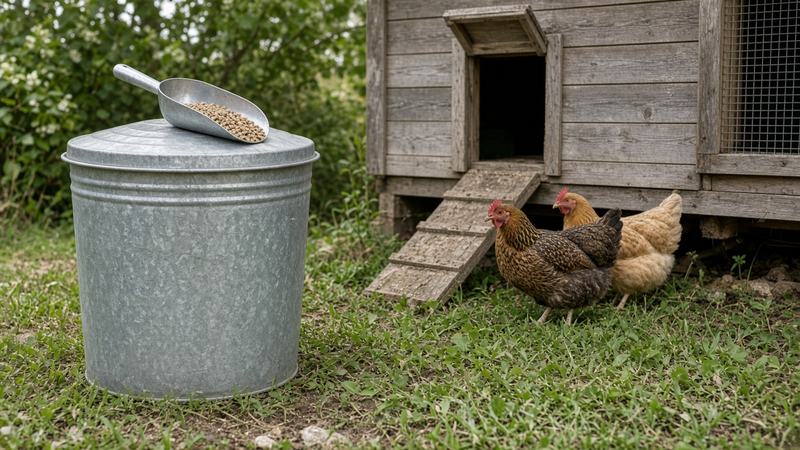
Read the tag on the bag before you buy. It lists crude protein and calcium. For laying hens, University of Maine suggests a layer feed with at least 2.5 to 3.5% calcium. The bag above lists 16% protein, which sits inside both ranges in the table.
How much and how often
| Hens | Feed per week | Feed per month | 25 lb bags per month |
|---|---|---|---|
| 3 | 9 lb | 36 lb | 2 |
| 4 | 12 lb | 48 lb | 2 |
| 6 | 18 lb | 72 lb | 3 |
| 8 | 24 lb | 96 lb | 4 |
| 10 | 30 lb | 120 lb | 5 |
| 12 | 36 lb | 144 lb | 6 |
Keep feed in front of the flock all day. University of Maine says to keep fresh feed available at all times. Hens eat to meet their energy needs, so they take more on cold days and less on hot ones.
Minnesota Extension says feed use may rise in winter, when hens burn more energy, and drop in summer heat. Use the table as a guide and watch the feeder. If it empties faster in January, that is normal.
Feed form is a matter of taste. Mash is a fine powder. Crumbles are small broken bits. Pellets are pressed rods. University of Maine notes that pellets stop hens from picking out the parts they like best, and that some mash is dusty. That makes pellets or crumbles the easy choice for a small flock.
Chicks are a separate story. They start on starter feed and move up in steps. Our chick starter feed guide covers the first 20 weeks, week by week.
- Set the feeder lip at about the height of the hens’ backs, the height University of Maine suggests.
- Fill a trough no more than half full, so hens do not flick feed out.
- Top up daily, or use a large hanging or treadle feeder that holds several days.
- Let the hens clean out the feeder about once a week, so old feed does not cake at the bottom.
- Set fresh water beside the feed every day.
Water matters as much as feed. Minnesota Extension calls continual access to clean, fresh water a critical part of the diet, and it matters most in summer. Set the waterer near the feeder, but not under it, so feed does not drop into the water. Check both every morning and again in the evening on hot days.
Feeder size follows from the table. Six hens eat about 18 lb a week. A 20 lb feeder covers about a week for that flock, and a 25 lb feeder a little more. Our chicken feeders page sorts feeders by hens and days per fill, and the waterers page does the same for water.
Grit, oyster shell and treats
| Item | What it is | How to offer it |
|---|---|---|
| Oyster shell | Extra calcium for laying hens | Free choice, in its own dish |
| Granite grit | Hard, insoluble stone for grinding | Free choice, or 2 to 3 days a month |
| Scratch grains | Mixed grains, about 10% protein | A handful the hens finish in 20 to 30 minutes |
| Kitchen and garden scraps | Fruit, vegetables, greens | Small amounts, in place of some scratch |
| Lawn clippings | Young, tender plants | Only from lawns with no recent sprays |
Oyster shell and grit are separate jobs. Oyster shell is calcium, and University of Maine says it can be offered free choice to laying hens, whatever the feed holds. Grit is hard granite that stays in the gizzard and grinds food. It comes in chick and hen sizes.
University of Maine says grit can be free choice or offered for 2 or 3 days each month. A feeder with two sections holds both shell and grit side by side. Young birds on starter or grower feed already get the calcium they need, so the oyster shell dish is for layers. Set that dish next to the feeder, not inside it. Do not mix shell into the layer pellets.
The pouch above holds 4 lb of flaked oyster shell. Serve it free choice in its own dish. Hens take what they need.
Refill the dish when you can see the bottom of it. A 4 lb pouch is the whole container. Buy the next one when this one is nearly empty.
Scratch and scraps are the fun part. Minnesota Extension notes that hens love fruit and vegetable scraps and that scratch is fine in moderation. Scratch averages about 10% protein, per University of Maine, so too much of it thins out the layer feed. Give only what the hens clean up in 20 to 30 minutes.
Fresh greens from the garden are welcome. University of Maine notes that young, tender plants are useful, while old, tough stems are not. Skip clippings from any lawn that was sprayed recently.
Keep scraps simple. Offer them in a dish or scatter them in the run in the afternoon. Clear what is left before dusk. University of Maine suggests scattering a little scratch in the litter late in the day, so hens turn it over as they search.
Storage
Feed keeps best cool, dry and sealed. University of Maine says to store feed in a clean, dry, rodent-proof spot. Keep bags off concrete floors, which pass moisture into the feed, and stand them on wooden pallets so air moves around them.
University of Maine also suggests watertight, nonmetal containers. It says to use feed within 1 month in summer and 2 months in winter. Buy bag sizes that your flock finishes within that window. For 4 hens, that is about one 50 lb bag a month, or two 25 lb bags.
Write the date on each bag when you open it. Pour the old feed on top of the new when you refill, so nothing sits at the bottom of the bin for weeks. A bin with a tight lid also keeps out rats, mice and raccoons, which find spilled feed quickly.
A few bags of feed a month adds up to real weight. Store them near the coop if you can. A dry shed or garage corner, a pallet and one lidded bin are all you need. The less you carry, the easier the daily round.
Common Questions
What do chickens eat every day?
A complete layer feed, free choice, with fresh water. Add oyster shell and grit in separate dishes, and a small amount of scraps or scratch.
How much feed does a chicken need per day?
Minnesota Extension gives about 3 lb a week for a 6 lb hen, which is a little under half a pound a day. Hens eat more in winter and less in summer.
When do I switch to layer feed?
When the first eggs appear. University of Maine says not more than 2 weeks before laying begins. For dual-purpose breeds, that is often around 22 weeks.
Can chickens eat kitchen scraps?
Yes, in small amounts. Minnesota Extension notes hens love fruit and vegetable scraps. Keep them a side dish, so the layer feed stays the main meal.
Read next
Sources
- University of Maine Cooperative Extension, Bulletin #2222 Nutrition for Backyard Chicken Flocks in Maine: extension.umaine.edu (Table 1 protein by age and type; layer feed when lay begins, not more than 2 weeks early; 2.5 to 3.5% calcium; oyster shell free choice; granite grit, 2 to 3 days a month; scratch about 10% protein, cleaned up in 20 to 30 minutes; feeder at back height, half full; storage off concrete, nonmetal containers, 1 month summer, 2 months winter; young tender greens; no sprayed clippings)
- University of Minnesota Extension, Raising chickens for eggs (reviewed 2025): extension.umn.edu (6 lb hen eats about 3 lb a week; more in winter, less in summer; scraps and scratch in moderation; oyster shell and grit)
- Protein, form and bag size: maker listing on Amazon, ASIN B01N7OKO5S, read 2026-10-12
- Pouch size and form: maker listing on Amazon, ASIN B00UIM7N0A, read 2026-10-12
How we pick and check numbers: How we research.