Chick Brooders: Floor Space, Heat and What Comes in the Kit
Coopgauge is reader-supported. When you buy through links on this page, we may earn a commission.
Give each chick 0.5 sq ft of brooder floor for the first two weeks and 1 sq ft after that. Fifteen chicks need about 7.5 sq ft at first and 15 sq ft by week 3. Pick a brooder that fits that floor and leaves a cool end away from the heat.
University of Maine sets the floor figures: 0.5 sq ft per chick at first, then 1 sq ft, then 2 sq ft as they grow. Missouri Extension gives the same first two steps. A brooder that is big enough on day one gets crowded by week three, so plan for growth.
Each box below lists what comes in the kit and the chick count from the maker listing. Kit counts are often for the first weeks only. Check them against the floor math before you rely on them.
Brooders side by side
| Brooder | Heat | Feeder and waterer | Chicks (maker) | Notes |
|---|---|---|---|---|
| 6-in-1 kit | 10 × 10 in plate | Yes | up to 15 | Mesh top, perch, mat |
| Pop-up pen | none | No | up to 15 | Double doors; 40.5 in |
| Tetuga kit | 10 × 12 in plate | Yes | see listing | Mesh sides, curtains, mat |
| Farm Innovators corral | lamp hanger only | No | up to 15 | 10 panels |
| Premier 1 plate | 12 × 12 in plate, 22 W | No | up to 20 | Pair with any box |
| Chicks | Weeks 1–2 (0.5 sq ft) | Weeks 3–6 (1 sq ft) | Later (2 sq ft) |
|---|---|---|---|
| 6 | 3 sq ft | 6 sq ft | 12 sq ft |
| 10 | 5 sq ft | 10 sq ft | 20 sq ft |
| 15 | 7.5 sq ft | 15 sq ft | 30 sq ft |
| 20 | 10 sq ft | 20 sq ft | 40 sq ft |
The jump is fast. Fifteen chicks fit 7.5 sq ft in the first two weeks, but they need 15 sq ft by week three. A 4 × 4 ft brooder gives 16 sq ft, enough for fifteen chicks to about week six. After that, they move to the coop or a bigger pen.
A kit rated for 15 chicks usually fits them only at first. Measure the floor of any pen. For a round pen, the floor is about 0.8 times the width squared. A pen 40 in across gives about 8.7 sq ft, enough for about 17 chicks at 0.5 sq ft, or 8 at 1 sq ft.
All-in-one kits
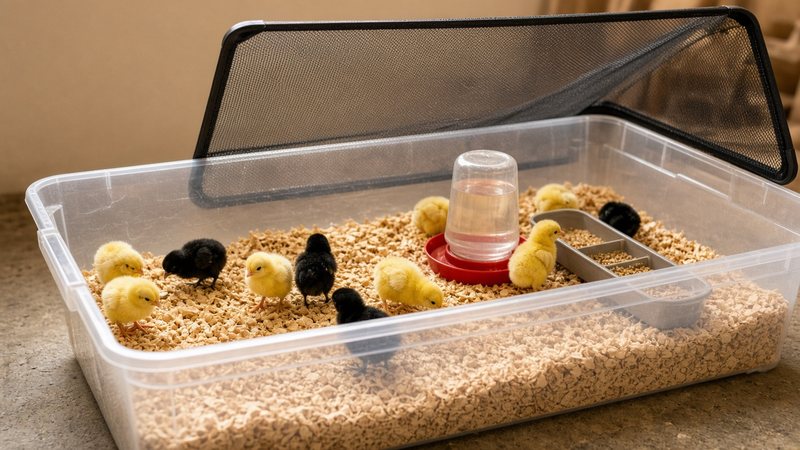
For a first batch, an all-in-one kit saves shopping. The 6-in-1 kit includes a pop-up pen, a 10 × 10 in heat plate, a feeder, a waterer, a perch and a mat, by its maker. The mesh top keeps chicks in once they start to hop.
The Tetuga kit pairs a pop-up pen with a 10 × 12 in heat plate, a feeder, a waterer and a floor mat. Three sides are mesh, and warm curtains close over them in a cold garage or on a porch. The pen is washable Oxford cloth, and the mat lifts out to rinse.
Pens without heat
If you already own a heat plate, a pen alone may be all you need. The pop-up pen has double doors and a removable mat, by its maker. It folds flat for storage between batches.
The Farm Innovators corral uses 10 plastic panels, each 18 in tall and 12 in wide. You can make the ring smaller in week one and larger as the chicks grow. It includes a lamp hanger, so you can add a heat lamp of your own. Check the listing for how many sets come in the pack.
Build your own
Many keepers use a large storage tote, a stock tank or a cardboard box for the first weeks. Add 3 to 4 in of litter, as Missouri Extension suggests, and a heat plate. University of Maine warns against hardwood shavings and hay for chicks, so use pine shavings.
A plate fits any box. The 12 × 12 in Premier 1 plate warms up to 20 chicks and draws 22 W, by its maker. It is a single plate with no cover, so chicks may perch on top; Premier sells a cover apart. Set it at one end so the other end stays cool.
Setting up the brooder
- Set the brooder in a draft-free room, away from doors.
- Lay 3 to 4 in of pine shavings, or paper towel over shavings for the first days.
- Put the heat at one end, and the feeder and waterer at the cool end.
- Turn the heat on 24 hours before chicks arrive.
- Check the temperature at chick level: about 95°F in week 1.
- Lower it 5°F a week until about 70°F.
University of Maine says to pre-heat the brooder for 24 hours, and to start at 95°F at chick level in week 1. Drop 5°F a week to about 70°F. Missouri Extension gives the same schedule. Our brooder setup guide goes week by week.
University of Maine also says chicks tell you if the heat is right. Huddled chicks are cold, evenly spread chicks are comfortable, and chicks that stay away from the heat are too warm. Raise or lower the heat to match.
Feeders, waterers and roosts
University of Maine gives 1 in of feeder space per chick to 4 weeks, and one 1-quart waterer per 16 chicks. Kit feeders and waterers usually cover a small batch. Raise them on a small block as chicks grow, so bedding stays out.
Missouri Extension suggests a roost of about 4 in per chick at 4 to 6 weeks. A low perch a few inches off the floor gives chicks practice. Many kits include one.
Where to put the brooder
A spare room, a basement or a garage all work. Chicks need fresh air but no draft, by University of Maine. Keep pets out of the room. A mesh top stops cats and keeps chicks in once they learn to hop.
Brooding makes dust. Pine shavings and chick feathers coat everything nearby. A garage or a basement is easier to clean than a living room. If the brooder is indoors, lay a sheet under it, and plan a weekly wipe of nearby shelves. A small hand vacuum makes that job quick.
Moving out
Missouri Extension keeps heat until chicks are well feathered. On the 5°F-a-week schedule, heat ends around week 6, and chicks can move to the coop in mild weather. Move them on a warm day, and keep them in the coop for a few days so they learn where home is.
Clean the brooder after each batch. Empty the bedding into the compost, wipe the pen and the plate, and let everything dry. Store it flat until the next spring. Check the pen, the mat and the plate legs before you set it up again, and replace anything cracked or bent.
Kit or home-made?
A kit is quick. Everything arrives in one box, and the parts fit each other. For a first batch of six to ten chicks, that saves a lot of guesswork. The trade-off is size: most kits are sized for the first weeks only.
A home-made brooder grows with the chicks. Start with a tote or a box, then move to a larger pen or a stock tank. A heat plate moves with them. Many keepers buy a plate and a pen, and make the rest from what they have.
Either way, plan the second space before the chicks arrive. By week three, fifteen chicks need twice the floor they had on day one. Have the bigger pen ready, so the move is easy.
Mixed batches
Bantam and large chicks can share a brooder for the first weeks. Bantams are smaller, so set the plate low enough for them, or use a plate with a sloped front. Watch that the small chicks reach the feeder and water.
Chicks of very different ages are harder to mix. Older chicks push the young ones away from the heat. Brood each batch on its own where you can, and merge them once both are off heat.
Common mistakes
The first mistake is buying for the chick count on the box. Measure the floor and divide by 0.5 sq ft for the first weeks and 1 sq ft after. The second is a brooder with no cool end. Put the heat at one end, never in the middle of a small box.
The third mistake is slippery flooring. Bare plastic or newspaper gives poor footing. Use pine shavings, or paper towel over shavings for the first few days. The last mistake is no lid. Chicks start to hop and flutter within a couple of weeks.
A day in the brooder
Morning: check the temperature at chick level, top up feed and water, and lift out any wet bedding. Midday: a quick look at how the chicks are spread. Evening: the same checks as the morning, and a look at the heat source.
Those checks take a few minutes each. They are also a good time to let the chicks get used to your hands. Sit by the brooder, move slowly and offer a little feed on your palm.
Keep a notebook by the brooder for the first batch. Write the date, the temperature at chick level and the height of the heat each day. By the next spring, you will have your own schedule, matched to your room and your season. It makes the second batch much easier than the first.
What to check on the listing
Read four things on any brooder listing. The floor size, not just the chick count. What heat is included, if any. Whether a feeder and waterer come with it. And whether it has a top.
Check how it cleans, too. A removable mat or a smooth floor is much easier than fabric. Pop-up pens fold away. Panel corrals reshape. Pick the one that fits your space and your batch size.
Common Questions
How much space do chicks need in a brooder?
0.5 sq ft each for the first two weeks, then 1 sq ft, then 2 sq ft, by University of Maine.
What size brooder for 15 chicks?
About 7.5 sq ft at first and 15 sq ft by week 3. A 4 × 4 ft brooder lasts to about week 6.
Do chick brooder kits include heat?
Some do, with a plate or a lamp. Others are pens only. Check the listing.
How long do chicks stay in a brooder?
Until well feathered, by Missouri Extension, often about six weeks.
Read next
Sources
- University of Maine Cooperative Extension, Bulletin #2219 Giving Chicks a Good Start: extension.umaine.edu (floor 0.5, 1, 2 sq ft per chick; 95°F week 1, minus 5°F a week to 70°F; pre-heat 24 hours; no hardwood shavings or hay; feeder 1 in per chick to 4 weeks; 1 quart waterer per 16 chicks; fresh air, no draft; huddle cold, spread comfortable, away too warm)
- University of Missouri Extension, G8351 Brooding and Growing Chicks: extension.missouri.edu (0.5 then 1 sq ft; 3 to 4 in litter; porcelain socket, guard, secure support; roost 4 in per chick at 4 to 6 weeks; heat until well feathered; 95°F then minus 5°F a week)
- Kit contents, plate size, chick count: maker listing on Amazon, ASIN B0F32CYGZR, read 2026-10-12
- Pen size, doors, chick count: maker listing on Amazon, ASIN B0DPFXB26C, read 2026-10-12
- Kit contents, plate size, curtains: maker listing on Amazon, ASIN B0BYYXY3ML, read 2026-10-12
- Panels, panel size, lamp hanger, chick count: maker listing on Amazon, ASIN B09PC3S46H, read 2026-10-12
- Plate size, 22 W, chick count: maker listing on Amazon, ASIN B00W43PHTA, read 2026-10-12
How we pick and check numbers: How we research.