Chicken Waterers: Gallons, Cups and How Long a Fill Lasts
Coopgauge is reader-supported. When you buy through links on this page, we may earn a commission.
A laying hen drinks about 0.06 gallon of water a day in mild weather and about 0.11 gallon in hot weather. Six hens empty a 2 gallon waterer in about 6 days, or 3 days in summer. Size the waterer for hot days, and check it twice a day.
The figures come from the University of Kentucky. Its table lists 5.55 gallons per 100 laying hens a day at 68°F, and 10.57 gallons at about 90°F. Kentucky also notes that birds drink about twice as much water as feed, by weight.
Each box below lists the capacity and the drinkers from the maker listing, plus how long one fill lasts by our math. Plan on the hot-weather number. A waterer that runs dry on a July afternoon is the one problem you never want.
Waterers side by side
| Waterer | Capacity | Drinkers | Days per fill, 6 hens, mild | Days per fill, 6 hens, hot |
|---|---|---|---|---|
| Harris Farms double-wall | 5 gal | fount | 15 | 8 |
| RentACoop corner | 5 gal | 4 cups, 4 nipples | 15 | 8 |
| ZenxyHoC on legs | 5 gal | 4 cups | 15 | 8 |
| Psarnuk float kit | your tank | 4 cups | hose refills | hose refills |
| Little Family metal | 1.5 gal | fount | 5 | 2 |
For six hens, a hot day uses about 0.63 gallon. That is a little over 2 quarts. A 5 gallon waterer lasts them about 8 hot days, and a 2 gallon waterer about 3. For three hens, halve those figures; for twelve, double them.
Bigger is easier, up to a point. Water in a big tank sits longer and warms in the sun. We suggest a capacity that lasts about a week in summer, then a fresh fill. For most flocks of four to eight, that is 3 to 5 gallons.
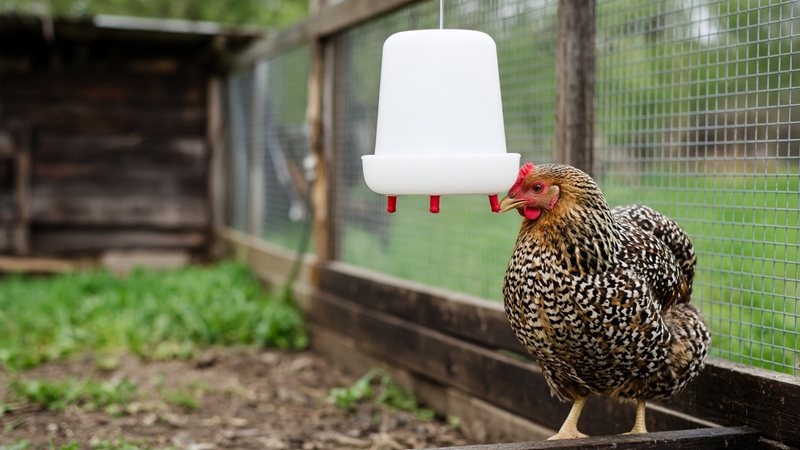
Cups, nipples or a fount?
A fount is the classic open trough around a tank. Hens drink from it easily, and new birds understand it at once. The trade-off is dirt. Hens kick bedding into an open trough, so it needs a daily rinse.
Cups and nipples keep water clean. A cup fills itself from the tank when a hen pecks the trigger. A nipple drips when a hen pushes it with her beak. Both take hens a day or two to learn. Show them by tapping the cup or nipple so a drop appears.
Penn State gives 1 linear inch of water space per bantam and 3 to 4 in per large bird. On a cup or nipple waterer, our rule of thumb is one drinker per three or four hens. Four cups serve a flock of twelve to sixteen, since hens take turns.
Classic fount: 6 to 12 hens
The Harris Farms drinker holds 5 gallons in a double wall of galvanized steel. A vacuum keeps the trough full as the hens drink. Hang it so the trough lip sits at the hens' back height, as Penn State suggests for waterers.
Bucket waterers: 6 to 12 hens
RentACoop makes a 5 gallon corner waterer with 4 cups and 4 nipples. It sits in a corner of the coop. For the middle of a run, the ZenxyHoC 5 gallon bucket has 4 cups and stands on legs that extend as the birds grow. Both have a cone on top that stops hens from perching on the lid.
For six hens, either one lasts about 15 days in mild weather and 8 in hot weather. For twelve hens, about 8 days and 4 days. Refill before the level drops to the last quarter, so the cups never run dry.
Hose-fed waterers
A float valve keeps the tank topped up from a hose. When hens drink, the level drops and the valve opens. That suits keepers who travel or who have a spigot near the coop. The Psarnuk kit below has a float valve, 4 cups and the drill bits to fit them to your own tank or bucket.
Small metal drinkers
For chicks and small flocks, a small metal drinker is easy to carry. The Little Family Members drinker holds 1.5 gallons and has a metal handle for carrying or hanging. The maker says it suits chicks as well as grown birds. A metal tank warms in the sun, so put it in shade where you can.
Placing the waterer
- Set it in shade, on a level block or hung from a chain.
- Raise it so the drinkers sit at back height.
- Keep it away from the feeder, so feed does not fall in.
- Check the level morning and evening.
- Rinse the cups or trough when you see bedding in them.
Penn State says to place feeders and waterers at the birds' back height to keep them clean and cut waste. A waterer on the floor fills with bedding in a day. A block or a chain fixes that.
Water near the feeder turns feed to mush. Put them a few feet apart. In a coop, place the waterer on a tray or a board, so spills do not soak the bedding.
Cleaning and refills
Rinse the waterer at every refill. Once a week, scrub the inside with a brush and clean water. Cups and nipples collect a little grit; pop them out and rinse them.
Fill with fresh, cool water. Kentucky notes that hens drink about twice their feed by weight, so water matters as much as feed. In summer, check twice a day. In winter, see our heated waterers page.
Summer tips
Hot weather nearly doubles how much hens drink, by the Kentucky table. Put the waterer in deep shade and add a second one on the hottest days. Two waterers also mean a bossy hen cannot guard the only drink in the run.
Refill with cool water in the morning, before the heat builds. A tank in the sun warms through the day. Shade cloth over that corner of the run helps keep it cool.
Keep a spare waterer in the shed. If one cracks or a cup sticks, you can swap it in a minute. A cheap fount is a good backup, even if you use a cup waterer every day.
Waterers for chicks
Chicks need a small waterer they cannot fall into. University of Maine gives one 1-quart waterer per 16 chicks. Set it on a small block so bedding stays out, and fill it with room-temperature water.
Cup and nipple waterers work for chicks too, once they learn. Set them low, and tap the cup the first day so the chicks see the water. Our brooder guide covers the full setup.
Going away for a few days
A float-valve waterer on a hose is the easy answer for short trips. It refills as the hens drink. Test it for a week before you leave, and check the hose is in shade, so the water inside does not get hot.
Without a hose, do the math. Six hens in summer use about 0.63 gallon a day. Three days away needs about 2 gallons, plus a margin. Two 5 gallon waterers give plenty of room. A neighbor who checks once a day is still the best backup.
Plastic or metal?
Plastic waterers are light, cheap and easy to carry when full. They do not rust. Over years in the sun, plastic can turn brittle, so store spares out of the light.
Galvanized and stainless steel last longer outside. Stainless does not rust and scrubs clean. Galvanized steel is tough, but it can corrode over time if the water sits in it for long. Metal tanks also get hot in direct sun, so shade matters more.
Weight matters when you carry it. Water weighs about 8.3 lb per gallon, so a full 5 gallon bucket weighs over 40 lb. If that is too heavy to carry from the tap, choose two smaller waterers or a hose-fed model.
Checking the math
Kentucky says hens drink about twice their feed by weight. Minnesota Extension says a 6 lb hen eats about 3 lb of feed a week. Twice that is about 6 lb of water a week, close to 0.1 gallon a day. That matches the Kentucky table for warm days.
Use the same check for your flock. Note the level in the morning and again the next morning. Divide by the number of hens. If the figure is far off, look for a leak or a spill. A dripping nipple can waste more than the hens drink. Tighten it, or swap it for a spare, and check the level again the next day.
Common mistakes
The first mistake is a waterer on the floor. It fills with bedding in hours. Raise it on a block. The second is a single small waterer in summer. Size for hot days, not mild ones.
The third mistake is a waterer next to the feeder. Feed falls in and turns sour. Keep them apart. The last is skipping the rinse. A quick rinse at every refill keeps cups clean and the water fresh.
What to check on the listing
Read four things on any waterer listing. The capacity in gallons. The type of drinker, such as fount, cup or nipple. How it refills: by hand, or by hose and float valve. And how it stands or hangs.
Check whether the lid seals and whether the waterer can be filled from the top. A top-fill bucket is easier than a fount you turn upside down. A stand or hanging handle keeps the drinkers at the right height.
Common Questions
How much water does a chicken drink a day?
About 0.06 gallon in mild weather and 0.11 in hot weather, by University of Kentucky.
What size waterer for 6 chickens?
About 3 to 5 gallons. A 5 gallon fill lasts six hens about 8 hot days.
Are nipple waterers better than cups?
Both keep water cleaner than an open trough. Cups are easier for new birds to learn.
How high should a chicken waterer be?
Drinkers at the hens’ back height, by Penn State.
Read next
Sources
- University of Kentucky, Poultry Production Manual, Chapter 12 Introduction (Table 12.1 water consumption): afs.mgcafe.uky.edu (Table 12.1: layer hens 5.55 gal per 100 birds a day at 68°F, 10.57 at 89.6°F; about twice as much water as feed by weight)
- University of Minnesota Extension, Raising chickens for eggs (reviewed 2025): extension.umn.edu (6 lb hen eats about 3 lb of feed a week)
- University of Maine Cooperative Extension, Bulletin #2219 Giving Chicks a Good Start: extension.umaine.edu (1 quart waterer per 16 chicks)
- Penn State Extension, Small Scale Poultry Housing (updated 2026): extension.psu.edu (water space 1 in for bantams, 3 to 4 in for large birds; feeders and waterers at back height)
- Capacity, double wall, galvanized: maker listing on Amazon, ASIN B006ZJHBPM, read 2026-10-12
- Capacity, cups and nipples, corner: maker listing on Amazon, ASIN B016AFYT4Q, read 2026-10-12
- Capacity, cups, legs: maker listing on Amazon, ASIN B0FMXYM4NB, read 2026-10-12
- Kit contents, float valve: maker listing on Amazon, ASIN B0D9FK63GK, read 2026-10-12
- Capacity, metal handle: maker listing on Amazon, ASIN B0C95GBGYP, read 2026-10-12
How we pick and check numbers: How we research.