Chicken Tractor: Sizes, Frames and How Often to Move It
Coopgauge is reader-supported. When you buy through links on this page, we may earn a commission.
A chicken tractor is a small coop and run on wheels or skids. For laying hens, plan 4 sq ft per hen in the house and 8 sq ft of grass under the run. Move it once a day on flat ground, and the lawn takes the manure.
Tractor sizes by flock
| Hens | House floor | Run area | Frame idea |
|---|---|---|---|
| 2–3 | 8–12 sq ft | 16–24 sq ft | 3 × 8 ft A-frame |
| 4 | 16 sq ft | 32 sq ft | 4 × 8 ft A-frame |
| 6 | 24 sq ft | 48 sq ft | 6 × 8 ft box with wheels |
| 8+ | 32+ sq ft | 64+ sq ft | two tractors, or a fixed coop |
A tractor is still a coop. Hens sleep and lay in the house, so the floor math is the same as any coop. We use 4 sq ft per standard hen, from the middle of Minnesota Extension's 3 to 5 sq ft range. Penn State gives 8 sq ft of run per laying hen.
Meat-bird tractors are packed much tighter. University of Maine gives pastured broilers 1.5 sq ft per bird. That figure is for young meat birds moved daily, not for laying hens kept for years. Use the layer numbers above.
Why a tractor works
Minnesota Extension calls moveable shelters a valuable tool. You move the house when manure builds up. The hens get fresh grass to graze and peck, and the lawn gets free fertilizer. There is far less bedding to clean out.
University of Maine says a tractor shades birds from the sun, keeps them dry in the rain, blocks wind and protects them from predators, all while they reach fresh pasture. That is a lot from one simple frame.
Tractors suit keepers with a flat lawn and a small flock. They are less handy on slopes, rough ground or deep snow. Winter needs a plan B, covered below.
Frame styles
University of Maine describes two common designs. One is a low cage about 10 ft wide, 12 ft long and 2 ft high. The other is a taller A-frame about 5.5 ft wide, 10 ft long and 5.5 ft tall. Both are built for meat birds, but the shapes work for hens too.
For laying hens, add a raised house with a roost and a nest box at one end. An A-frame keeps the roof steep, so rain runs off. A box frame on wheels is easier to fit with doors. The Maine author prefers A-frames, because you can walk in to check feeders and birds.
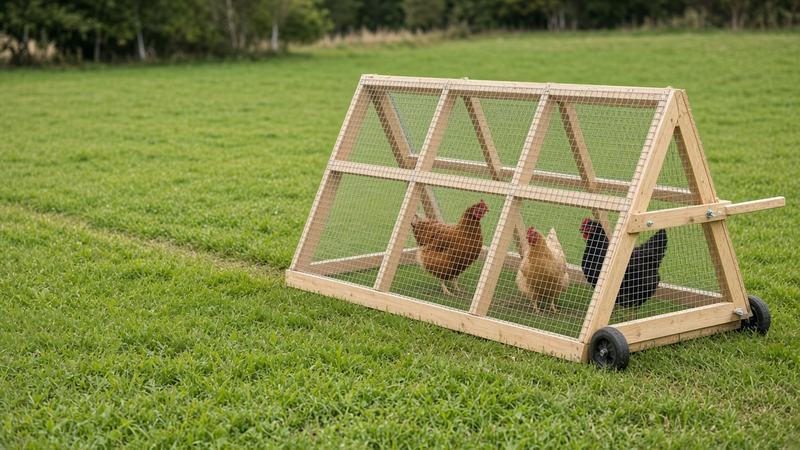
In the plan above, the house sits over one end of the run, raised so hens can walk under it. That gives 32 sq ft of grass for four hens, plus a sleeping house. Put the wheels at the house end, where the weight is, and a handle at the far end.
The tractor above is 82.4 in long and 25.8 in wide, with two wheels and a pull handle. Its label says 4 to 6 hens. By our floor math, it suits 2 or 3 standard hens on fresh grass. Measure the house floor before you rely on the label.
Build and move it safely
- Pick a flat patch of lawn, free of holes and sprinkler heads.
- Frame the tractor light enough for one or two people to move.
- Cover all sides and the top with ½ in hardware cloth.
- Add a mesh skirt along the bottom edge that lies flat on the grass.
- Fit a latch that takes two motions on every door.
- Move the tractor slowly, watching the hens, so no toes get caught.
- Shut the hens in the house at night.
University of Maine moves broiler tractors every few days in the first week, then daily, to protect the pasture and keep the area clean. For a small flock of hens, once a day is a good habit. Move it one full length so the hens land on fresh grass.
The Maine author warns that running over birds with the frame is a common problem. Move slowly and watch where every hen is. A helper on the far side makes it easy.
Predators test tractors at the ground. A tractor has no buried apron, so a mesh skirt that lies flat on the grass helps stop digging. University of Maine suggests electric net fencing around the tractor area where predators are common. Close the house door every night.
Kentucky Extension sets the mesh standard: ½ in hardware cloth stops raccoon paws, and gaps over ¼ in let weasels in. Use the same mesh on a tractor as on a fixed coop.
Buy or build?
Kit tractors are quick. Most arrive flat and go together in an afternoon. They are light, which makes moving easy. They are also small, so read the floor area, not the hen count on the box.
Building your own lets you size it to your flock. A frame of 2 × 2 lumber or light metal tube keeps the weight down. Wheels at one end and a handle at the other let one person move it. Use ½ in hardware cloth, not chicken wire, on every side.
Weight is the main trade-off. A heavy frame stays put in wind and resists a digging dog. A light frame is easy to move every day. Aim for a tractor you can move alone without strain. If it is hard to move, it will not get moved.
Mesh is the part most kit tractors get wrong. Chicken wire keeps hens in. It does not stop a raccoon. Kentucky Extension wants ½ in hardware cloth, and gaps over ¼ in let weasels through.
Cover the sides, the top and a skirt that lies flat on the grass. A 48 in roll is wide enough for a low tractor wall. Measure the frame before you cut. Overlap the skirt so it sits on the lawn, not under the wheels.
The roll above is 48 in by 100 ft, 19 gauge galvanized wire, with ½ in openings. One roll covers a small tractor and still leaves cloth for the skirt.
Seasons and weather
Spring and fall are tractor seasons. The grass grows fast, and the hens keep it trimmed. In high summer, give shade and move the tractor to a cooler part of the yard. In wet spells, the run can turn to mud, so move it more often.
Snow ends most tractor seasons. Wheels sink and frames freeze to the ground. Many keepers move the hens to a fixed coop for winter and use the tractor again in spring. A tractor also makes a handy pen for new birds or a broody hen.
Wind is the other risk. A light frame can tip in a storm. Stake the corners or park the tractor against a fence or wall when strong wind is coming. Check the latch and the skirt after any storm.
Common mistakes
The most common mistake is too many hens for the size. The grass under a crowded tractor turns bare in a day. Stick to the floor and run figures in the table. Another mistake is skipping the daily move. Manure builds up fast, and the patch goes muddy.
Gaps under the frame are the third trap. Uneven ground leaves room for a fox or a dog to dig. Check the skirt every time you move it. The last mistake is leaving the house door open at night. Shut it every evening, even in a tractor.
Keep a simple log for the first month. Note where you parked the tractor each day. You will see how fast the grass comes back, and you can plan a loop around the yard. Over a season, you will learn how long your own grass takes to come back.
Feed and water
Hang the feeder and waterer from the frame, so they move with the tractor. University of Maine says hanging feeders and waterers cut waste and keep the area cleaner. Set the lip at the hens' back height, as Penn State suggests.
Check water twice a day in summer. A tractor in full sun gets warm, so park it with part of the run in shade during the hottest hours, or add a tarp over one end.
Common Questions
How big should a chicken tractor be?
For laying hens, 4 sq ft per hen in the house and 8 sq ft of run. Four hens fit a 4 × 8 ft tractor.
How often should you move a chicken tractor?
Once a day is a good habit, by the University of Maine guidance for pastured birds.
Can you keep laying hens in a chicken tractor?
Yes, with a house, roost and nest box at one end and enough run space.
How do you stop predators getting under a tractor?
Use a mesh skirt along the bottom, ½ in hardware cloth and, where needed, electric net fencing.
Read next
Sources
- University of Minnesota Extension, Raising chickens for eggs (reviewed 2025): extension.umn.edu (3 to 5 sq ft indoor per bird; moveable shelters, move when manure builds up, grass and free fertilizer)
- Penn State Extension, Small Scale Poultry Housing (updated 2026): extension.psu.edu (8 sq ft run per laying hen; feeder lip at back height)
- University of Maine Cooperative Extension, Bulletin #2214 A Quick Guide to Raising Pastured Broilers in Maine: extension.umaine.edu (tractor shades, keeps dry, blocks wind, protects; 10 × 12 × 2 ft and 5.5 × 10 × 5.5 ft designs; 1.5 sq ft per pastured broiler; electric net fencing; hanging feeders and waterers; running over birds is common; move every few days in week one, then daily)
- University of Kentucky, ID-245 Predator Management for Small-scale Poultry Enterprises: publications.mgcafe.uky.edu (½ in hardware cloth; weasel through ¼ in)
- Size, wheels and label count: maker listing on Amazon, ASIN B0DPQK9Z6Y, read 2026-10-12
- Mesh opening, gauge and roll size: maker listing on Amazon, ASIN B09V3BPKGL, read 2026-10-12
How we pick and check numbers: How we research.