Chicken Coop Bedding: Depth, Materials and What to Do With It After
Coopgauge is reader-supported. When you buy through links on this page, we may earn a commission.
Lay about 4 in of pine shavings on the coop floor and keep 2 in of clean shavings in each nest box. Stir the floor bedding, add fresh layers, and clean it out when it is about 40% manure. Then compost it for the garden.
- Floor depth to start
- about 4 in
- Deep litter goal
- 10 in by winter, up to 12 to 15 in
- Nest boxes
- 2 in of clean, dry material
- Best material
- pine shavings
- Clean out
- at about 40% manure, 60% bedding
- Compost mix
- 70 to 75% carbon, 25 to 30% nitrogen
Floor and deep litter depths: Minnesota Extension. Nest boxes and pine shavings: Penn State. Clean out and compost mix: Kentucky Extension ASC-242.
Bedding does three jobs. It soaks up droppings, keeps eggs clean in the nest and gives hens something soft to scratch. Minnesota Extension says 85% of chicken droppings, by weight, is water. Good bedding holds that water so the coop stays dry.
Pine shavings are the easy pick. Penn State names them as the preferred nest material. They soak up water, stay loose and smell clean. Straw, shredded paper and sand all work too, with trade-offs we cover below.
Bedding checklist by coop
| Coop floor | Hens (4 sq ft each) | Shavings at 4 in | 4 cu ft bags |
|---|---|---|---|
| 3 × 4 ft (12 sq ft) | 3 | 4 cu ft | 1 |
| 4 × 6 ft (24 sq ft) | 6 | 8 cu ft | 2 |
| 5 × 8 ft (40 sq ft) | 10 | 13.3 cu ft | 4 |
| 8 × 10 ft (80 sq ft) | 20 | 26.7 cu ft | 7 |
The math is simple. Multiply the floor area by the depth in feet. At 4 in, that is a third of a foot. A 4 × 6 ft coop needs 8 cu ft of loose shavings to start, which is two 4 cu ft bags. Buy one extra bag for top-ups.
Nest boxes take far less. Manna Pro tells keepers to spread a 2 in layer in the boxes, which matches Penn State. A box 12 in square holds about a sixth of a cubic foot at that depth.
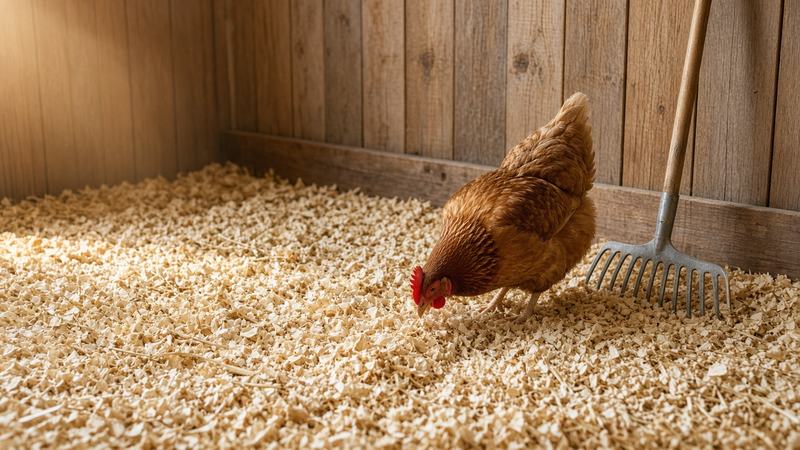
The 2-pack above holds 141 L, which is about 5 cu ft. At 4 in deep, that covers about 15 sq ft, enough for a full 3 × 4 ft coop for three standard hens with some left for top-ups. Compressed bags expand when you break them up, so loosen the shavings before you judge the depth.
Materials compared
| Material | Soaks up water | Notes |
|---|---|---|
| Pine shavings | Well | Preferred by Penn State for nests |
| Straw | Fair | Mats down; chop it for compost |
| Dry leaves | Fair | Free in fall; good compost carbon |
| Shredded paper | Fair | Mats when wet |
| Sand | Low | Scoop daily; does not compost |
Straw is cheap and easy to find, but it mats when wet. Leaves are free in the fall and make good compost. Sand drains well in a run, but it does not soak up water, and you have to scoop it often. Pine shavings are the safe default for the coop floor.
Skip hay, which stays damp. Keep the material dry when you store it. A bag left in the rain is a bag of wet sawdust.
Bedding by setup
A small kit coop with a pull-out tray is the simplest case. Line the tray with a thin layer of shavings and empty it into the compost bin each week. Deep litter does not suit a shallow tray, so keep it light and change it often.
A walk-in coop with a solid floor is where deep litter shines. You can stand inside with a fork, and the pack has room to build. Sill boards across the door keep the bedding from spilling out as it gets deeper.
A chicken tractor needs little bedding at all. Minnesota Extension notes that a movable house lets you shift the flock when manure builds up. The grass under it takes the droppings, and the lawn gets fed.
Nest boxes deserve their own check. Keep the 2 in layer clean and dry. Swap it out when it gets soiled. Clean nests mean clean eggs, and clean eggs need less work in the kitchen. A lip at the front of the box keeps the shavings in, and Penn State suggests one 3 to 4 in tall.
Climate shapes the routine too. In a wet climate, keep the coop on high, well-drained ground, as Penn State advises, and top up more often. In a dry, hot climate, a thinner layer stays fresher, and you can clean more often instead of building a deep pack.
The run is a separate case. A covered run stays dry enough for wood chips or sand. An open run turns to mud in the rain, and a few inches of wood chips over the wet spots keep the hens out of the worst of it.
Deep litter, step by step
- Start in spring or fall with about 4 in of fresh shavings on a dry floor.
- Stir the bedding every week or two with a rake or fork, so it does not crust.
- Add a fresh layer whenever the top looks damp or packed.
- Build up to about 10 in by winter, as Minnesota Extension suggests.
- Keep going to 12 to 15 in, where the pack begins to compost in place.
- Clean it all out once a year, usually in spring.
Deep litter saves work. Minnesota Extension says to lay about 4 in, stir often and add fresh bedding until it is 10 in deep by winter. At 12 to 15 in, composting begins in the pack. The warm pack adds a little heat in the cold months.
It does need air. Good airflow in the coop keeps the pack dry and fresh. If the coop smells sharp, add a layer of shavings and open a vent. A dry pack smells earthy, never sharp.
Throw a handful of scratch on the bedding now and then. The hens dig for it and turn the pack for you. That is the cheapest stirring help you will find.
Composting coop manure
Spent bedding is garden gold once it is composted. Kentucky Extension says to clean out the coop when the litter is about 40% manure and 60% bedding. That mix is close to what a compost pile needs, so most of the work is already done.
The target is a carbon to nitrogen ratio of about 30:1. Kentucky Extension says the pile should be 70 to 75% carbon material, such as shavings, leaves or yard waste, and 25 to 30% nitrogen material, such as manure and grass clippings.
| Ingredient | C:N ratio | Role |
|---|---|---|
| Wood shavings | 500:1 | Carbon |
| Straw | 80:1 | Carbon |
| Dry leaves | 60:1 | Carbon |
| Grass clippings | 17:1 | Nitrogen |
| Kitchen scraps | 15:1 | Nitrogen |
| Chicken manure | 8:1 | Nitrogen |
- Set up three bins in a shady spot, with a fork and a compost thermometer.
- Put about 6 in of litter in the first bin. Add a 3 in layer of manure from under the roosts, then a layer of leaves or shavings.
- Repeat the layers until the bin is full. Keep the pile damp, like a wrung-out sponge.
- Cover it and leave it for at least two weeks. The middle should reach 130 to 150°F.
- Move it to the second bin for three more weeks.
- Move it to the third bin. Then use it in the garden or store it under cover.
Those steps come from Kentucky Extension, which suggests three bins so the next clean out always has a home. If the pile smells like ammonia, add leaves or shavings. If it smells like rotten eggs, it is too wet; turn it and add dry material. If it stays cool, it may be too dry or too small.
Finished compost is dark and crumbly and smells like soil. Kentucky Extension says properly composted litter can go on any lawn or garden. Mix it into beds before planting, or spread it as mulch around plants.
Cleaning routine
Minnesota Extension suggests cleaning the coop and pen weekly as needed, with a full clean out at least once a year, usually in spring. Wear a dust mask for the big clean, since dry manure dust is unpleasant to breathe, and mist the area first.
Daily jobs are small. Pick up eggs, check the nest boxes and lift out any wet patch under the waterer. A droppings board under the roost catches much of the overnight mess and makes the weekly job faster. The nest layer touches the eggs, so keep 2 in of clean shavings in each box.
The box above has 3 compartments. Each one is 12 in square and 11 to 15 in tall, in solid wood. At 2 in of shavings, one compartment holds about a sixth of a cubic foot.
Penn State starts with 2 nests for the first 4 hens, then 1 nest per 4 hens after that. Three boxes cover about 12 hens. Swap the shavings when they cake.
Common Questions
How deep should coop bedding be?
Start with about 4 in on the floor and 2 in in nest boxes. For deep litter, build up to 10 in by winter.
What is the best chicken coop bedding?
Pine shavings are the common choice. Penn State prefers them for nests.
How often should I change coop bedding?
Clean out when the litter is about 40% manure, by Kentucky Extension, or once a year for deep litter.
Can I compost chicken bedding?
Yes. Aim for about 30:1 carbon to nitrogen and let the pile reach 130 to 150°F.
Read next
Sources
- University of Minnesota Extension, Raising chickens for eggs (reviewed 2025): extension.umn.edu (85% of droppings is water; lay about 4 in, stir, 10 in by winter, 12 to 15 in composts; heat in cold months; clean weekly; full clean once a year in spring; dust mask)
- Penn State Extension, Small Scale Poultry Housing (updated 2026): extension.psu.edu (2 in clean dry nesting material; pine shavings preferred; 3 to 4 in lip on nests; at least 12 × 12 in; 2 nests for the first 4 hens, then 1 per 4; high, well-drained site)
- University of Kentucky, ASC-242 Composting Poultry Litter in Your Backyard: publications.ca.uky.edu (clean out at 40% manure, 60% bedding; 30:1; 70 to 75% carbon, 25 to 30% nitrogen; 40 to 60% moisture; three bins in shade; 6 in litter, 3 in manure; 2 weeks, 130 to 150°F; 3 more weeks; troubleshooting; safe for lawn or garden; Table 1 C:N ratios)
- Manna Pro, Fresh Flakes Poultry Bedding directions: mannapro.com (2 in layer in coop and nest boxes)
- Volume, material: maker listing on Amazon, ASIN B0D853N438, read 2026-10-12
- Compartment size, count and material: maker listing on Amazon, ASIN B0GHR4ZQWM, read 2026-10-12
How we pick and check numbers: How we research.