Chicken Roost Bar: 8 in Per Hen, 2 ft Up, 10 in Apart
Coopgauge is reader-supported. When you buy through links on this page, we may earn a commission.
Give each standard hen about 8 in of roost bar. Set the bars 18 to 24 in off the floor and 10 to 12 in apart. Bantams need about 4 in each, and large breeds about 10 in. Never set a perch higher than 4 ft.
- Length per standard hen
- 8 in (sources: 5 to 10 in)
- Bantam
- 4 in, 12 to 18 in high
- Large breed
- 10 in
- Height
- 18 to 24 in off the floor
- Spacing
- 10 to 12 in between bars
- Lumber
- 1 to 2 in square, top edges rounded
- Top limit
- no perch over 4 ft
- Silkies
- about 1 ft high
Length and spacing: Oregon State EC 1644 (5 to 10 in, 10 in apart, 2 ft up) and Penn State (6 in, 1 ft apart, 18 to 24 in). Bantams and 4 ft limit: Penn State. Silkies and lumber: Oregon State. Our 8 in and 10 in: calculator.
Hens sleep perched, side by side. Roost length decides how many fit. Oregon State gives 5 to 10 in of pole per bird. Penn State gives 6 in for standard hens and 4 in for bantams. We use 8 in for standard hens, in the middle, and 10 in for large breeds.
In winter, hens huddle closer and use less bar. In summer they spread out. Planning for the middle of the range gives room in warm weather without wasting coop space.
Roost length by flock size
| Hens | Standard (8 in each) | Bars at 4 ft long | Bantams (4 in each) |
|---|---|---|---|
| 2 | 16 in | 1 | 8 in |
| 4 | 32 in | 1 | 16 in |
| 6 | 48 in | 2 | 24 in |
| 8 | 64 in | 2 | 32 in |
| 10 | 80 in | 3 | 40 in |
| 12 | 96 in | 3 | 48 in |
Six standard hens need 48 in of bar, which is one 4 ft board. Ten hens need 80 in, so two bars. Large breeds such as Orpingtons need 10 in each, so six of them need 60 in. Round up to whole boards; extra bar costs little.
Plan for the flock you will have next year, not just this one. Many keepers add a few hens in spring. A longer bar now saves a rebuild later, and a spare stretch of roost gives a new bird somewhere to sit while the flock settles.
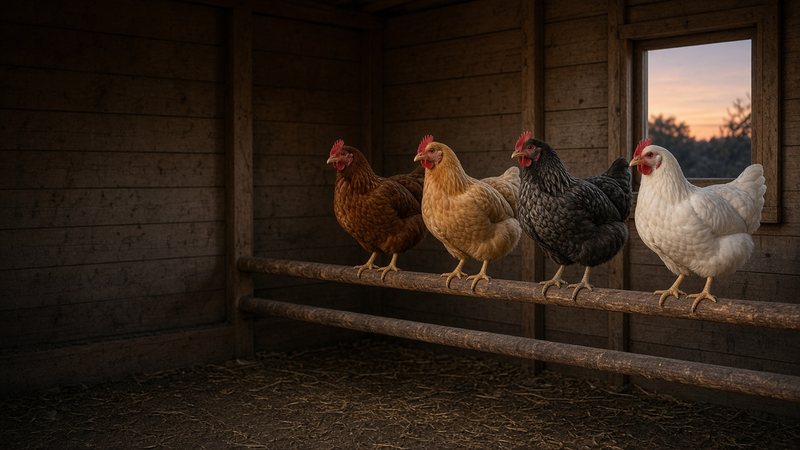
Height and spacing
Oregon State sets roost poles 2 ft off the floor, 10 in apart. Penn State gives 18 to 24 in high and 1 ft apart. Both keep the bars low. Penn State warns against any perch more than 4 ft above the floor, because hens land hard when they jump down.
Lower is kinder for some breeds. Oregon State says Silkies need a pole only 1 ft off the ground. Penn State puts bantams at 12 to 18 in. Cackle Hatchery lists 0 to 2 ft for Cochin Bantams. Heavy hens appreciate a low bar too.
If you use more than one bar, set them level or in a ladder. Oregon State shows both a bed formation, with bars side by side, and a ladder formation. Hens will crowd the highest bar, so a level bed of bars spreads them out better.
Space the bars at least 10 in apart, so hens on one bar do not sit on the tails of the next.
Lumber and shape
Wood gives the best footing, by Oregon State. Use 1 to 2 in square lumber with the top edges rounded off. A 2 × 2 is common. Many keepers use a 2 × 4 laid flat. That gives a wide, flat top that suits heavy breeds.
Avoid thin dowels and metal pipe. Oregon State says poles that are too small or too round give poor footing. Sand the edges smooth, and screw the bars into brackets so you can lift them out to clean.
The perch above has 2 × 1 in bars on a 43 × 36 in frame. It suits a run or a large walk-in coop, where hens can rest by day. Its top bar sits about 32 in up, inside the 4 ft limit. Check the label count against 8 in per hen before you rely on it for sleeping.
Placement in the coop
Put the roost on the wall away from the nest boxes. Penn State says to keep roosts away from nests, so hens do not sleep in the boxes. It also says nests should sit at least 4 ft from the roosts. Oregon State says nests should not be lower than the roosts.
Put a droppings board or tray under the roost. Most droppings land there at night, so a quick scrape each morning keeps the bedding clean much longer. Leave room above the bar for the birds to stand up without hitting the roof.
Build and fit a roost
A roost is one of the easiest coop jobs. Cut the bar to length, round the top edges with sandpaper or a plane, and set it on two brackets or cleats screwed to the walls. Lift-out bars make cleaning easy, so avoid nailing them in place.
Check the bar for rough spots and splinters before the hens move in. Run your hand along the top. If it snags your skin, it needs more sanding. A smooth bar is easy to scrape clean as well.
Watch the flock for the first few nights. If hens crowd one end or sleep in the nest boxes, the bar may be too short, too high or too close to the boxes. Move it, lengthen it or add a second bar at the same height.
Young birds start to perch as they grow. A low practice bar, a few inches off the floor, helps them get the idea. Raise it in steps as they grow, until it matches the adult bar.
Keep the roost out of drafts but near fresh air. A vent above head height on the opposite wall moves air without blowing on sleeping hens. Oregon State notes coops do not need insulation if they are free of drafts.
Light matters less than you might think. Hens head to the roost at dusk on their own. A dim coop at night keeps them settled. Close the door once they are all up, and check the count before you latch it. A quick count each night is the best habit in any coop.
Common Questions
How much roost space per chicken?
About 8 in for a standard hen. Sources range from 5 to 10 in. Bantams need about 4 in.
How high should a chicken roost be?
About 18 to 24 in off the floor, by Penn State and Oregon State. Never over 4 ft.
How far apart should roost bars be?
10 to 12 in apart, by Oregon State and Penn State.
What size wood for a chicken roost?
1 to 2 in square lumber with rounded top edges, per Oregon State. A 2 × 4 laid flat also works.
Read next
Sources
- Oregon State University Extension, EC 1644 Backyard chicken coop design (2014, reviewed 2023): extension.oregonstate.edu (1 to 2 in square lumber, rounded edges; too small or round is poor footing; bed or ladder formation; 2 ft off floor; 10 in apart; 5 to 10 in per bird; Silkies 1 ft; nests not lower than roosts; no insulation needed if draft free)
- Penn State Extension, Small Scale Poultry Housing (updated 2026): extension.psu.edu (6 in per standard bird; 1 ft apart; 18 to 24 in high; bantams 4 in, 12 to 18 in; never over 4 ft; roosts away from nests; nests at least 4 ft from roosts)
- Cackle Hatchery, Buff Cochin Bantam breed facts: cacklehatchery.com (Cochin Bantam roost 0 to 2 ft)
- Footprint, bar size, label count: maker listing on Amazon, ASIN B0DMNNJD5D, read 2026-10-12
How we pick and check numbers: How we research.