Rat-Proof Chicken Feeders: Lid Type, Capacity and Mounting Height
Coopgauge is reader-supported. When you buy through links on this page, we may earn a commission.
Rats get into an open feeder, so a rat proof chicken feeder is judged by its lid. The lid type decides how the cover opens. It decides who can open it too. A 6 lb hen eats about 3 lb of feed a week. A 20 lb feeder holds 8 days of food for six hens, by our math. Two to four hens calls for a different structure. So does your run with no beam to hang from.
Feed comes out from under the lid, or through a port in the side. A port is an opening too, so a rat has to reach the lid or reach the port. Miss either one and the feeder becomes a pantry.
Two numbers decide most of the purchase. How the lid opens. How wide every opening is when it does. Kentucky Extension puts the gap figure at ¼ in. We apply it to every feeder below.
Rat-proof is a lid, not a mesh
Three lid mechanisms do this work. Which one fits depends on your birds and your space. Not on the word printed on the box.
A treadle feeder has a plate on the floor and a lever above it. A hen steps on the plate. The lever lifts the lid. Step off, and the lid drops shut. The lid opens for weight. A rat brings none.
The threshold sets the limit. One maker opens its 40 lb treadle for adult birds on a wide plate. The 25 lb model further down ships a detachable step weight for lighter birds. Under that threshold the lid stays shut, and the feed stays put.
A closed gravity feeder never opens its lid. Feed drops into a trough through a port. The bird reaches in from the side. The lid is not a door. There is nothing to lever.
A feeder hung off the ground adds a second line: height and a cover. The bucket feeder below can be carried. It can hang inside a run. Its lid seals against rain.
One part gets mistaken for a lid. A front grid sits between the bird and the feed. Makers call it an anti-flick grill. It stops a hen throwing grain onto the ground. It does not close the feed off from a rat.
Kentucky Extension closes any gap of ¼ in or more. A least weasel fits through a hole that size. The same figure covers a lid seam and a feed port. We use it on every gap here.
That leaves our own test. The lid cannot be pried open. Every opening measures ¼ in or less. Two questions, and you answer both before the box arrives.
Side guards are a different job again. They stop a hen feeding from the side. And flinging feed across the run. That is a waste problem, not a rat problem.
| Lid type | How it opens | Who can open it | Weight to open | Opening size | Rain | Fits |
|---|---|---|---|---|---|---|
| Treadle lever lid | A hen steps on the plate, the lever lifts the lid, it drops shut when she steps off | Hen only. A bird, a squirrel or a rat cannot lift it | adult birds on one model | ¼ in or less, our rule | Full coverage lid, by the maker | Flocks of 4 to 12 standard hens |
| Closed gravity lid with ports | It never opens. Feed falls into the trough by gravity | Nobody. Birds reach in through the ports | none | Ports at ¼ in or less, our rule | Needs a rain cover | Covered runs and small coops |
| Hanging lid with a sealed cover | It stays shut. You open it to fill | Nobody, unless it works the latch | none | Port at ¼ in or less, our rule | Airtight lid, by the maker | Runs with no floor space |
| Open trough with anti-flick grill | Nothing holds it closed | Any bird or rat that reaches the trough | none | Open along the whole top | Rain lands straight in the feed | Not a rat-proof feeder |
| Bucket with cut ports | The lid lifts for filling, then gravity feeds the trough | Any bird that reaches a port | none | 3.15 in port, so cover it | Rain cover in the kit | 2 to 4 hens under cover |
Row four is worth reading twice. The grid is the part of a feeder that stops waste. It is not the part that stops a rat. Many listings put both words on the same box.
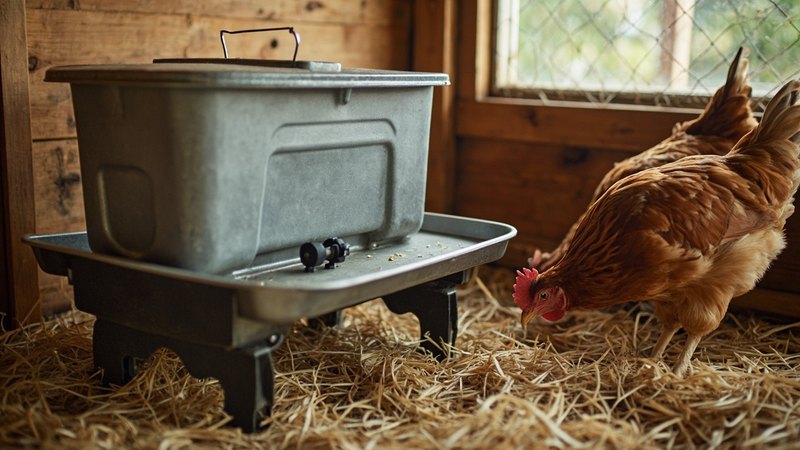
Feeders side by side
Our assumptions for every day count below. One standard 6 lb hen eats 3 lb of feed a week. Minnesota Extension gives that figure. That is 0.43 lb a day per hen. Days = capacity in pounds ÷ (hens × 0.43), rounded to a whole day.
Bantams weigh less than 6 lb and eat less. The same fill lasts them longer. Penn State gives 1 in of feeder space per bantam. A large bird gets 3 to 4 in. We count days for standard hens. Bantam numbers are our judgment.
| Feeder | Capacity | Material | Lid | Opening | Size | Fits | Days, 4 hens | Days, 6 hens | Days, 12 hens | Maker's count and days | Our read |
|---|---|---|---|---|---|---|---|---|---|---|---|
| Grandpas Feeders 20 lb | 20 lb | galvanized steel | treadle, full coverage lid | ¼ in or less | 17 × 15 × 12 in, 10 lb empty | 4 to 8 hens | 12 | 8 | 4 | 6 hens up to 10 days | 8 days for 6 hens, so plan the refill on day 8 |
| Hsmanchry 40 lb | 40 lb | galvanized steel | treadle, weatherproof lid | ¼ in or less | 22.44 × 20.08 × 14.57 in | 8 to 12 hens | 23 | 16 | 8 | 6 to 12 chickens, no day count | 8 days at 12 hens, and a window to check the level |
| RentACoop 25 lb | 25 lb | galvanized metal | treadle, lid latch, step lock | ¼ in or less | 21 × 18.5 × 14 in | 6 to 10 hens | 15 | 10 | 5 | no hen count listed | Two locks, and a step weight for light birds |
| ZenxyHoC bucket | 3.6 gal | plastic bucket | airtight lid, 4 covered ports | ports at ¼ in or less | 11 × 7 × 19 in | 2 to 6 hens | by weight | by weight | by weight | no day count listed | Gallons, not pounds, so weigh your bag |
| 6-port bucket kit | set by your container | BPA-free plastic ports | lid from your bucket | 3.15 in port, so cover it | 4.1 × 4.1 × 3.9 in ports | 2 to 4 hens | by bucket | by bucket | by bucket | no day count listed | A conversion, and the ports need mesh |
The maker's day count is the number to doubt. It assumes a flock of a certain size. It only means something after you divide by your own count.
| Feeder | Maker's count | Maker's days | Our days at that count |
|---|---|---|---|
| 20 lb treadle | 6 hens | 10 | 8 |
| 40 lb treadle | 6 to 12 chickens | not listed | 8 days at 12 chickens |
| 25 lb treadle | none listed | not listed | 10 days at 6 hens |
Read the chart against your own number of hens. Six hens and a 20 lb feeder means a refill every week. Twelve hens a refill every fourth day.
Small flocks: 4 to 6 hens
Four to six standard hens eat 12 to 18 lb a week. A 20 lb feeder matches that flock. The treadle style closes when nobody stands on it.
The Grandpas Feeders 20 lb model measures 17 × 15 × 12 in. It weighs 10 lb empty. The lid covers the whole top. The maker calls it rat proof, rodent proof and weather proof. An anti-flick grill sits in front of the feed. Side guards close the sides.
By our math, 4 hens empty it in 12 days. Six hens in 8 days. The listing says 6 chickens up to 10 days. Plan the refill for day 8 rather than day 10.
Check two numbers before you order. Capacity of 20 lb, and the treadle step. Both sit on the listing. Both decide whether the feeder works in your run.
One detail matters at this size. A feeder on the ground takes the width of a small run. A hanging feeder of the same weight keeps that floor space free.
Mid-size flocks: 8 to 12 hens
Eight hens eat 24 lb a week. Twelve hens eat 36 lb. At that size a 40 lb feeder is the match. It is the same treadle mechanism with a bigger body.
The Hsmanchry 40 lb model measures 22.44 × 20.08 × 14.57 in. Its lid closes over the trough, the maker says, to keep feed covered from mice, rats, wild birds, insects, rain and snow. The body is galvanized steel, with a red weatherproof lid, side guards and a wide diamond treadle plate. A visible window shows the feed level without opening the lid.
Our days: 12 for 8 hens, and 8 for 12 hens. The listing names 6 to 12 chicken setups and gives no day count. Our 8 days is the number to plan the refill on.
At 12 hens the front grille earns its place. A bigger flock eats faster. It also flicks more feed out of the trough. That waste comes out of the same 40 lb.
Capacity is not the only limit here. Penn State gives 3 to 4 in of linear space per large bird. Twelve hens want about 48 in of trough. One feeder serves them in turns, not all at once.
Hanging feeders: feed off the ground
Some runs have no floor space to spare. No beam to spare either. A feeder that hangs or stands on legs keeps the ground clear.
University of Maine notes that hanging feeders cut wastage. They keep the area cleaner. That matters in a run where spilled feed draws rats.
The ZenxyHoC feeder holds 3.6 gal. It measures 11 × 7 × 19 in. The maker says it can be carried or hung within your run. The lid is airtight. Four ports carry downward openings, and covers sit over them.
Those port covers are the part that matters. A cover you can lift off and a cover a rat cannot lift are different products. Read the listing for which one it shows.
Here is the limit of height. It reduces the risk rather than removing it. We say so plainly. A rat that can reach the port can still reach in. Hanging helps only when the lid does the rest.
So hang it where your hens still reach the feed. University of Maine puts the feeder lip at the birds' back height. A feeder above that is a feeder the flock cannot use.
Small flocks and DIY conversions: 2 to 4 hens
Two to four hens eat 6 to 12 lb a week. At that size a 20 lb treadle feeder is more machine than you need. A bucket conversion is often the better fit.
The port kit below cuts six openings of 3.15 in. It fits any container. It holds a rain cover, a rubber gasket and plugs. Capacity is set by the bucket you choose. The day count comes from the weight of your own feed.
Those 3.15 in ports are a reach-in opening, not a sealed one. Cover your ports with ½ in hardware cloth. The port stops being a way in. That mesh and the frame spacing are on our predator-proof coop page.
A lidded bucket with covered ports feeds like a closed gravity feeder. Feed falls as the birds eat. The lid stays shut until you lift it to fill.
For 2 to 4 hens, weigh the bag before you fill. A 10 lb bag covers three hens about a week. A 20 lb bag covers them about two. This one has no maker's day count. The capacity comes from your bucket.
Bantams and other small birds
For bantams, the step weight comes before the capacity. A treadle needs a certain weight to open. A lighter bird will not move it.
The RentACoop 25 lb feeder answers that. The maker lists a detachable step weight. A lighter bird can then trigger the treadle. The same maker adds an optional step lock for the night.
Those two parts are the only pair of locks on this page. A lid latch and a step lock close the feeder twice over. Our take: the step lock is the one that matters after dark.
Feeder space matters here too. Penn State gives 1 in per bantam. University of Maine gives 1 in per chick to 4 weeks. A trough built for standard hens is too wide for the birds in front of it.
Our days for the 25 lb feeder: 15 for 4 hens, 10 for 6 hens, and 5 for 12 hens. Bantams eat less than the 6 lb hen in our formula. A real fill lasts them longer.
Height, mounting and keeping feed out of reach
Height is the second half of the job. University of Maine says the feeder lip belongs at the birds' back height. A feeder kept about half full cuts waste.
The same source says to store spare feed off concrete. It says to use a non-metal container with a sealed lid. Feed keeps about a month in summer and two months in winter.
Kentucky Extension adds the habit that closes the loop. Leave no feed in the run at night. Clear the feed that spills each evening. Spilled grain is what keeps a rat close.
So hang at the lowest height where the hens still reach the feed. Every extra inch helps. The line the feed sits on stays put, because the birds grow.
The last piece is the store. A sealed, non-metal container off the ground takes the spare feed. That is the feed not in the feeder. Our chicken feeders page covers the storage routine.
Turning an ordinary feeder into a rat-proof one
A feeder you already own can often be fixed. Five changes do most of the work. Each one is a structure rather than a product.
First, cover the trough in ½ in welded hardware cloth. Kentucky Extension uses that mesh because a raccoon paw stops at it. Our predator-proof chicken coop page has the roll size and the frame spacing.
Second, add a cover that slopes. A slope gives a flat surface nothing to stand on. That is our judgment rather than a published rule.
Third, close every opening to ¼ in or less. That is the Kentucky figure for a gap a weasel can use.
Fourth, swap an open trough for a closed gravity lid. The lid then never opens, so there is nothing to lever. Fifth, carry the feeder into the coop before dark and sweep up what spills each evening. That is the habit Kentucky Extension asks for.
| Material | Size | Where it goes | Step |
|---|---|---|---|
| Welded hardware cloth | ½ in mesh, 48 in × 100 ft roll | Over the trough and around the feed ports | 1 |
| Galvanized ties or strapping | short lengths | Fix the cloth to the feeder frame | 1 |
| Hasp or small lock | 1 | Hold the sloped cover shut | 2 |
| Sheet metal or a cut bucket lid | cut to the feeder top | The sloped cover itself | 2 |
| Chain and a hook | 4 ft | Lift the feeder to back height | 5 |
Order the work that way and the feeder stays usable while you do it. Mesh first, because it closes the port. The cover second, because it closes the climb.
Material: galvanized steel, plastic and wood
Most feeders here are galvanized steel. The makers say so in plain words. One calls its body high quality galvanized steel built to last. Another lists galvanized steel panels and a weatherproof lid for outdoor use.
Steel also takes a sheet of mesh or a lock without splitting. The conversion steps need that. Our chicken feeders page puts galvanized steel ahead of plastic for sun and for chewing.
Plastic is light, but it has conditions. The port kit comes with a rainproof cover and a rubber gasket. Its maker says it can sit outdoors. The bucket feeder is weather resistant by the maker. Its sealed lid keeps the feed dry.
Wood needs the same structure checks as metal. The seam between lid and trough wants ¼ in or less. The lid and the end cap want to be replaceable. A maker with spare parts is worth asking about before you buy.
What to check on the label
Five numbers on a feeder listing decide whether it works in your run. Take them in this order, because each one changes what the others mean.
Capacity comes first, in pounds rather than quarts or gallons. One feeder here holds 3.6 gal, and another holds 25 lb. Convert before you use any day count.
The day count comes next. The phrase that feeds N chickens for up to M days assumes a flock of a certain size. Divide it by your own count. The 20 lb model says 6 chickens up to 10 days. Six hens eat 8 days of it by our math.
Then look past the maker's word for rat proof. The lid mechanism and the opening size decide. Read those instead, and use the ¼ in rule.
Weight to open the step matters if you keep bantams. One maker opens its step for adult birds on a wide plate. Another ships a detachable step weight.
Last comes material and mounting. Galvanized or plastic, on the ground or hung, and whether the lid locks. The 20 lb treadle feeder settles that last pair of numbers. Check its capacity and lid on the listing.
Read next
- GearChicken feeders
- CoopsPredator-proof chicken coop
- FeedWhat to feed chickens
- GearChicken waterers
- HubChicken feeding
Sources
- University of Minnesota Extension, Raising chickens for eggs (reviewed 2025): extension.umn.edu (a 6 lb hen eats about 3 lb of feed a week)
- Penn State Extension, Small Scale Poultry Housing (updated 2026): extension.psu.edu (3 to 4 linear in of feeder space per large bird, 1 in per bantam)
- University of Maine Cooperative Extension, Bulletin #2222 Nutrition for Backyard Chicken Flocks in Maine: extension.umaine.edu (feeder lip at back height, feeder about half full; store feed off concrete in a non-metal container with a sealed lid; 1 month summer, 2 months winter)
- University of Maine Cooperative Extension, Bulletin #2219 Giving Chicks a Good Start: extension.umaine.edu (feeder 1 in per chick to 4 weeks)
- University of Maine Cooperative Extension, Bulletin #2214 A Quick Guide to Raising Pastured Broilers in Maine: extension.umaine.edu (hanging feeders reduce wastage, keep the area cleaner)
- University of Kentucky, ID-245 Predator Management for Small-scale Poultry Enterprises: publications.mgcafe.uky.edu (close any gap of ¼ in or more; ½ in hardware cloth stops a paw; no feed left in the run at night; clear spilled feed; lock the doors before dark)
- Hardware cloth roll size and frame spacing: our predator-proof chicken coop page
- Capacity, treadle, full coverage lid, 17 by 15 by 12 in, 10 lb empty: maker listing on Amazon, ASIN B00TXW0UQK, read 2026-11-02
- Capacity, weatherproof lid over a covered trough, side guards, 22.44 by 20.08 by 14.57 in, 6 to 12 chicken setups: maker listing on Amazon, ASIN B0H2NQYQWQ, read 2026-11-11
- Capacity, airtight lid, 4 covered ports, 3 leg heights, 11 by 7 by 19 in: maker listing on Amazon, ASIN B0FW4YT9LF, read 2026-11-02
- Port size, rain cover, hole saw: maker listing on Amazon, ASIN B0BH2QQT9K, read 2026-11-02
- Capacity, lid latch, optional step lock, detachable step weight, 21 by 18.5 by 14 in: maker listing on Amazon, ASIN B07MQW8MQK, read 2026-11-02
How we pick and check numbers: How we research.