Chicken Breeds: Size, Egg Color and Broodiness
Coopgauge is reader-supported. When you buy through links on this page, we may earn a commission.
Know the name already? Use “Every breed page” below. Still choosing a flock? Compare space, egg color and broodiness in the table first, then use “Pick by goal” to narrow the list. The directory covers 18 breed, hybrid and variety entries; bantams are a size group and frizzle describes feathering, so neither gets a made-up single egg rate. For a laying-focused shortlist, see egg laying chickens. For a daily count, see how many eggs a day.
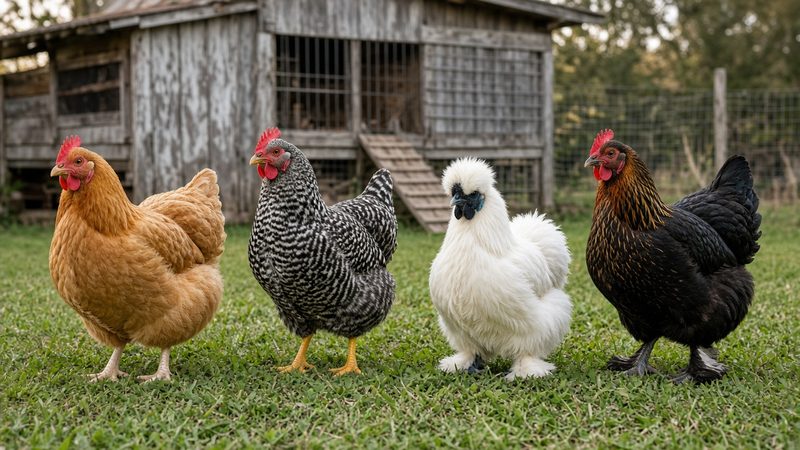
Compare chicken breeds
| Breed | Size class | Sq ft each | Egg output — window and source matter | Egg color | Broodiness |
|---|---|---|---|---|---|
| Silkie | Bantam | 2 | 100 to 120 | Cream, small | Very broody |
| Orpington | Large | 5 | 150 to 280 | Light brown | Setter |
| Barred Rock | Standard | 4 | about 200 | Brown | At times |
| Marans | Standard | 4 | 180 to 200 | Dark brown | By line |
| Easter Egger | Standard | 4 | 200 to 280 | Blue, green, pink | Low |
| Olive Egger | Standard | 4 | 180 to 220 | Olive green | Rarely |
| Polish | Standard | 4 | 150 to 200 | White | Non-setter |
| Bantam breeds | Bantam | 2 | varies by breed | varies | varies |
| Ameraucana | Standard; bantam line also exists | 4 (standard) | 180–200 (Cackle); about 250 in the Townline line | Blue; some light green | Non-setter |
| Ayam Cemani | Light breed; standard calculator band | 4 | 80–120 (Cackle); other profiles give different ranges | White-tinted to cream (American standard); other standards differ | Occasional; South African standard lists non-sitters |
| Brahma | Large | 5 | 150–200 (hatchery estimate) | Brown | Setter |
| Cream Legbar | Light / large fowl; standard calculator band | 4 | 180–200, depending on strain | Blue or green; some sources/strains also list olive | Rarely; Cackle marks occasional |
| Frizzle | Feather type / variety; large and bantam forms | 4 standard; 2 bantam | Use the host breed; not one annual rate for all frizzles | Use the host-breed page; do not assume one color | Depends on host breed: Silkie very broody; Polish non-setter |
| Leghorn | Standard light breed; bantam line exists | 4 | Cackle about 220–300; Townline 280–320 | White | Non-setter |
| Rhode Island Red | Standard; bantam line exists | 4 | 200–280 on hatchery cards; old-type sources use a different range | Brown to light brown | Occasional; laying strains sit less |
| Wyandotte | Standard; bantam line exists | 4 | 180–260; about 200 on one card | Light brown to brown | Setter; sometimes broods |
| Cochin | Large; bantam line exists | 5 (large) | 150–200 if not sitting; other large-breed cards give 110–160 | Brown | Strong setter |
| ISA Brown | Commercial layer cross; standard backyard calculator band | 4 | 470 eggs per hen housed, weeks 18–100 (North American guide); not an annual figure | Brown | Not listed in the cited performance tables |
Use the space column as the site’s backyard planning rule, not a claim that every bird has the same needs: 2 sq ft indoors for the bantam band, 4 for standard birds and 5 for large birds. Where a page covers both large fowl and bantams, choose the matching form before multiplying by your flock size.
Floor area, run area and roost length are separate checks. A mixed flock needs each size group counted separately; a single breed label is not enough to size the whole coop. Read the individual breed card for the form and source behind a row before you buy chicks.
Compare like windows next. An annual hatchery estimate is not the same measure as eggs per hen housed over a commercial laying cycle. The ISA Brown row keeps its weeks 18–100 window visible rather than turning 470 into a yearly promise. Source and strain differences remain visible where the breed pages disagree.
Egg color is the fun part. Easter Eggers lay blue, green or pink eggs, Olive Eggers lay olive green, and Marans lay the darkest brown. Each hen lays one color all her life, so a mixed flock fills a carton with every shade.
Egg size tracks body size in most breeds. Large hens such as Orpingtons and Barred Rocks lay large brown eggs. Silkies lay small cream eggs that weigh about 1.5 oz each, by the Townline figure. Plan for two small eggs where a recipe calls for one large egg.
Broodiness matters if you want chicks, or do not. Silkies and Orpingtons go broody often and make good mothers, while Easter Eggers and Olive Eggers rarely sit. Pick a broody breed to hatch eggs without an incubator.
Climate narrows the list last, and most breeds here are cold hardy. Silkies do not suit hot climates, by Townline Hatchery. Easter Eggers and Olive Eggers handle both heat and cold.
A mixed flock is the usual answer for a family. Pick two or three chicken varieties that share a size class and a calm temper. Barred Rocks, Orpingtons and Easter Eggers live well together in one standard coop. Keep bantams with bantams where you can, so the small birds eat in peace.
Temper matters as much as eggs in a small yard. Orpingtons are gentle and can be pushed around by bossier birds, as Oklahoma State notes. Put them with calm breeds of the same size, and give the flock two feeders so no hen goes hungry.
Every breed page
Breed cards
- Silkie chickensBreed
- Easter egger chickenBreed
- Olive egger chickenBreed
- Barred rock chickenBreed
- Bantam chickensBreed
- Orpington chickenBreed
- Marans chickenBreed
- Polish chickenBreed
- Ameraucana chickensBreed
- Ayam Cemani chickensBreed
- Brahma chickensBreed
- Cream Legbar chickensBreed
- Frizzle chickensBreed
- Leghorn chickensBreed
- Rhode Island Red chickensBreed
- Wyandotte chickensBreed
- Cochin chickensBreed
- ISA Brown chickensBreed
- Crested chicken breedsCompare
- Meat chicken breedsCompare
- Black chicken breedsCompare
Eggs
- Chicken lifespanSpec card
- Best egg laying chickensSpec card
- How many eggs does a chicken lay a daySpec card
- Egg color chartSpec card
The comparison table and directory cover the same 18 named breed, hybrid and variety entries. The directory also keeps the existing comparison guides and egg-reference pages below them. Open the individual page for its source-specific figures; the summary is a route into those pages, not a new breed standard.
Pick by goal
| You want | Start here | Why |
|---|---|---|
| More eggs | Egg laying chickens | Yearly counts, side by side |
| Colored eggs | Easter Egger, Olive Egger, Marans | Blue, green or dark brown, sorted by the shell colors by breed |
| White eggs | Polish | White shells, and 4 sq ft of floor each |
| A small yard | Bantams, Silkie | 2 sq ft of floor each |
| A hen that sits | Silkie, Orpington | Both are setters |
| A rooster in the flock | Rooster breeds | Cock weight, comb and floor by size class |
Start with three hens of one or two calm breeds. Run the count through the coop size calculator before you order chicks. Three standard hens need 12 sq ft of floor. Three bantams need 6. You can mix egg colors after the floor is set, because chicken breeds in one size class take the same floor space.
Gear
Count the hens, then measure the floor. Three standard hens need 12 sq ft at 4 sq ft each. The RUNSHED listing says 4 to 6 chickens and is 80 in long. It does not list house floor in sq ft, so measure that before you trust the label. Use the coop size calculator for any mix of sizes.
Chicks of every breed start in a brooder. Our brooder page covers heat, space and the first weeks, the same for every breed on this list.
Sources
- Penn State Extension, Small Scale Poultry Housing (updated 2026): extension.psu.edu (bantams about half the floor space of large chickens)
- Townline Hatchery, White Silkie Bantam breed facts: townlinehatchery.com (Silkie 100 to 120 eggs; not suited to hot climates; very broody)
- Cackle Hatchery, Buff Orpington breed facts: cacklehatchery.com (Orpington 150 to 280 eggs; setter)
- Oklahoma State University, Breeds of Livestock: Orpington Chickens (APA standard weights): breeds.okstate.edu (Orpington hen 8 lb; cold endurance)
- The Livestock Conservancy, Plymouth Rock chicken breed facts: livestockconservancy.org (Plymouth Rock around 200 eggs; hen 7.5 lb)
- Cackle Hatchery, French Black Copper Marans breed facts: cacklehatchery.com (Marans eggs and weight)
- Oklahoma State University, Breeds of Livestock: Marans Chickens: breeds.okstate.edu (Marans winter hardy)
- Cackle Hatchery, Easter Egger breed facts: cacklehatchery.com (Easter Egger eggs and colors)
- Tractor Supply, Easter Egger Chicken Guide (PDF): tractorsupply.com (Easter Egger cold and heat hardy)
- Cackle Hatchery, Olive Egger breed facts: cacklehatchery.com (Olive Egger eggs and weight)
- Townline Hatchery, Olive Egger breed facts: townlinehatchery.com (Olive Egger hardiness)
- RUNSHED 80 in coop with run, label says 4 to 6 chickens: maker listing on Amazon, ASIN B0H2DW68D8, title read 2026-10-23 (house floor in sq ft not listed)
How we pick and check numbers: How we research.