Grit and Oyster Shell for Chickens: What Each One Does and How to Serve It
Coopgauge is reader-supported. When you buy through links on this page, we may earn a commission.
Grit and oyster shell for chickens do two separate jobs, and the first question is what the bag is made of. A laying hen needs both. University of Maine puts granite grit out free choice, or for 2 or 3 days a month, and oyster shell in its own dish. Layer feed carries 2.5 to 3.5% calcium, and a 6 lb hen eats about 3 lb of feed a week. Pullets need neither yet.
- Material
- hard, insoluble granite
- Sizes
- chick size and hen size
- Start
- pullet-size granite grit from 6 weeks
- How often
- free choice, or 2 or 3 days a month
- Job
- grinding, in the gizzard
- Amount
- about 1 lb per 100 birds a month
Material, sizes, frequency and amount: University of Maine Bulletin #2222. Start at 6 weeks: University of Maine Bulletin #2222, grain feeding. Amount: the meat bird rate.
- Material
- oystershell, calcite or limestone
- Form
- flaked or crushed
- Who
- laying hens
- How
- free choice, in its own dish
- Feed calcium
- 2.5 to 3.5% on the label
- Extra calcium
- can be added whatever the feed holds
Material, free choice and calcium: University of Maine Bulletin #2222. Crushed shell: University of Minnesota Extension.
Do chickens need both?
Complete feed carries most of what a bird needs. Age decides the rest. That is why one side dish serves the whole flock while the other serves the layers only.
University of Maine says you can supply an extra source of calcium regardless of the amount in the feed, so the dish is a second source and not the base.
The ration carries its own calcium. The dish sits on top of that.
For a layer, the tag says 2.5 to 3.5% calcium. The dish adds to that.
The same bulletin is plain. About the other half of the flock. Complete feeds for raising replacement pullets have adequate calcium.
Extra calcium should not be supplied to pullets. A shell dish belongs to the layers only.
Chicks from 0 to 6 weeks need neither side dish. A pullet gets pullet-size granite grit at 6 weeks. A layer gets both.
| Bird | Grit | Oyster shell | Why |
|---|---|---|---|
| Chick, 0 to 6 weeks | none | none | Complete starter feed. Nothing to add yet. |
| Pullet, 6 weeks to first egg | pullet-size granite grit, free choice | none | Pullet feeds carry enough calcium. |
| Layer, from the first egg | granite grit, 2 or 3 days a month | oyster shell, free choice | Both side dishes start at the first egg. |
| Mixed ages | granite grit for all of them | shell dish for the layers only | The pullets in the flock skip the shell dish. |
Read the pullet row twice. It says pullet-size granite grit from 6 weeks. No shell yet. Our chick starter feed guide has the week-by-week feed switch that goes with it.
The mixed row is the one to plan for. The hens take what they need from the dish, and the pullets in the same flock skip it.
Our guidance: you set the shell dish apart from the grit dish, and fill it with a little at a time.
Top it up when the dish looks low, and keep the pullets on the grit side. University of Maine says extra calcium should not be supplied to them.
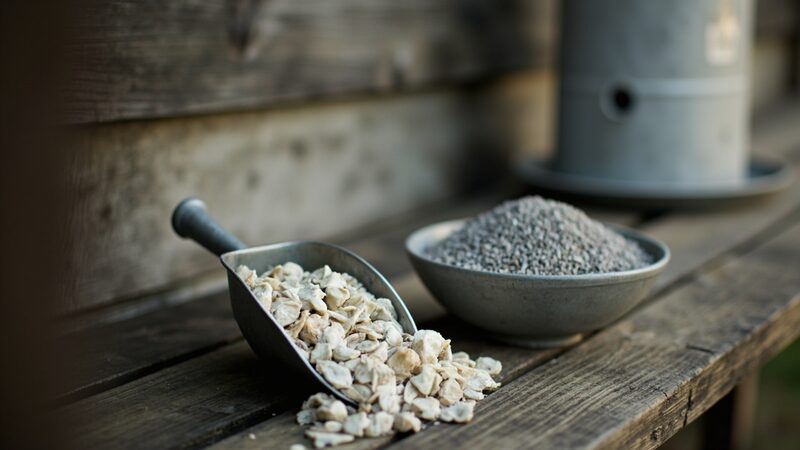
Grit or shell: what each one does
Two materials, two jobs. Granite is insoluble. Shell dissolves. That one difference decides where a bag goes.
University of Maine is direct about calcium grit. The gizzard is acidic, so a calcium grit dissolves quickly and never does the grinding. A bag labelled grit that lists crushed limestone is a calcium source, not grit.
| Item | Material | What it does | Where it ends up | Who eats it | How it is offered | What it is not |
|---|---|---|---|---|---|---|
| Granite grit | hard, insoluble granite | grinds coarse feed | stays in the gizzard | any bird on grain and scratch | free choice, or 2 or 3 days a month | a calcium source |
| Oyster shell | oystershell, calcite or limestone | adds calcium | dissolves in the gizzard | laying hens | free choice, in its own dish | a grinding grit |
So the two cannot trade places. Shell is not grinding material. Limestone grit is not a calcium dish. Minnesota Extension lists crushed oyster shell and grit for layer birds. Those jobs stay apart.
The grit side runs 2 or 3 days a month, and the shell side runs every day.
Our what to feed chickens page covers the rest of the diet, from layer feed to scratch.
Grit sizes by age
University of Maine lists grit in 2 sizes, chick and hen. Pullets move up at 6 weeks, and the pullet-size bag starts then. Hen size takes over at the first egg, around 6 months after the chick hatches. You match the size to the bird, not to the bag.
| Size | Which bird | When | Source |
|---|---|---|---|
| Chick size | chicks | only for chicks that get grain | University of Maine: grit comes in chick and hen sizes |
| Pullet size | pullets | from 6 weeks | University of Maine: pullet-size granite grit from 6 weeks |
| Hen size | laying hens | from the first egg | University of Maine: grit comes in chick and hen sizes |
The stage bar is the order of operations. No grit before 6 weeks, pullet-size grit after that, hen size and the shell dish at the first egg.
Seasons do not change these numbers. The feed switch does. Our chick starter feed guide has the feed ages that line up with it.
How much and how often
University of Maine says grit does not have to be fed every day. Free choice works, and so does offering it for 2 or 3 days a month. Shell is the other way round: free choice, and it stays there.
Our assumptions for the table: grit use of 1 lb per 100 birds a month, the rate University of Maine prints for meat birds. A month counts as 30 days. The ounces are our math.
The rate works out small. Less than most keepers expect. Six hens use 0.06 lb a month, which is about 1 oz, and about 27 g by our conversion.
So the grit dish takes a spoonful. You tip it in. No scoop, no measuring.
That is 0.01 lb per bird a month, about 4.5 g a month by our conversion. 4 hens use 0.04 lb, and 8 hens use 0.08 lb.
Ten hens use 0.1 lb. That is 1.6 oz. The gap between a flock of four and a flock of ten is about an ounce a month.
University of Maine puts the grit out for 2 or 3 days a month, so a calendar works. Our framing: the 1st and the 15th, a day each time.
Free choice works as well, and it suits you if the whole flock shares one run.
Shell has no published rate. University of Maine prints a grit rate, and no per-bird rate for oyster shell.
So the dish itself is your measure. When you can see the bottom, it is time to refill.
That is why the shell column has no numbers, and why the box below is a pouch size, not a monthly allowance.
| Hens | Grit per month | In ounces | Oyster shell | What you put out |
|---|---|---|---|---|
| 4 | 0.04 lb | 0.6 oz | no published rate | a spoonful of grit, 2 or 3 days a month |
| 6 | 0.06 lb | 1 oz | no published rate | one shell dish, refilled as it empties |
| 8 | 0.08 lb | 1.3 oz | no published rate | the same, for 8 birds |
| 10 | 0.1 lb | 1.6 oz | no published rate | the same, for 10 birds |
The table covers 4, 6, 8 and 10 hens. Any flock size works, because the rate is per bird. Grit is a spoonful. Shell is a standing dish.
The pouch above holds 4 lb of flaked oyster shell. Serve it free choice in a dish of its own, and refill it when the bottom shows.
Grit is the other way round: a spoonful now and then, not a bag you order every month.
The 4 lb pouch of flaked oyster shell is the standing refill for the flock, and it is the one item you want on hand.
Serving it: two dishes, one hopper
You get the order right before you pick the gear. Shell first, grit second, then the feeder you already own.
Two compartments is not fussiness. The two materials behave differently in the gizzard. One dissolves. One stays and grinds.
Mixed in one pile, the birds cannot tell the two apart, and the shell ends up in the grit side.
Grit goes in the second compartment. Shell goes in the first. The table says 0.01 lb per bird a month on the grit side. The shell side has no number at all.
- Give the shell its own dish. Set it beside the feeder.
- Keep shell out of the layer pellets.
- Fill the second compartment with granite grit, if the hopper has two.
- Offer grit for 2 or 3 days a month, or leave it free choice.
- Check both dishes. Every time you top up the feed.
University of Maine describes a grit and oyster shell hopper for a laying flock, split into 2 compartments. One hopper, two materials, no mixing.
The gizzard decides the rest. Shell dissolves there. Granite stays and does the grinding. That is why the two dishes stay apart, and why a limestone bag does not belong in the grit side.
Our chicken feeders page sorts the containers by flock size and by how many days a fill lasts, if you are buying the feeder as well.
Read the label
Only "grit" on the bag leaves you with questions. Ask them in this order. Before you fill a dish.
Material first. University of Maine says hard, insoluble granite grit should be fed. That is the whole test.
Crushed limestone dissolves in the gizzard, so a bag that lists limestone is a calcium source in a grit bag.
Read the ingredient line yourself. Not the word on the front.
Particle size second. Chick size, pullet size and hen size are different products. A laying hen needs hen size. A pullet from 6 weeks is on pullet size.
Grit comes in chick and hen size. That is the word that changes from one bag to the next.
Pouch size last. One lb per 100 birds a month is about 1 oz for 6 hens. Buy the smallest pouch. One that fills the dish you use.
A 4 lb pouch is 64 oz by our conversion. Divide that by the rate in the table to see how long a bag lasts.
The pouch on this page is the shell, and it is what you refill. The grit rate is 1 lb per 100 birds a month, so 6 hens use 0.06 lb.
On the shell side, flaked or crushed both work. Free choice, in its own dish.
Our read of the two forms is simple. Flaked is thin, flat pieces. Crushed is rougher, broken grain.
University of Minnesota lists crushed oyster shell for layer birds. Both go in a dish of their own.
Common Questions
Do chickens need grit and oyster shell?
Both, for a laying hen. University of Maine puts granite grit out free choice, or for 2 or 3 days a month, and oyster shell in its own dish every day. Layer feed carries 2.5 to 3.5% calcium, and you can add a shell source on top of that. Pullets need neither side dish. You start both at the first egg.
Can oyster shell replace grit?
No. They are different materials with different jobs. Shell is calcium and dissolves in the gizzard. Granite is insoluble, so it stays there and grinds feed. A bag of crushed limestone sold as grit is calcium too. Keep the two dishes apart and label them.
Can I put grit and shell in the same feeder?
One hopper can hold both, in 2 separate compartments. University of Maine describes a grit and oyster shell hopper for a laying flock, divided in two. Two dishes on the floor do the same job. Mixing both in one pile does not, because the shell ends up in with the grit.
When do chicks get grit, and what size?
At 6 weeks, and not before on complete starter feed. University of Maine says to give pullet-size granite grit from 6 weeks. Chicks on a complete starter do not need grit at all. After the first egg, you move to hen size and set out the shell dish.
How much grit does a flock eat in a month?
About 1 oz for 6 hens. University of Maine prints 1 lb per 100 birds per month, so six hens use 0.06 lb. Ten hens use 0.1 lb, or 1.6 oz. That is a spoonful in the dish, not a bag you order every month. Shell has no published rate, so refill the dish when you see the bottom.
Read next
Sources
- University of Maine Cooperative Extension, Bulletin #2222 Nutrition for Backyard Chicken Flocks in Maine: extension.umaine.edu (oystershell, calcite or limestone, free choice; a second calcium source whatever the feed holds; layer feed 2.5 to 3.5% calcium; complete pullet feeds carry enough calcium; hard, insoluble granite grit; calcium grit dissolves in the gizzard; grit in chick and hen sizes; pullet-size granite grit from 6 weeks; grit 2 or 3 days a month; a grit and oyster shell hopper for a laying flock, in two compartments; 1 lb of grit per 100 birds a month, the meat bird rate)
- University of Minnesota Extension, Raising chickens for eggs (reviewed 2025): extension.umn.edu (a 6 lb hen eats about 3 lb of feed a week; crushed oyster shell and grit for layer birds; hens begin laying at around six months of age)
- Pouch size and form: maker listing on Amazon, ASIN B00UIM7N0A, read 2026-11-10
- Monthly grit amounts by flock size: our math, from the 1 lb per 100 birds rate
How we pick and check numbers: How we research.