How to Hatch Chicken Eggs: Incubator Settings for Days 1 to 21
Coopgauge is reader-supported. When you buy through links on this page, we may earn a commission.
Chicken eggs take 21 days at 99.5–100°F. Keep humidity at 55–60% until day 18, then 65–70%. Turn the eggs at least 5 times a day. On day 18, stop turning and leave the lid shut. Texas A&M AgriLife Extension sets those numbers. Batch size changes nothing: 12 eggs and 60 eggs run the same way. You only change the number of incubators.
- Days
- 21
- Temp, days 1–17
- 99.5–100°F, within ±0.5°F
- Temp, day 18 on
- down 1°F to 98.5°F
- Humidity, days 1–17
- 55–60% RH
- Humidity, day 18 on
- 65–70% RH
- Turning
- 5 times a day, hourly is better
- Lockdown
- day 18: no turning, no opening
- Eggs
- small end down, large end up
Settings and day counts: Texas A&M AgriLife Extension POSC-PU-018 (2022).
The schedule is short. Every day has two jobs: you read the gauges, and you keep the machine steady. The rest of this page is the detail of those two jobs.
Setup
The room decides how much work you give the machine. Texas A&M asks for constant temperature, no drafts and no direct sunlight. Get that right, and the numbers on the dial hold steady on their own.
- Choose the room first. You want constant temperature, no drafts, no direct sunlight.
- Run the incubator empty for a few days. Temperature and humidity should settle before any egg goes in.
- Warm the eggs 4 to 8 hours to room temperature. Cold eggs in a warm cabinet make condensation on the shell.
- Set each egg small end down, large end up. The air cell sits at the wide end.
- Put the thermometer and hygrometer at egg level. A reading from the shelf beside the machine is not the incubation temperature.
- Start a log sheet on the same day. You write the date, two readings, humidity, turns and notes.
| Item | What it must do | Source |
|---|---|---|
| Incubator | Fan, humidity display, auto turn | Listing |
| Thermometer | Probe at egg level | Texas A&M |
| Hygrometer | Reads 55–60% at egg level | Texas A&M |
| Water and refill | Refill without opening the lid | Listing |
| Egg tray | Small end down, large end up | Texas A&M |
| Log sheet | Date, two readings, humidity, turns | Texas A&M, Appendix A |
| Towel, paper towels | Ready for hatch day | Texas A&M |
The maker's manual has the fill line and the refill port for your model. Read it before you fill anything. The checklist says what the machine has to do. The manual says how.
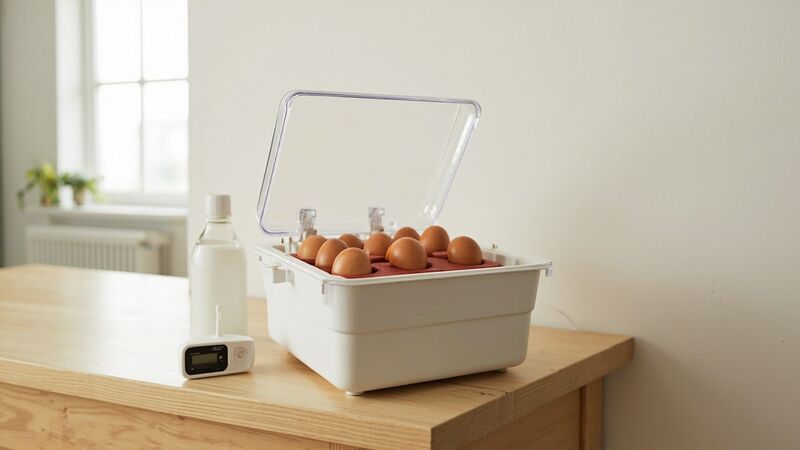
Two features carry most of the work. A humidity display tells you when to add water, and an automatic turner keeps the five-turns-a-day count on schedule. The unit in the box below lists 20 eggs, a humidity display, turning every 60 minutes, and an automatic stop 3 days before the hatch. That stop lands on day 18, the day the schedule changes anyway.
Count the batch before you count the machines. The 20-egg unit in the box takes one batch of 20 eggs, so a 40-egg batch means two machines on the same schedule.
Day-by-day
Twenty-one days divide into three blocks. The settings hold for 17 days, then day 18 changes three things at once. The table below is the whole schedule.
| Days | Temperature | Humidity | Turning | Opening the lid | Log this |
|---|---|---|---|---|---|
| 1 to 7 | 99.5–100°F | 55–60% | 5 a day, hourly is better | For checks and water | Two temperatures, humidity, turns |
| 8 to 17 | 99.5–100°F | 55–60% | 5 a day, weekends too | For checks and water | Same, plus candling on day 8 to 12 |
| 18 to 21 | 98.5°F | 65–70% | None | None | Humidity, ventilation, first pip |
Days 1 to 7 are the quiet stretch. Nothing changes. Set up the log sheet on day 1. After that, you fill in the same row twice a day.
Two readings a day keep the settings honest. Texas A&M says to check the temperature at least twice a day. Both numbers belong in the log sheet. Morning and evening checks show the swing a warm afternoon causes.
Turning is the step people drop first. Eggs must be turned at least 5 times every 24 hours. Once an hour is better. Turning has to keep going over the weekend, which is where a manual routine falls apart. An automatic turner removes that job completely.
Between day 8 and day 12, a candling lamp lets you see inside an egg. Texas A&M puts that window at 8 to 12 days of incubation. What to look for in that window is on the candling eggs page. Keep the check short, under 10 minutes, and put the egg back straight away.
Day 18 changes three settings at once. The machine stays shut after that. Stop turning the eggs. Raise humidity to 65–70%. Drop the temperature 1°F, which puts it at 98.5°F.
Put a cloth or rough paper under the eggs. The new chicks need something to stand on. Keep that paper clear of the water and off the heating element. Texas A&M also asks for more ventilation in the last third of incubation.
Pipping starts within a day of the 21-day mark. The hatch itself runs 10 to 20 hours. Leave the new chicks in the incubator about 24 hours, or until their feathers are dry. Then they move to a brooder. Our brooder setup guide covers that next week.
A page of log sheet beats memory. Write the date, both temperatures, the humidity and the turn count every day for 21 days. When a number moves, the sheet tells you which day it moved on.
Calibrate your thermometer and hygrometer
A thermometer that reads 2°F high gives away 2°F of incubation temperature, every hour, for 21 days. Check it before the eggs go in, not after. The fix takes five minutes and a glass of ice.
- Fill a glass with crushed ice and clean water, then stir it.
- Put the probe at least 2 in into the ice water. Keep it off the glass.
- Wait at least 30 seconds and read the display.
- Compare that reading with 32°F, the ice-water point in the USDA check.
- Note the difference and subtract it from every incubator reading.
A reading of 34°F means your thermometer runs 2°F high. Subtract 2°F from every number you take in the incubator. A reading of 31°F means it runs 1°F low, and you add 1°F instead.
The hygrometer belongs beside the probe, at egg level inside the cabinet. A number from the room tells you about the room. Texas A&M asks for humidity between 55% and 60% through the set stage, so the reading you check is the one inside the machine.
Leave the settings alone for the first few hours after the eggs go in. Texas A&M says to wait 4 hours before making adjustments, unless the temperature runs above 102°F. After that, small corrections are fine.
Check the thermometer again if a reading looks odd. A probe resting against a warm wall reads warmer than the air around the eggs. Move it a few inches.
| Date | Day | Temp AM | Temp PM | Humidity | Turned | Notes |
|---|---|---|---|---|---|---|
| ____ | 1 | Eggs set | ||||
| ____ | 8 | Candling window | ||||
| ____ | 18 | Stop turning |
Equipment troubleshooting
Every reading problem has a machine-side cause you can check without opening the cabinet. Start with the machine. Work from the number on the dial. Do not guess.
| Reading | What to check | What to change |
|---|---|---|
| Above 100°F | Room warmed up, probe near a fan | Move the probe, steady the room |
| Below 99°F | Draft at the lid, cold room, open door | Close the gap, let the room settle |
| Humidity stays low | Pan empty, port shut, probe in the water | Fill through the port, lift the probe |
| Reading jumps after a check | Air moved when the lid opened | Close it, wait, read again |
| Power cut | Outlet and breaker | Second circuit, spare lamp |
| Water level drops fast | Small pan, warm room | Top up through the port |
Humidity is the setting people chase, and it is usually a water problem rather than a control problem. Check the pan level and the refill port first, then look at where you put the probe. A probe lying in the water reads a different humidity than the air above the eggs.
By batch size and room
The settings never move. The number of machines does. A batch goes in on one day and comes out on one day. You cannot mix two batches in one machine, even when the tray has room.
| Eggs in the batch | Incubators | Tray capacity used |
|---|---|---|
| 12 | 1 | 12-egg unit |
| 18 | 1 | 18-egg unit |
| 20 | 1 | 20-egg unit |
| 22 | 1 | 22-egg unit |
| 30 | 1 | 30-egg unit |
| 40 | 2 | two 20-egg units |
| 60 | 2 | two 30-egg units |
The label counts the tray, not the birds it will hold. One listing takes up to 22 chicken eggs, and the same machine takes 12 to 18 duck eggs. Another lists 18 eggs for standard sizes and 40 for quail. Fill a tray with the number it lists and stop there.
Two units for 40 eggs means two machines running side by side. Not one tray with room to spare. Both machines take the same schedule, and both need their own log sheet. Keep them in one room so the readings match.
Rooms change the readings more than people expect. Check the room first. Texas A&M asks for a room with constant temperature, no drafts and no direct sunlight. The table turns that rule into what to do in four common rooms.
| Room | What the room does | What to change |
|---|---|---|
| Dry inland winter | Dry air, so humidity climbs on its own | Read the hygrometer twice a day |
| Humid coastal summer | Damp air slows the climb | Keep the machine in a closed room |
| Room with forced heat | Warm air pushes the temperature up | Keep the unit off the floor and off the radiator |
| Garage or basement | Swings with the weather, damp air holds moisture | Closed inner room, log the room temperature |
Two machines need shelf space, two sockets and room to read both dials. Measure the space first. Then order. Keep enough room to open each lid.
Two habits carry the rest of the run. Keep the room steady, and write down what the gauges say. A drifting number in a steady room is a machine problem, and the troubleshooting table above starts from the reading.
Common Questions
What temperature should a chicken egg incubator be at?
99.5 to 100°F, and no more than 0.5°F off 99.5°F. Texas A&M AgriLife Extension gives that range for chicken eggs and asks for twice-daily checks. Forced-air incubators hold a steady temperature better than still-air models.
What humidity does an egg incubator need?
55 to 60% relative humidity from day 1 to day 17, then 65 to 70% from day 18 until the hatch. Texas A&M lists 58% for chicken eggs and 66 to 75% for the hatcher. Read the hygrometer at egg level, twice a day.
When do I stop turning the eggs?
On day 18 of a 21-day cycle. Texas A&M says not to turn for the final 3 days, and to keep the lid shut in that stretch. Raise humidity to 65 to 70%, drop the temperature 1°F, and lay a cloth under the eggs.
When should I candle the eggs?
Between day 8 and day 12 of incubation. Texas A&M says development can be confirmed after 8 to 12 days, and a small flashlight or a candling lamp does the job. Keep each check under 10 minutes, and put the egg back.
What do I do after the chicks hatch?
Leave them in the incubator about 24 hours, or until their feathers are dry. Then they move to a brooder, where the temperature starts at 95°F and drops 5°F a week. Our brooder setup guide has the schedule.
Read next
Sources
- Texas A&M AgriLife Extension, POSC-PU-018 Incubating and Hatching Eggs (2022): cdn-de.agrilife.org (21 days; 99.5–100°F within ±0.5°F; 55–60% RH, then 65–70%; 98.5°F and 66–75% RH in the hatcher; 5 turns a day, none for the final 3 days; cloth under the eggs; 4 hours before adjusting; eggs warm 4 to 8 hours; small end down; candling after 8 to 12 days; hatching takes 10 to 20 hours; chicks stay about 24 hours)
- USDA Food Safety and Inspection Service, Food Thermometers (ice-water check): fsis.usda.gov (ice water reads 32°F; probe 2 in deep; wait 30 seconds)
- Egg capacity, humidity display, turning interval and refill port: maker listings on Amazon, ASIN B0DLWDCHJD (20 eggs, 60-minute turning, stops 3 days before hatch), B0GH5GBPSK (12 eggs), B0G5WZXQYJ (18 eggs), B0793HHZ1L (22 chicken eggs, 12 to 18 duck eggs), B09Y84KPNC (30 eggs), read 2026-11-02
How we pick and check numbers: How we research.