Candling Eggs: What to Look For on Days 8 to 12
Coopgauge is reader-supported. When you buy through links on this page, we may earn a commission.
Twenty-four eggs in the incubator, one flashlight, no idea when to look. The rule: candle on day 8 to 12, keep a session under 10 minutes, and use a focused flashlight or candling lamp in a dark room. Earlier checks work too, and Illinois Extension reads white shells from day 3 and brown shells from day 5 or 6. Texas A&M AgriLife Extension sets the day 8 to 12 window and the 10-minute cap.
- When to look
- day 8 to 12
- Light
- focused flashlight or candling lamp
- Session cap
- under 10 minutes
- Egg position
- large end against the light
- Shell
- white reads easiest, brown hardest
- Marking
- day and egg number in pencil on the shell
- Room
- dark room or a covered box
Day 8 to 12, the 10-minute cap, the flashlight or candler, the large end and the white-or-brown rule: Texas A&M AgriLife Extension POSC-PU-018 (2022). Darkened room, egg position and the day 3 and day 5 reading: University of Illinois Extension, Candling Eggs. Pencil marking is our own practice.
Setup
Start with the room and the tray, not the light. You need somewhere dark, and a way to hold the eggs still while you look at each one.
The rest is a timer. If your tray comes out of the incubator on schedule, the session ends on schedule.
| Item | What it must do | Source |
|---|---|---|
| Focused flashlight | A narrow beam you can aim at one egg | Texas A&M |
| Candling lamp | One egg at the opening, no aiming | Texas A&M; Illinois Extension |
| Egg tray or cut carton | Holds the eggs large end up | Texas A&M |
| Box lid or towel | Keeps room light off the tray | Our practice |
| Pencil | Writes the day and egg number on the shell | Our practice |
| Log sheet | Date, day and what you saw | Texas A&M, Appendix A |
A shallow carton with the sides cut down gives you a steadier place to stand the eggs, large end up, so one hand stays free for the light.
- Make the room dark, or put your tray under a box lid. Illinois Extension calls for a darkened room, and a covered box does the same job.
- Set the lamp on a box or table so the light sits about 38 to 44 in off the floor. That keeps the beam out of your eyes.
- Take the whole tray out of the incubator and set it on the table. You keep the eggs large end up, the way Texas A&M sets them.
- Hold one egg with the large end against the light opening, slanted. Turn it quickly so the contents move, the way Illinois Extension describes.
- Give each egg 5 to 10 seconds, then set it down large end up. Five to ten seconds is our planning number, not a maker's figure.
- Keep the whole session under 10 minutes. Texas A&M caps a candling session at 10 minutes.
- Write the day and the egg number on the shell in pencil, then note the date on the log sheet.
Put the eggs back the way they came out. Texas A&M sets eggs small end down and large end up, and the same order tells you later which way is up when you pick an egg up in the dark.
The lamp in the box makes 250 lumens and runs on batteries, so no cord crosses the tray. The 250-lumen candling lamp holds the egg against the opening, which is the position Illinois Extension describes. Check the lumen figure on the listing before you buy.
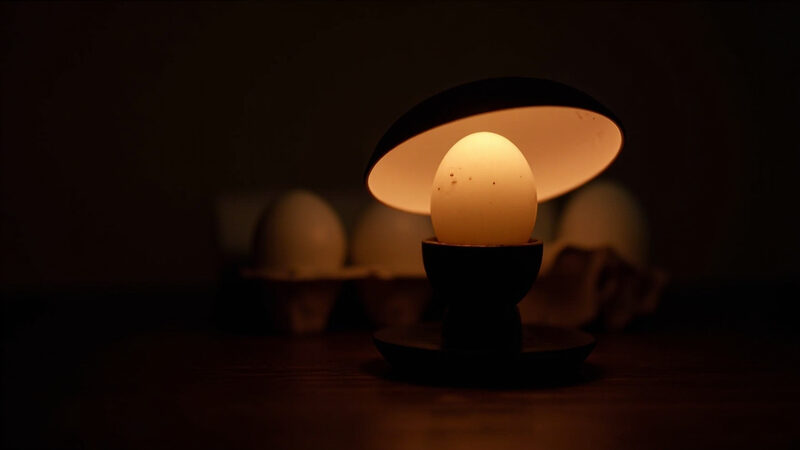
What you see by day
The light shows three shapes at every age: blood vessels, the embryo, and the air cell at the large end. What changes is how much of the egg each one takes up.
The table below reads one 21-day cycle at six ages, and every row names its source.
| Day | What the light shows | Air cell | Source |
|---|---|---|---|
| 3 to 4 | A small red area with blood vessels running away from it. White shells show it from day 3, brown shells from day 5 or 6. Legs and wings begin on day 3, and the tongue on day 4. | At the large end, still small | Illinois Extension; Mississippi State P1150 |
| 7 to 8 | A dark spot in the large end, ringed by blood vessels that now look firm and distinct. Feathers begin on day 8. | Larger than at the start | Texas A&M; Mississippi State P1150 |
| 9 to 12 | The dark spot in the large end grows as the days pass. The beak starts to harden on day 10. | Larger still | Texas A&M; Mississippi State P1150 |
| 14 to 16 | More of the egg is filled with the embryo. On day 14 it moves into position to break the shell, and by day 16 the scales, claws and beak are firm. | Keeps growing | Mississippi State P1150; Texas A&M |
| 17 to 18 | The beak turns toward the air cell on day 17. Later in the cycle the light shows a dark mass and the air cell. | Keeps growing | Mississippi State P1150; Texas A&M |
| 19 to 21 | The yolk sac is drawn into the body cavity. By day 20 the embryo fills nearly everything except the air cell. | The open space left in the egg | Mississippi State P1150; Texas A&M |
The shell and the air cell change the read. A white shell lets more light through, so the vessels stand out. A brown shell hides them, which is why Illinois Extension starts brown eggs on day 5 or 6.
The air cell grows through the cycle, so a day 16 egg does not look like a day 8 egg. The rest of the 21-day schedule is on our incubation guide.
Read the same egg twice. Illinois Extension says to candle every few days to watch the growth and development, and a second look at the same egg is easier to compare than a first look at a different one.
Our assumptions
Before we count anything, four assumptions hold. The light comes through the large end, where the air cell sits.
One egg takes 5 to 10 seconds to read, and that is our planning number rather than a maker's figure.
One session covers up to 48 eggs, which is 8 minutes at the slow end of our range. A 60-egg tray is two sessions. The shell carries a pencil mark with the day and the egg number, which is our own practice.
The 10-minute cap comes from the cooling the eggs take while the tray is out. Read it as a limit, not a target: when the timer goes, the session is over and the eggs go back in.
| Light source | Stated output | Stated reach | Shell note | Time per egg | Listing |
|---|---|---|---|---|---|
| LED flashlight | 1,200 lumens | up to 1,000 ft | A white shell shows the vessels; a brown shell needs more of the beam | 5 to 10 s | B07FNRNC2B |
| LED candling lamp | 250 lumens | not printed; the egg sits at the opening | One egg at a time, so the beam stays on target | 5 to 10 s | B0787TKGL1 |
| Incandescent bulb | 60 W, 560 lumens | not printed | Warm white light; the shell rule does not change | 5 to 10 s | B00NE4XK3S |
| Phone flashlight | not printed | not printed | No listing, so no output figure; the shell rule does not change | 5 to 10 s | n/a |
Every row has the same job: show the vessels and the dark spot through the shell. The reach figure on the flashlight listing is a beam distance for open ground, not a reading distance for an egg.
A phone light has no listing, so the table prints no figure for it. The 10-minute cap and the 5 to 10 seconds per egg still apply, whichever light you use.
Shell, light and room
The shell decides how hard the read is. The room decides whether you can read it at all. Texas A&M and Illinois Extension agree on the first point: white or pale shells are the easy ones.
Give your eyes a minute before the first egg. A dark room needs a moment to adjust.
| Factor | What it changes | What to do |
|---|---|---|
| White shell | Vessels and the dark spot come through clearly | Read the large end first, where the air cell sits |
| Brown shell | The same shapes, dimmer and harder to separate | Wait until day 5 or 6 before the first read |
| Blue or green shell | Not white and not pale, so expect the harder read | Check the breed list in our egg color chart |
| LED flashlight | A beam you aim and zoom at one egg | Fill the whole egg; keep your fingers off the shell |
| Incandescent lamp | Warm white light from a bare bulb | Give the egg more seconds, not more light |
| Phone flashlight | A beam that moves when your hand moves | Rest the phone on something solid and use both hands for the egg |
| Dark room | Room light off, so the vessels show | Turn off the lights and wait a minute for your eyes |
| Box with a lid | A darkened box, and it travels | Cut the hole so no light leaks around the egg |
| Bright kitchen | Room light competes with the beam | Work under a towel and keep the tray out of the light |
Now the arithmetic, because that is what decides the session. At 5 to 10 seconds an egg, a 24-egg tray takes 2 to 4 minutes. A 60-egg tray takes 5 to 10 minutes, which is the cap, so it is two sessions.
| Eggs in the tray | At 5 s each | At 10 s each | Sessions |
|---|---|---|---|
| 12 | 1 min | 2 min | 1 |
| 24 | 2 min | 4 min | 1 |
| 36 | 3 min | 6 min | 1 |
| 48 | 4 min | 8 min | 1 |
| 60 | 5 min | 10 min | 2 |
Plan the session before you open the incubator. A tray of 24 needs 4 minutes at the slow end, so the answer is not a long evening. It is a lamp, a timer and a pencil. Set the timer for the whole tray, not for each egg.
Common Questions
When should I candle my eggs?
Day 8 to 12 is the window Texas A&M AgriLife Extension gives, because the embryo reads clearly from then on. Illinois Extension opens the window earlier for white shells, from day 3, and from day 5 or 6 for brown shells, which hide the embryo at the start. One session of under 10 minutes is enough either way.
How long should one candling session last?
Under 10 minutes. Texas A&M caps a candling session at 10 minutes, and the cap applies to the whole tray rather than to one egg. At 5 to 10 seconds an egg, one session covers up to 48 eggs. A 60-egg tray needs two, because 60 eggs at 10 seconds each is exactly the cap.
Can I use a flashlight instead of a candling lamp?
Yes. Texas A&M says many people candle eggs with a small flashlight that can be focused, and commercial candlers are the alternative. Put the lamp on a box or table, about 38 to 44 in off the floor, so the beam stays out of your eyes. That height comes from Illinois Extension.
Do I have to candle the eggs inside the incubator?
No. Take the whole tray out and set it on the table, with the eggs large end up, the way Texas A&M sets them. Put the eggs back the same way after the session. Our 21-day incubation guide covers the rest of the schedule.
Is candling the same as turning the eggs?
No. Candling is a look through the shell. Turning is a separate job: Texas A&M says to turn at least 5 times a day until 3 days before the hatch, and not to turn for the final 3 days. A candling session replaces no turn, and a turn shows you nothing. Keep the two on separate lines in the log, so the stop does not get lost.
What do I write down after a candling?
Write the day and the egg number on the shell in pencil, then note the date and what you saw on the log sheet. Texas A&M's incubator data sheet has a Candling column and a Remarks column for exactly this. Candle again in a few days and compare the same egg against the same notes.
Read next
- HubChicks: hatching, brooding and starter feed
- GuideHow to hatch chicken eggs: settings for days 1 to 21
- GearChicken egg incubators by batch size
- GuideBrooder setup for the week after the hatch
Sources
- Texas A&M AgriLife Extension, POSC-PU-018 Incubating and Hatching Eggs (2022): cdn-de.agrilife.org (candle on day 8 to 12; a 10-minute cap on one candling session; a small focused flashlight or a commercial candler; a dark room; white or pale eggs easier to candle; a dark spot in the large end with a faint outline of blood vessels; the air cell grows as incubation progresses; eggs set small end down, large end up; turning at least 5 times a day until 3 days before the hatch and none for the final 3 days)
- University of Illinois Extension, Candling Eggs: extension.illinois.edu (candling in a darkened room; candler on a box or table about 38 to 44 in from the floor; the egg held slanted with the large end against the opening; brown eggs harder to candle than white eggs; white shells read from day 3 and brown shells from day 5 or 6; a small reddish area with blood vessels running away from it; candle every few days)
- Mississippi State University Extension, P1150 The Avian Embryo: extension.msstate.edu (development chart by day and hour, after A. L. Romanoff, Cornell University Extension Bulletin 205: legs and wings on day 3, tongue on day 4, feathers on day 8, beak hardening from day 10, position for breaking the shell on day 14, firm scales and claws on day 16, beak toward the air cell on day 17, yolk sac drawn into the body on day 20)
- Maker listings on Amazon, read 2026-11-11: B0787TKGL1 (250 lumens, batteries, aluminum case), B07FNRNC2B (1,200 lumens, beam up to 1,000 ft), B00NE4XK3S (60 W, 560 lumens, 2 pack)
- Our math: 5 to 10 seconds per egg, the minutes per session and the session counts in the table above
How we pick and check numbers: How we research.