Chicken Coop Heaters: Watts, Panel Heat and a Safety Checklist
Coopgauge is reader-supported. When you buy through links on this page, we may earn a commission.
Chicken coop heaters for backyard flocks are mostly flat radiant panels. The five here draw 140 to 200 watts. A 200 W panel running all day uses at most 4.8 kWh. Pick the panel by watts, mounting and shutoff, then set it up by the checklist below.
A chicken coop warmer is not a space heater. A space heater pulls 1,500 W. These panels pull a fraction of that and warm the area right in front of them. Each box below lists the watts and the safety marks from the maker listing.
We pick only the numbers we can read on a listing or in an extension guide. How we check them is on our research page.
Chicken coop heaters side by side
| Heater | Watts | Max kWh a day | Mounting | Control | Safety mark |
|---|---|---|---|---|---|
| Farm Innovators 2-in-1 | 200 W | 4.8 | stand, wall, hang, flat | inline switch | ETL, zero clearance |
| Cozy Coop | 150 W | 3.6 | wall or stand | on/off switch | ETL, zero clearance |
| HOPOCO | 200 W | 4.8 | wall or stand | 122 to 191°F, remote | UL |
| TIMEBAL | 200 W | 4.8 | wall or stand | 122 to 191°F, remote | UL |
| PETNF | 140 W | 3.4 | wall or stand | 122 to 167°F | UL-compliant wire |
Watts set the most power a panel can draw. At 200 W, a full day costs at most 4.8 kWh. At 140 W, it is 3.4 kWh. Panels with a set point switch off when they reach it, so real use is lower.
A panel heats what faces it. It does not heat the air of a whole coop. That is why mounting height and distance from the roost matter more than the last 50 W.
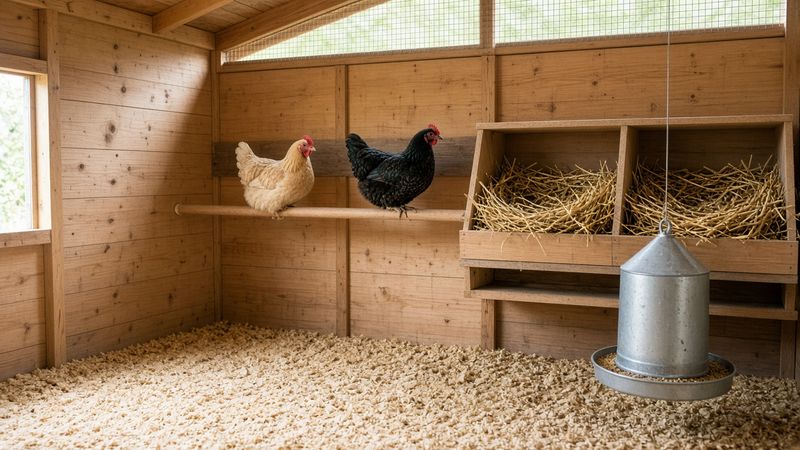
What kind of heater can you use in a chicken coop?
Three types come up for coops. Flat radiant panels are the main one, and all five boxes here are panels. Hanging radiant heaters are a second type. They hang above the roost and warm downward.
Oil-filled radiators and ceramic fan heaters are the third type. The ones we found on Amazon are sold for indoor use. A coop is dusty and damp. We do not box them.
Heat lamps are the type we leave out. Missouri Extension, writing about brooder lamps, asks for a porcelain socket, a lamp guard and secure support. It also says the lamp must touch nothing. A coop full of dry shavings makes that hard to keep up.
Open flame heaters are out too. No fuel heater belongs in a closed coop with bedding.
| Type | Watts | Where it goes | Shutoff | Boxed here |
|---|---|---|---|---|
| Flat radiant panel | 140–200 W | wall or stand by the roost | set point or tilt, by model | yes, 5 |
| Hanging radiant | by model | above the roost | by model | no, not sold by Amazon |
| Oil-filled or ceramic | often 1,500 W | floor | by model | no, sold for indoors |
| Heat lamp | 250 W bulb | clamped or hung | none | no |
Two jobs in one panel
The Farm Innovators panel runs at 200 W in coop mode. Lay it flat and it becomes a 50 W brooder heater. The listing gives three brooder heights: 3.5, 5 and 6 in. An inline switch on the 8 ft cord changes the mode.
That suits a keeper who raises a few chicks each spring. One panel covers the brooder in April and the roost in January. It can stand, hang, mount to a wall or lie flat.
The listing calls it ETL listed and zero clearance, with a thermal protector. Zero clearance is the maker's rating. Still read the manual for where bedding may touch the panel, and keep shavings off the face. For brooder setup, see our heat lamps and plates page.
Small coops: a low-watt wall panel
The Cozy Coop panel draws 150 W and is 2 in deep. It mounts on a wall or stands on its own feet. The thin body suits a small coop where a box heater would block the floor.
The listing gives it an ETL mark, a zero clearance rating and a thermal protector. The face can reach 170°F, by the listing. Mount it where hens cannot perch on it and where a wing cannot rest on the face.
A 2 in panel on the wall behind the roost warms the birds at night. It leaves the floor clear for the feeder and the waterer. If you use a wall mount, screw the bracket into a stud or a solid board, not into thin siding.
Coops with a timer or a thermostat plug
The HOPOCO panel draws 200 W. Its set range runs from 122 to 191°F, with a display and a remote. The listing says it works with outlet timers and thermostat plugs. It turns back on after a power cut, in the same mode.
The panel shuts off if it tilts or falls to 180°, by the listing. It is UL certified. It can hang on a wall or stand inside the coop.
A thermostat plug is the simple way to run any panel only when it is cold. You set an on and an off point, and the plug does the rest. Read the plug's watt limit first. A 200 W panel is well under most plug ratings, but check the label.
A remote and a tighter tilt shutoff
The TIMEBAL panel also draws 200 W, with the same 122 to 191°F set range and a remote. The difference is the tilt shutoff. It stops if the panel tilts past 45°, by the listing.
That means a bumped panel shuts off sooner. The maker says you can turn the tilt feature off. We would leave it on in a coop.
The remote helps in a walk-in coop, where you may not want to reach behind a roost. It also helps with a tall roost, where the panel sits high on the wall. Keep the remote out of the coop, so the dust stays off it.
One corner of a small coop
The PETNF panel draws 140 W, the lowest here. The panel measures 11.81 × 15.74 in. The listing says its radiant heat reaches within 40 cm, about 16 in. It is built for partial heating, not a large area.
That suits a small coop with one roost bar. Set the panel so the roost sits inside that 16 in reach. The cord is 9.8 ft, and the panel stands or mounts on a wall.
The set range runs from 122 to 167°F, by the listing. A heat sticker on the panel turns red above 113°F. That gives you a quick look at whether the panel is on, without touching it.
How to size a heater for your coop
No listing above gives a coop area in square feet. So size by reach, not by area. A panel warms the birds in front of it. Put the panel within reach of the roost and count roost length.
Take a 4 × 8 ft coop for 8 hens. That is 32 sq ft at 4 sq ft per hen, the floor figure our coop size calculator uses. At 8 in of roost per hen, 8 hens need 64 in of bar.
One 140 W panel with a 16 in reach covers part of that 64 in bar. Two panels, or one panel at the middle of a shorter bar, cover more. A 200 W panel does not list a reach, so read the manual for spacing.
Oregon State puts roost bars about 2 ft off the floor and 10 in apart. Mount the panel at roost height, beside or behind the bar. Hens then choose to sit close or move away.
Heater safety checklist
- Read the clearance in the manual. Keep bedding off the panel face, even with a zero clearance rating.
- Screw the panel or its stand down. A hook alone can be knocked off.
- Use an outdoor-rated outlet with a ground-fault breaker, or an outdoor cord rated for the load.
- Run the cord along a wall or in conduit, out of reach of beaks.
- Wipe dust off the panel each week, with the power off.
- Pick a model with a thermal protector or a tilt shutoff, and test it in fall.
Missouri Extension reminds keepers to follow load limits for outlets and circuits. Do not run a heater, a heated waterer and a light on one thin cord. Add the watts first. A 200 W panel and a 125 W waterer base come to 325 W.
How do I heat my chicken coop without electricity?
Start with wind, not heat. Close the gaps at floor level, where wind blows across the birds. Keep the vents open up high. Oregon State says good ventilation removes moisture from a coop.
Penn State puts vents away from prevailing winds and not over the perch. So block the windward side low, and leave the high vents on the sheltered side open.
Deep litter adds warmth too. Minnesota Extension describes building bedding to about 10 in by winter, and notes it gives off heat in cold months. Our coop bedding page covers how to build it up.
An insulated chicken coop or insulated chicken house holds that warmth longer. Put insulation in the walls and roof, behind a solid inner board, so hens cannot peck it.
Water is the other winter job. A plain waterer freezes. Swap two waterers each morning, or see our heated waterers page for powered ones.
When is it cold enough to consider a heater?
Answer it from the coop side. Is the waterer freezing overnight? Is wind getting through at roost height? Does a coop thermometer read well below freezing at dawn, week after week?
If the answer is no, fix drafts and bedding first. If the waterer still freezes, a heated waterer may be the only power you need. Add a panel when the coop stays cold after those fixes.
| What you see | First fix | Then |
|---|---|---|
| Waterer freezes overnight | heated waterer or two-waterer swap | panel only if the coop stays cold |
| Wind at roost height | close low gaps on the windward side | keep high vents open |
| Damp bedding | open high vents, add dry shavings | no heater until it is dry |
| Cold coop after the fixes | one low-watt panel by the roost | thermostat plug |
What to check on the label
Read five things on any coop heater listing. The watts. The safety mark, such as UL or ETL. The shutoff, whether a thermal protector, a set point or a tilt switch. The cord length. And how it mounts.
Be wary of a listing that names a coop size without a figure behind it. A panel warms what is in front of it. If a box says it heats a whole coop, ask how many square feet, and at what outside low.
Common Questions
How many watts does a chicken coop heater use?
The five panels here draw 140 to 200 W, by the maker listings. Running all day, that is at most 3.4 to 4.8 kWh. A set point or a thermostat plug cuts real use.
Is a heat lamp safe in a chicken coop?
We do not box heat lamps. Missouri Extension asks for a porcelain socket, a lamp guard, secure support and no contact with anything. A panel with a shutoff is easier to keep safe in dry bedding.
Where should I put a heater in a coop?
At roost height, beside or behind the bar, screwed down. Keep bedding off the face. Oregon State puts roosts about 2 ft up, so the panel often sits about there.
Can I heat a coop without power?
Block low drafts, keep high vents open and build deep litter to about 10 in. Minnesota Extension notes deep litter gives off heat in cold months.
Read next
Sources
- University of Missouri Extension, G8351 Brooding and Growing Chicks: extension.missouri.edu (250 W lamp; porcelain socket, lamp guard, secure support; no contact with objects; load limits for receptacles and circuits)
- Oregon State University Extension, EC 1644 Backyard chicken coop design (2014, reviewed 2023): extension.oregonstate.edu (ventilation removes moisture; roost poles 2 ft up, 10 in apart)
- Penn State Extension, Small Scale Poultry Housing (updated 2026): extension.psu.edu (vents away from prevailing winds, not over the perch)
- University of Minnesota Extension, Raising chickens for eggs (reviewed 2025): extension.umn.edu (deep litter about 10 in by winter; heat in cold months; 3 to 5 sq ft indoor per bird)
- Roost length: 8 in per hen, the planning figure on our roost bar page (Oregon State gives 5 to 10 in).
- 200 W, 50 W brooder mode, 3.5, 5 or 6 in heights, 8 ft cord, ETL, zero clearance: maker listing on Amazon, ASIN B0DX445TS2, read 2026-10-23
- 150 W, 2 in deep, ETL, zero clearance, surface to 170°F: maker listing on Amazon, ASIN B01LX9K1JI, read 2026-10-23
- 200 W, 122 to 191°F, timer and thermostat plug, tilt shutoff, UL: maker listing on Amazon, ASIN B0H2DT8KVX, read 2026-10-23
- 200 W, 122 to 191°F, shutoff past 45°, UL: maker listing on Amazon, ASIN B0H1C7JV51, read 2026-10-23
- 140 W, 11.81 × 15.74 in, 40 cm reach, 122 to 167°F, 9.8 ft cord: maker listing on Amazon, ASIN B08J7Y1T2S, read 2026-10-23
How we pick and check numbers: How we research.