Chicken Egg Incubators: Capacity, Turning Interval, Humidity and Power
Coopgauge is reader-supported. When you buy through links on this page, we may earn a commission.
Count the eggs in this batch first. Then buy the machine that holds them. A chicken egg incubator runs a 21-day cycle, by Texas A&M AgriLife Extension. Maker capacities run from 12 to 48 egg positions.
One machine runs one batch. A 48-position unit loaded with 30 eggs is a 30-egg machine that season. Turning intervals come in 60, 90, 120, 150, 180 and 210 minute steps. Those are the next numbers to read.
Capacity comes first because every other number follows from it. Your batch decides how many machines you need. Ten maker listings sit in the table below, read on Amazon on 2026-11-02. Blank cells mean the listing prints nothing.
That rule matters more than it sounds. One unit in this group states in its own listing that it shows no humidity value. Six of the ten listings print no weight.
A table that fills those blanks with guesses is worse than no table. A 12-position unit on a worktop and a 48-position unit on a shelf are different purchases, and capacity decides the shelf, the weight and the power.
Egg incubators side by side
Read the table across, not down. Turning interval, the day the machine stops turning, the humidity readout and the water port say more about daily handling than the capacity number does.
Humidity is where the listings differ most. Six of the ten print a reading, three print no readout, and one says in its own listing that it shows no humidity value.
| Unit (ASIN) | Eggs as listed | Chicken positions | Turning | Auto stop | Humidity readout | Water | Size, in |
|---|---|---|---|---|---|---|---|
| 12-egg digital unit (B0GH5GBPSK) | 12 chicken, 40+ quail | 12 | 60, 120, 180 min | 72 h before hatch, day 18 | Yes, 40 to 80% RH | 2 × 500 ml tanks | 6.21 × 11 × 11 |
| 12-egg grey unit (B0G2Y4PDYH) | 12 | 12 | 60, 120, 180 min | 3 days before hatch, day 18 | Readout not printed | External fill port | 10 × 6 × 10 |
| 16-egg roller unit (B0FW3MFJRC) | 16 | 16 | Every 90 min | Not printed | No, listing says no value | External bottle and base, bottles not included | 12.05 × 11.22 × 7.44 |
| 18-egg orange unit (B0G5WZXQYJ) | 18 standard, 40 small | 18 | 60, 120, 180 min | 96 h before hatch, day 17 | Readout not printed | Auto-regulated tank | 11.73 × 11.73 × 6.85 |
| 18 + 8 tray unit (B0FWC8XSC5) | 18 standard, 8 large, 50 small | 18 | 1, 2, 3 h | Stops at lock-down, day 18 | Readout not printed | External bottle, auto refill | Not printed |
| 20-egg unit (B0DLWDCHJD) | 20 | 20 | Every 60 min | 3 days before hatch, day 18 | Yes, humidity display | External fill | Not printed |
| 22-egg unit (B0793HHZ1L) | 22 chicken, 12 to 18 duck, 22 to 24 pheasant | 22 | Automatic, interval not printed | 3 days before hatch, day 18 | Yes, display and knob | Not printed | 14 × 13.75 × 9.25 |
| 30-egg unit (B09Y84KPNC) | 30 | 30 | Every 60 min | 3 days before hatch, day 18 | Yes, humidity display | External fill | 14.1 × 14.1 × 9.1 |
| 48-egg breeder unit (B0GC3J9Q1P) | 48 chicken, 96 quail | 48 | 60, 90, 120, 150, 210 min | Last 4 days, day 17 | Yes, 20 to 75% RH | 2 fill ports | Not printed |
| 48-egg square unit (B0G4LSY5NS) | 48 | 48 | Automatic, interval not printed | Not printed | Yes, live reading | Not printed | 16.93 × 16.93 × 7.48 |
The stop column is worth a second look. Five of the ten listings print a three-day stop, which lands on day 18 of a 21-day cycle.
Two stop on day 17, one 96 hours ahead and one 4 days ahead. One stops at its own lock-down setting instead of a day count. Two listings print no stop day at all. The cycle is from Texas A&M AgriLife Extension, the stop days from the maker listings.
| Unit (ASIN) | Weight, lb | Power (maker) | Where it goes |
|---|---|---|---|
| 12-egg grey unit (B0G2Y4PDYH) | 3.66 | Not printed | Sturdy shelf, 10 in tall |
| 16-egg roller unit (B0FW3MFJRC) | Not printed | 110 V, 12 V clamp lead | Worktop or shelf, 7.44 in tall |
| 20-egg unit (B0DLWDCHJD) | 6.8 | Not printed | Size not printed, check the box |
| 22-egg unit (B0793HHZ1L) | 6.70 | Not printed | Sturdy shelf, 9.25 in tall |
| 48-egg square unit (B0G4LSY5NS) | 8.49 | 110 V, 12 V battery switch | Shelf, 16.93 in square |
Only five of the ten listings print a weight or a power supply. The other five are on the box. You check the weight there.
Two units take a 12 V supply as well as 110 V. You need that when a power cut comes.
Placement is our read of the printed size. Under 8 in tall fits a worktop. Taller units want a sturdy shelf, and a wide box wants a shelf at any height.
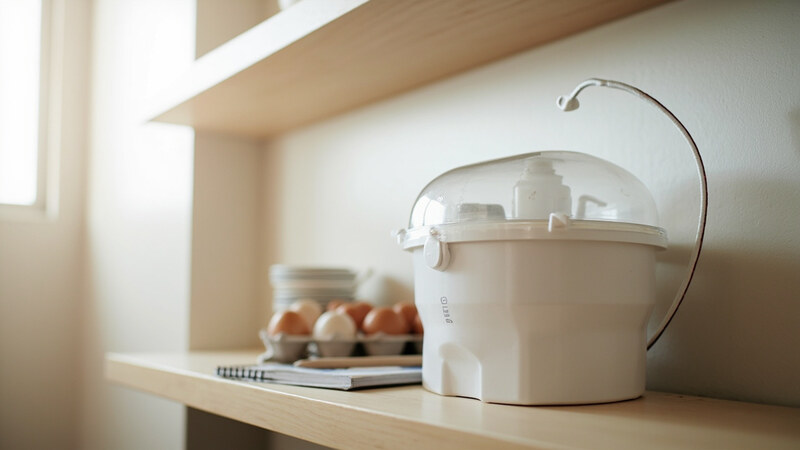
What the egg count on the box means
The capacity on the box counts positions. Not eggs you will collect. One listing in this group gives three numbers for one box: 22 chicken eggs, 12 to 18 duck eggs and 22 to 24 pheasant eggs.
Another says 48 chicken eggs or 96 quail eggs. That is one tray with movable dividers, so read the chicken number when you plan your own batch.
Our counts below use three assumptions. A batch is the eggs you set on one day in one machine.
A chicken position holds one standard chicken egg. The maker's chicken number is the number of positions. A quail count is a different egg size, so it cannot be added to a chicken count.
| Unit (ASIN) | Capacity as listed | Standard chicken eggs | Small eggs (quail) | Large eggs (duck, goose) |
|---|---|---|---|---|
| 12-egg digital unit (B0GH5GBPSK) | 12 chicken, 40+ quail | 12 | 40 | Not printed |
| 12-egg grey unit (B0G2Y4PDYH) | 12 | 12 | Not printed | Not printed |
| 16-egg roller unit (B0FW3MFJRC) | 16 | 16 | Not printed | Not printed |
| 18-egg orange unit (B0G5WZXQYJ) | 18 standard, 40 small | 18 | 40 | Not printed |
| 18 + 8 tray unit (B0FWC8XSC5) | 18 standard, 8 large, 50 small | 18 | 50 | 8 |
| 20-egg unit (B0DLWDCHJD) | 20 | 20 | Not printed | Not printed |
| 22-egg unit (B0793HHZ1L) | 22 chicken, 12 to 18 duck, 22 to 24 pheasant | 22 | Not printed | 12 to 18 |
| 30-egg unit (B09Y84KPNC) | 30 | 30 | Not printed | Not printed |
| 48-egg breeder unit (B0GC3J9Q1P) | 48 chicken, 96 quail | 48 | 96 | Not printed |
| 48-egg square unit (B0G4LSY5NS) | 48 | 48 | Not printed | Not printed |
Read the quail column as a separate count, not a bonus. The 18-position unit that takes 40 quail eggs lists 18 standard eggs, not 40.
The 18 + 8 unit has a second tray for 8 large eggs. Its real footprint is two trays in one box. Four units print a small-egg count. Only two print a large-egg count.
| Eggs in the batch | Machines | Which units | Positions used |
|---|---|---|---|
| 12 | 1 | 12-position unit | 12 |
| 24 | 1 | 30-position unit | 24 of 30 |
| 24 | 2 | 20-position and 12-position units | 20 and 12 |
| 36 | 2 | 20-position and 16-position units | 36 |
| 60 | 2 | two 30-position units | 60 |
| 60 | 3 | three 20-position units | 60 |
| 96 | 2 | two 48-position units | 96 |
Sixty eggs is the row worth planning. Two 30-position units hold the batch. So do three 20-position units.
They do not take the same shelf space, or the same number of log sheets. Three machines means three water checks. One power cut takes out all three.
Read the ladder first. The jump from 30 to 48 positions is not a bigger version of the same machine.
The 48-egg breeder unit (B0GC3J9Q1P) is a different class of box: dividers, alarms and two water ports. The jump from 12 to 16 is a small one. A 20-position machine covers both.
First batch: 10 to 12 eggs
This is the smallest group. It suits a first run. You need 12 positions and a machine that fits on the counter. Water goes in without opening the lid.
The unit in the box below prints temperature and humidity on one panel, so the reading and the setting sit in the same place.
The two numbers that matter at this size are the humidity range and the refill port. The maker lists 77 to 103°F and 40 to 80% RH on the display.
Two external 500 ml tanks need refills. Two or three in a cycle. Two tanks mean you top up from outside the box and the lid stays shut.
Turning here is a choice: 60, 120 or 180 minutes. The machine stops turning 72 hours before the hatch day, which is day 18 of the 21-day cycle.
It measures 6.21 × 11 × 11 in. Measure the shelf before you order.
16 to 18 eggs: a family-sized batch
Minnesota Extension gives about six eggs a hen a week. Six hens lay about 36 eggs a week, so one batch of 16 to 18 eggs is half a week of eggs.
Our eggs per hen page has the same count. At this size the tray changes, and with it the turning interval and the power lead.
Two listings show two ways to build a tray. One has roller spacing you can adjust, so the same box takes eggs of different sizes.
The other has two trays. The standard tray holds 18 chicken eggs, or up to 50 quail eggs. The large tray holds 8 duck, goose or turkey eggs.
The 16-position unit in the box above turns every 90 minutes. It holds 68 to 104°F and reaches the set temperature in about an hour.
It takes a 12 V clamp lead as well as 110 V. That keeps it running through a power cut. Its listing says it shows no humidity value.
Plan on your own hygrometer. Or pick a unit that prints one.
20 to 24 eggs: the standard size
Twenty to twenty-four positions is the middle band of the table, above the 18-position units and below the 30-position one. Two dozen eggs is a load one machine handles. Check the box for its size before you pick a shelf.
You read three numbers here. Weight, size, and how the water gets in. The 20-egg unit prints a weight but no size.
The 20-position unit in the box below turns every 60 minutes. It stops turning three days before the hatch day.
It carries a built-in candler and an external water port, so you refill without lifting the lid. It weighs 6.8 lb. That is the number people forget when the shelf sits above a worktop.
One machine with spare positions beats two smaller ones. Two machines mean two water checks, two log sheets and two sets of readings to write down.
The spare positions cost you nothing except the empty tray space.
30 eggs: a bigger batch
Thirty positions is where the home machines stop looking small. The footprint moves out to about 14 in square. The weight is not printed for this one.
Buy this size when your batch runs above 24 eggs. Not for a batch you think you may get.
The 30-position unit in the box below turns every 60 minutes. It stops three days before the hatch day, with a built-in candler and an external water port.
It measures 14.1 × 14.1 in and stands 9.1 in tall. It wants a shelf, not a worktop.
Above 30 positions the machines change shape. Cabinets, dividers, two water ports and alarms. Read the next section before you order that size.
When the batch is out, the box you need next is a brooder, not a larger incubator. Our chick brooder page covers the days after the hatch.
48 eggs: breeders, schools and market batches
Forty-eight positions is a different kind of purchase. It suits breeders and school rooms. It suits anyone running the same batch week after week.
The unit that prints a size is B0G4LSY5NS: 16.93 in square. At 8.49 lb, it is no longer a kitchen appliance.
The parameters at this size are dividers, turning steps and what the machine does on its own.
The 48-position unit in the box below takes 48 chicken eggs or 96 quail eggs. Turning steps run 60, 90, 120, 150 and 210 minutes.
It stops turning for the last four days before the hatch day, and adds two water ports, two vent switches, a chick separator and alarms.
Movable dividers change the arithmetic. The same tray takes eggs of different sizes. A batch of mixed eggs does not need a second machine.
This unit prints two numbers for one tray: 48 chicken eggs or 96 quail eggs. Ninety-six eggs is two 48-position units, not one.
What to check on the label
Read eight lines before you order. They decide how the machine works for 21 days.
- Is the capacity a chicken count or a maximum? Two numbers for one machine can mean two trays or one tray with movable dividers. The 18 + 8 unit has two trays; the 48-position unit prints 48 chicken or 96 quail for one tray. Find the number that belongs to chicken eggs.
- What is the turning interval? 60, 90, 120, 150, 180 and 210 minutes all appear in this group. Texas A&M AgriLife Extension asks for at least 5 turns a day.
- When does it stop turning? Three days before the hatch day lands on day 18 of the 21-day cycle, and 96 hours lands on day 17.
- Is there a humidity reading? One unit states it shows no humidity value. Then you need a separate hygrometer.
- How does the water get in? An external bottle means the lid stays shut. You refill from outside. A base you fill means you open the lid.
- Is a light built in? Nine of these ten listings include one. The 22-position unit prints no built-in light.
- What power does it take? Eight of these ten listings print no supply at all. Two take a 12 V lead or a 12 V battery switch as well as 110 V.
- What are the dimensions and the weight? The size decides the shelf, and the weight decides whether you can lift it onto the shelf.
Turning and the stop day change what you do. Check them first. The 21-day cycle comes from Texas A&M AgriLife Extension.
It asks for at least 5 turns a day. No turning in the last 3 days. The maker stop days land on day 17 or day 18 of that cycle. The timeline below puts both on one scale.
The rest of the checklist is about your room. Not your eggs. Measure the shelf, read the power line, and keep a hygrometer if the panel shows no humidity.
Do those three things first. Then the number on the box stops being the only one that matters to you.
Read next
- GuideBrooder setup
- GuideHow to hatch chicken eggs
- GearChick brooders
- GuideChick starter feed
- DataHow many eggs a day
- HubChicks
Sources
- Texas A&M AgriLife Extension, POSC-PU-018 Incubating and Hatching Eggs (2022): cdn-de.agrilife.org It gives 21 days for chicken eggs. It asks for at least 5 turns a day. It says no turning for the final 3 days.
- University of Minnesota Extension, Raising chickens for eggs (reviewed 2025): extension.umn.edu A laying hen gives roughly six eggs a week.
- 12-egg digital unit: maker listing on Amazon, ASIN B0GH5GBPSK, read 2026-11-02. It lists 12 chicken eggs and 40+ quail eggs. The display shows 77 to 103°F and 40 to 80% RH, ±0.5°F. Turning runs every 60, 120 or 180 minutes. Auto stop comes 72 hours before the hatch. Size is 6.21 × 11 × 11 in from productInfo; the listing's own feature text prints 11 × 12.4 × 6.7 in, and we use the productInfo figure.
- 12-egg grey unit: maker listing on Amazon, ASIN B0G2Y4PDYH, read 2026-11-02. It lists 12 eggs. Turning runs every 60, 120 or 180 minutes. Auto stop comes 3 days before the hatch. Water goes in through an external fill port. Size is 10 × 6 × 10 in, and the weight is 3.66 lb.
- 16-egg roller unit: maker listing on Amazon, ASIN B0FW3MFJRC, read 2026-11-02. It lists 16 eggs. It measures 12.05 × 11.22 × 7.44 in. Turning runs every 90 minutes. The listing says no humidity value is displayed. It takes a 110 V and 12 V clamp lead, and has a built-in candler.
- 18-egg orange unit: maker listing on Amazon, ASIN B0G5WZXQYJ, read 2026-11-02. It lists 18 standard eggs and 40 small eggs. Turning runs every 60, 120 or 180 minutes. Auto stop comes 96 hours before the hatch. Size is 11.73 × 11.73 × 6.85 in.
- 18 + 8 tray unit: maker listing on Amazon, ASIN B0FWC8XSC5, read 2026-11-02. The standard tray holds 18 chicken eggs, or up to 50 quail eggs. The large tray holds 8 duck, goose or turkey eggs. Turning runs every 1, 2 or 3 hours. Turning stops at the lock-down. Water comes from an external bottle that refills itself.
- 20-egg unit: maker listing on Amazon, ASIN B0DLWDCHJD, read 2026-11-02. It lists 20 eggs. Turning runs every 60 minutes. Auto stop comes 3 days before the hatch. The title lists a humidity display, and there is a built-in egg candler. Water goes in through an external refill. The weight is 6.8 lb.
- 22-egg unit: maker listing on Amazon, ASIN B0793HHZ1L, read 2026-11-02. It holds up to 22 chicken eggs, 12 to 18 duck eggs and 22 to 24 pheasant eggs. Turning is automatic, and the interval is not printed. Auto stop comes 3 days before the hatch. There is a humidity display and a knob. Size is 14 × 13.75 × 9.25 in, and the weight is 6.70 lb.
- 30-egg unit: maker listing on Amazon, ASIN B09Y84KPNC, read 2026-11-02. It lists 30 eggs. Turning runs every 60 minutes. Auto stop comes 3 days before the hatch. The title lists a humidity display, and there is a built-in egg candler. Water goes in through an external refill. Size is 14.1 × 14.1 × 9.1 in.
- 48-egg breeder unit: maker listing on Amazon, ASIN B0GC3J9Q1P, read 2026-11-02. It holds 48 chicken eggs or 96 quail eggs. Temperature runs 68 to 104°F, and humidity 20 to 75% RH with manual boost. Turning steps are 60, 90, 120, 150 and 210 minutes. Turning stops for the last 4 days. Dividers move, and there are two water ports, two vent switches, a chick separator and alarms.
- 48-egg square unit: maker listing on Amazon, ASIN B0G4LSY5NS, read 2026-11-02. It lists 48 eggs. It shows temperature and humidity on the panel. It runs on 110 V, and can be switched by hand to a 12 V battery. Size is 16.93 × 16.93 × 7.48 in, and the weight is 8.49 lb.
- Batch size to machine count, egg positions per egg type and placement: our math from the maker capacities and sizes in items 3 to 12
How we pick and check numbers: How we research.