Egg Color Chart: 9 Shell Colors and the Breeds That Lay Them
An egg color chart sorts every shell into 9 color groups. Each hen lays about 6 eggs a week. One hen lays one color for life. Six hens of six colors give about 36 eggs a week, or 3 dozen.
Egg colors at a glance
- Shell color groups
- 9
- Colors per hen
- 1
- Eggs a week, per hen
- about 6
- Eggs a week, 6 hens
- about 36
- Dozens a week, 6 hens
- 3
- White shells
- Leghorn, 250 to 300 a year
- Brown shells
- Australorp, about 250
- Dark brown shells
- Marans, 200 or more
- Colored shells
- Easter Egger, 200 to 280
- Bantam eggs
- Nankin Small, Sebright Very Small
Rates and egg sizes: The Livestock Conservancy chart. Colored shells: Cackle Hatchery and Townline Hatchery. Eggs a week: Minnesota Extension.
Shell color comes from the breed. That one rule decides the rest of the page. If you want a single color, pick one breed. If you want a mixed carton, mix the flock, not the feed.
Three numbers sit behind every table here. Six eggs a week per hen is the Minnesota Extension figure for a hen in her peak years. The 9 color groups are our own sorting of The Livestock Conservancy chart.
That chart lists one egg color for each breed. Every other number on this page is a printed figure we copied. You can open the source and check it.
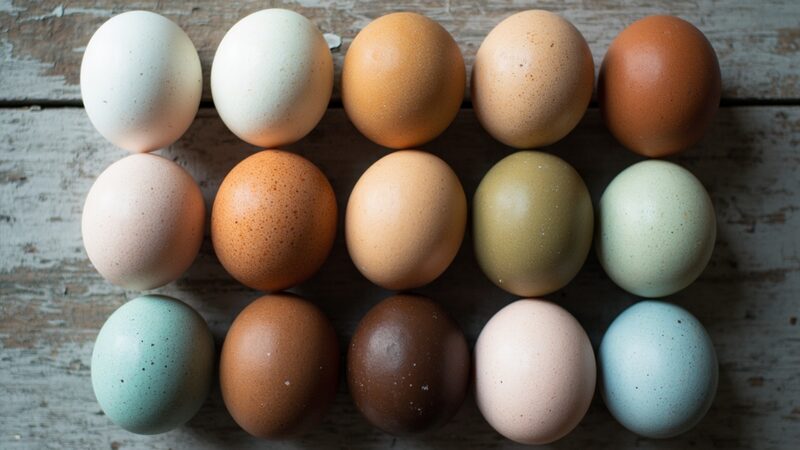
Shell colors and the breeds that lay them
| Shell color | Breeds in that group | Eggs a year | Egg size | Source |
|---|---|---|---|---|
| White | Leghorn, Hamburg, Sultan, Ancona, Spanish, Andalusian, Holland | 120 to 300 | Medium to Large | Livestock Conservancy chart |
| Cream | Nankin, Sebright | 90 to 100 | Small to very small | Livestock Conservancy chart |
| Tinted | Catalana, Cornish, Sumatra, Yokohama | 50 to 150 or more | Small to Medium to Large | Livestock Conservancy chart |
| Pale brown | Faverolles, Sussex, Orpington, Russian Orloff | 150 to 280 | Small to Large | Livestock Conservancy chart; Cackle Hatchery for the Orpington |
| Brown | Australorp, Barred Rock, Dominique, Delaware, Jersey Giant, Buckeye | 120 to 275 | Medium to Jumbo | Livestock Conservancy chart; Livestock Conservancy breed page for the Barred Rock |
| Dark brown | Marans | 180 to 200+ | Large | Cackle Hatchery |
| Blue | Araucana, Cream Legbar, Easter Egger | 180 to 280 | Medium to Large | Livestock Conservancy chart; Cackle Hatchery for the Legbar and the Egger |
| Green | Easter Egger, Cream Legbar, Olive Egger | 180 to 280 | Medium to Large | Cackle Hatchery for the Egger and the Legbar; Townline Hatchery for the Olive Egger |
| Pink | Easter Egger, Olive Egger | 180 to 280 | Medium to Large | Cackle Hatchery for the Egger; Townline Hatchery lists pink as an Olive Egger variant |
White is the plain group. The Leghorn leads it, at 250 to 300 white eggs a year. Those eggs are medium to large. Hamburg eggs are smaller, at 200 to 225. Spanish and Andalusian shells read chalk-white.
Cream is the warm white group. The Nankin lays a creamy white egg, small, at 90 to 100 a year. The Sebright egg reads white or creamy and very small. The chart prints no rate for the Sebright.
Tinted is a pale wash, not a true shade. The Catalana runs white to tinted, at 150 or more a year. The Cornish lays 50 to 80. The Yokohama adds a light brown tint at 80.
Pale brown covers the tan and buff end of brown. The Sussex goes tan to brown, large, at about 200 a year. The Orpington lays 150 to 280 a year. Cackle Hatchery calls the shells light brown.
Brown eggs come in a wide range of rates. The Australorp lays about 250 brown eggs a year, large. The Dominique runs 230 to 275. The Buckeye lays 120 to 150.
Dark brown belongs to the Marans. Cackle Hatchery grades the Black Copper Marans at number 5 to 8. The Cuckoo Marans come in at number 3 to 6. Both lines lay 180 or more a year. The eggs are large.
Blue comes in shades, not one color. The Araucana egg is a medium to large blue, about 200 a year. The Cream Legbar lays minty blue or aqua blue, by Cackle Hatchery.
Green is the olive end of the range. The Olive Egger lays an olive green egg, medium, at 1.75 oz. It gives 180 to 220 a year, by Townline Hatchery. The Cream Legbar lays green too.
Pink shows up on two hatchery lists. Cackle Hatchery lists pink among the Easter Egger shell colors. That breed lays 200 to 280 a year. Townline Hatchery lists pink as a possible Olive Egger variant, so count it as a bonus.
Read the rate beside the color. A green egg does not mean more eggs.
You do not have to keep all 9 groups. Six hens already give you 6 colors, by the flock table. Pick the breeds you can find, then read the yearly rate beside each one.
Color sits with the hen, not with the feed. Each hen lays one color for life, so the flock decides the mix you collect. A flock of four Easter Eggers can fill a carton with three shades.
Read the color name, not the shade. Cackle Hatchery lists the Cream Legbar as minty blue or aqua blue. Townline Hatchery calls the Olive Egger olive green. Those words describe a shell you get, not a color you pick at the counter.
Two names get mixed up at the farm store, so read the label before you choose. The Ameraucana is the recognized breed. The Easter Egger is a mixed bird that carries its blue egg gene. Our Easter Egger page sorts out the names.
Our assumptions
Everything below comes from one rate and one rule. Minnesota Extension puts a good layer at about 6 eggs a week. One hen lays one color. Multiply the hens by 6 for a weekly count. Divide by 12 for dozens.
One rule, one rate. Every other figure on this page is printed somewhere you can check it.
The rate is the peak figure, for a hen in her first two years. Real counts drop in fall and winter. Older hens lay less. The eggs per day page covers the daily side of the same number.
The 9 color groups are our own sorting of the chart. The chart lists one egg color for each breed. Egg sizes come from its Egg Size column. The rates come from its Rate of Lay column.
Every total in the tables is our math, and each table says so. Change the hen count and the arithmetic stays the same.
By flock size
| Hens | Colors | Eggs a week, each color | Eggs a week, all colors | Dozens a week | Hens for a dozen of one color |
|---|---|---|---|---|---|
| 4 | 4 | 6 | 24 | 2 | 2 |
| 6 | 6 | 6 | 36 | 3 | 2 |
| 8 | 8 | 6 | 48 | 4 | 2 |
| 10 | 9 | 6 | 60 | 5 | 2 |
Start with the hens you already have. Four hens of four colors give 24 eggs a week. That is two dozen. Six hens give 36, or three dozen. Eight give 48. Ten give 60.
Check the count before you add breeds. The color list changes, the rate does not.
Two colors give 12 eggs a week, one dozen. Three give 18, which is 1.5 dozen. Four give 24, two dozen. Six give 36, three dozen. Two hens of one color fill a dozen. Pick the row that matches your flock.
A dozen in each of 6 colors needs 12 hens. That flock gives about 72 eggs a week. That is 6 dozen.
Nest boxes still follow the hen count, not the color count. Oregon State asks for 1 box per 4 hens. So 12 hens need 3 boxes. Add birds later and the box count goes with the hens, not the colors.
You do not need a new flock to add a color. One extra Easter Egger changes the mix in every carton. Keep her with a flock of white Leghorns and the same nest boxes give you two colors.
Standard, bantam and large
| Size class | Breed and shell | Egg size | Eggs a year | Egg weight | Source |
|---|---|---|---|---|---|
| Standard | Leghorn, white | Medium to Large | 250 to 300 | not printed | Livestock Conservancy chart |
| Standard | Olive Egger, olive green | Medium | 180 to 220 | 1.75 oz | Townline Hatchery |
| Standard | Easter Egger, blue, green, pink | Medium to Large | 200 to 280 | not printed | Cackle Hatchery |
| Bantam | Nankin, creamy white | Small | 90 to 100 | not printed | Livestock Conservancy chart |
| Bantam | Silkie, cream | Small | 100 to 120 | about 1.5 oz | Townline Hatchery |
| Bantam | Sebright, white or creamy | Very Small | not printed | not printed | Livestock Conservancy chart |
| Large | Jersey Giant, brown | Extra Large | 175 to 185 | not printed | Livestock Conservancy chart |
| Large | Delaware, brown | Large to Jumbo | 150 to 200 | not printed | Livestock Conservancy chart |
Two birds, one shell color, different size. The size column tells you which one you have.
The same color can sit two sizes apart. A Nankin egg is a small creamy white. A Leghorn egg is a medium to large white. Both read as white on the shelf, so you need the size column to tell them apart.
A bigger egg does not mean more eggs. Size follows body size. The Jersey Giant egg is extra large, and the flock lays 175 to 185 a year. The Leghorn egg is smaller, and the flock lays 250 to 300. If you count eggs per year, the smaller egg can carry the flock.
Bantams also need less ground. The coop size calculator gives 2 sq ft for a bantam. A standard hen gets 4 sq ft. Ten bantams need 20 sq ft of floor. Ten standard hens need 40. A bantam flock of 10 takes the floor of 5 standard hens.
Common Questions
What colors can chicken eggs be?
Nine groups cover the range on this page: white, cream, tinted, pale brown, brown, dark brown, blue, green and pink. The groups are our sorting of The Livestock Conservancy chart. That chart lists one egg color per breed. Color comes from the breed, and each hen keeps the color she starts with.
Do all hens lay the same color egg?
No. Each hen lays one color for life, so a flock of mixed breeds fills a carton with several shades. The Easter Egger alone can run blue, green or pink, with each hen holding one of those. Six hens of six colors give about 36 eggs a week.
Which chickens lay blue eggs?
The Araucana, the Cream Legbar and the Easter Egger. The Araucana egg is a medium to large blue, about 200 a year in the chart. Cackle Hatchery lists the Cream Legbar at 180 to 200, in minty blue or aqua blue. Easter Eggers lay 200 to 280, in blue, green or pink. If you want a blue egg every time, the Araucana is the one to look at.
Which chickens lay green eggs?
The Olive Egger, the Cream Legbar and the Easter Egger. Townline Hatchery gives the Olive Egger olive green shells, medium size at 1.75 oz. That breed gives 180 to 220 eggs a year. The Cream Legbar green runs 180 to 200 by Cackle Hatchery.
How many hens for a dozen eggs of one color?
Two. At about 6 eggs a week each, two hens of the same color give 12 eggs a week. That is one dozen. For a dozen in each of 6 colors you need 12 hens, and that flock gives about 72 eggs a week, 6 dozen. Two hens of one color is the whole rule.
Do bantam eggs look different?
Same color, smaller egg. The Nankin egg is small and the Sebright egg very small, by The Livestock Conservancy chart. Townline Hatchery puts the Silkie egg at about 1.5 oz. Bantams also need less floor, 2 sq ft against 4 sq ft for a standard hen. If you keep bantams, the floor drops with them.
Read next
- DataBest egg laying chickens
- BreedEaster Egger chicken
- BreedOlive Egger chicken
- BreedMarans chicken
- DataHow many eggs a day
- DataNesting boxes for chickens
Sources
- The Livestock Conservancy, Heritage Chicken Breed Comparison Chart (2026): livestockconservancy.org (Egg Color, Egg Size and Rate of Lay per Year columns. Leghorn 250 to 300; Hamburg 200 to 225; Ancona 120 to 180; Araucana about 200; Nankin 90 to 100; Catalana 150 or more; Cornish 50 to 80; Yokohama 80; Sussex about 200; Australorp about 250; Dominique 230 to 275; Delaware 150 to 200; Jersey Giant 175 to 185; Buckeye 120 to 150. Spanish and Andalusian shells read chalk-white, and the Sebright egg is very small.)
- The Livestock Conservancy, Plymouth Rock chicken breed facts: livestockconservancy.org (Plymouth Rock around 200, with brown shells.)
- Cackle Hatchery, French Black Copper Marans breed facts: cacklehatchery.com (Shell dark brown, number 5 to 8. 200 or more a year, large. The Cuckoo Marans number 3 to 6, 180 or more.)
- Cackle Hatchery, Cuckoo Marans breed facts: cacklehatchery.com (Shell dark brown, number 3 to 6. 180 or more a year, large.)
- Cackle Hatchery, Cream Legbar breed facts: cacklehatchery.com (Shell minty blue, aqua blue, green. 180 to 200 a year, medium to large.)
- Cackle Hatchery, Easter Egger breed facts: cacklehatchery.com (Green, blue, pink and multi shells. 200 to 280 a year, medium to large.)
- Cackle Hatchery, Buff Orpington breed facts: cacklehatchery.com (150 to 280 eggs, light brown shells, egg size large.)
- Townline Hatchery, Olive Egger breed facts: townlinehatchery.com (Olive green shell, with green, brown and pink variants. 180 to 220 a year, medium, 1.75 oz.)
- Townline Hatchery, White Silkie Bantam breed facts: townlinehatchery.com (100 to 120 eggs. Small cream eggs, about 1.5 oz.)
- University of Minnesota Extension, Raising chickens for eggs (reviewed 2025): extension.umn.edu (Roughly six eggs a week for a good layer in her peak years.)
- Oregon State University Extension, EC 1644 Backyard chicken coop design (2014, reviewed 2023): extension.oregonstate.edu (1 nest box per 4 hens.)
- Penn State Extension, Small Scale Poultry Housing (updated 2026): extension.psu.edu (Bantams get about half the floor space of large chickens.)
- Color groups, flock-size counts, dozens and the 2 hens per dozen rule: our math from the six eggs a week rate, worked out on this page.
How we pick and check numbers: How we research.