Chicken Run Cover: What to Use, How to Size It and How to Fix It Tight
Coopgauge is reader-supported. When you buy through links on this page, we may earn a commission.
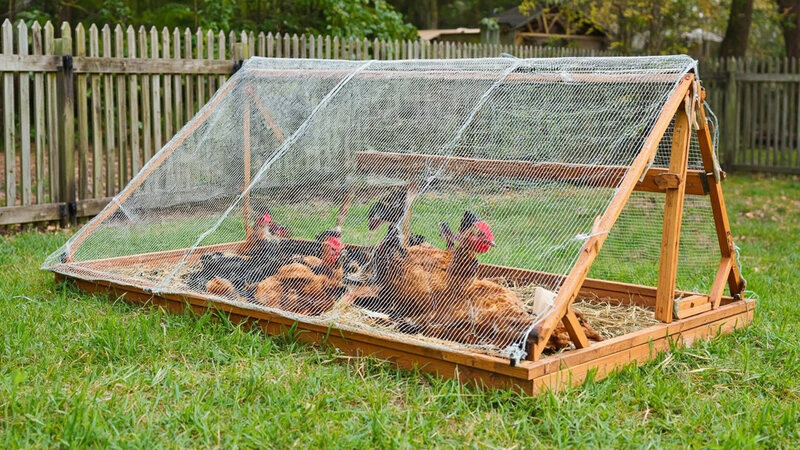
A chicken run cover starts with the run you already have: measure its length and width, then check the area against 8 sq ft for every standard hen. Penn State asks for mesh wire or netting over the top of a run. Kentucky Extension wants that mesh fixed tight. A run that already sits under a solid roof does not need a second layer. Bantams fly, so their run needs a full mesh top.
Run cover spec card
Ten numbers run the rest of the page, each with a source under the card.
- Run area per hen
- 8 sq ft standard, 4 sq ft bantam
- Roof material
- mesh wire or netting
- Mesh size
- ½ in welded; ¼ in where weasels are
- Opening and gauge
- ½ in opening, 19 gauge, galvanized welded
- Roll
- 48 in × 100 ft
- Overlap
- 1 ft of mesh extra on every side
- Seam
- one full mesh square
- Support
- center post on a wide run, sloped to one side
- Fixings
- screws with fender washers, every few inches
- Cheap start
- wire or twine grid, 3 to 4 ft apart
Run area and roof material: Penn State. ¼ in mesh where weasels are: Kentucky ID-245. ½ in opening, gauge and roll: maker listing. Overlap, center post, seams and fixings: our build standard.
Do you need a cover?
The answer depends on what comes from the sky. Kentucky Extension puts it plainly. Hawks and owls work from above, and they find every loose corner in a net. A run in the open needs a roof.
Ground mesh and a top cover do two different jobs. The fence line handles the ground. The cover handles the sky.
| Situation | Cover? | What to use | Why | Source |
|---|---|---|---|---|
| Open yard, large run | Yes | ½ in welded mesh over the whole top | Hawks and owls work from above | Kentucky ID-245; Penn State |
| Small run against a fence or tree | Yes | ½ in mesh over the open side | The sky stays open above the flock | Our guidance |
| Bantam run | Yes, full mesh | ½ in mesh on every part of the top | Bantams fly, so a half cover does not hold them | Our run ideas page |
| Run under a coop with a solid roof | No second layer | Nothing extra on top | The roof already closes the top | Our guidance |
| Daytime fence range | Fence first | Netting on the fence line | The fence length decides; bantams still want a net on top | Our free range page |
The bantam row is the one people miss. The chicken run ideas page has the run shapes. The predator-proof chicken coop page has the wall, seam and fixing details.
Two things decide the row: what is above the run and what is under it. A net over the top closes the sky, and a buried edge closes the ground. Kentucky Extension asks for hardware cloth on the run, and ¼ in mesh where weasels are. The ½ in opening is the roll in the box. Leave a corner loose and the sky is open again.
Cover materials compared
Seven materials cover a run. Read the table by what each one stops first, then by the opening size. A roof that keeps the rain off can still leave a gap a weasel can use, so the problem is not solved.
| Material | Opening | Stops | Rain | Sun | Where it goes | Source |
|---|---|---|---|---|---|---|
| ½ in welded hardware cloth | ½ in, 19 gauge | Weasels; hawks, once the mesh is tight | No | No | Whole roof, or the coop end of the run | Maker listing; Kentucky ID-245 |
| Poultry netting, hexagonal | 1 × 2 in on run walls | Birds from above, once the net is tight | No | No | Wide runs, far from the ground | Oregon State EC 1644; Penn State |
| Chicken wire, hexagonal | Not stated | Little. A raccoon can reach through it | No | No | Not on the roof | Our predator-proof page |
| Tarp or waterproof cover | Not applicable | Snow and wind; nothing that flies or climbs | Yes, while it is held down | Yes | Windward side, one end | Our run ideas page |
| Clear panel | Not applicable | Rain and snow | Yes | Yes, and it passes light | One end, over the feed | Our run ideas page |
| Shade cloth | Not applicable | Sun | No | Yes | Over part of the roof | Our run ideas page |
| Wire or twine grid | 3 to 4 ft apart | Flying predators | No | No | A cheap first cover over a big run | Penn State |
Two rows do most of the work. Welded ½ in cloth belongs over the coop end, where a climb or a reach is likely. Netting belongs over the far end of a wide run, where the height does the work for you.
The last row is the cheapest way to start on a big yard. Penn State describes a grid of wire or twine, 3 to 4 ft apart, woven over the pen. It works against flying predators. Use it as a first cover, not a finished one. Close it in with mesh once the run is settled.
Now doubt the label. If a run listing says it holds 6 hens, work out the area first. Six hens at 8 sq ft each is 48 sq ft, an 8 × 6 ft rectangle. If the footprint on the label is smaller, the hen count is wrong.
The roll in the box above is 48 in wide and 100 ft long, with a ½ in opening in 19 gauge galvanized wire. One roll covers three runs of 8 × 6 ft. The 1 ft overlap folds down on every side.
Check the opening on the listing before you order. Kentucky Extension asks for hardware cloth, and the gauge tells you the wire thickness. The run area is the other number to check: 48 sq ft fits 6 hens at 8 sq ft each.
Size the cover
Four numbers set up the table below. Run area comes from Penn State: 8 sq ft for a standard hen and 4 sq ft for a bantam. The run shape is an 8 ft wide rectangle, the same shape we use on the free range page. The roll is 48 in wide and 100 ft long, and our predator-proof coop page sizes the netting 1 ft past the run on each side.
Work from the yard first. Measure the ground you have, then pick the row that fits it. The hen count comes second, and a run that is too small shows up as worn ground by the gate.
| Hens | Run area | Run size | Mesh to buy | Strips from one roll | Runs per 100 ft roll |
|---|---|---|---|---|---|
| 4 standard | 32 sq ft | 8 × 4 ft | 60 sq ft | 3 strips, 6.5 ft each | 5 |
| 6 standard | 48 sq ft | 8 × 6 ft | 80 sq ft | 3 strips, 8.5 ft each | 3 |
| 8 standard | 64 sq ft | 8 × 8 ft | 100 sq ft | 3 strips, 10.5 ft each | 3 |
| 10 standard | 80 sq ft | 8 × 10 ft | 120 sq ft | 3 strips, 12.5 ft each | 2 |
| 12 standard | 96 sq ft | 8 × 12 ft | 140 sq ft | 3 strips, 14.5 ft each | 2 |
| 6 bantam | 24 sq ft | 6 × 4 ft | 48 sq ft | 2 strips, 6.5 ft each | 7 |
Every cell is arithmetic. The 10 hen row needs 120 sq ft of mesh and 37.5 ft of roll per run, so two runs fit in one roll with 25 ft to spare. The 12 hen row needs 43.5 ft per run, so two of them fit in a roll as well. The bantam row is cheapest in mesh: it needs 13 ft of roll per run, and seven runs come out of one roll.
The area per hen is on our coop size calculator. The run shapes are on the chicken run ideas page. The fence line around the same run is worked out on the free range chickens page.
Build the cover in six steps
The order matters. Measure before you cut, and cut before you climb.
- Measure the run. Write down the length and the width in feet, then multiply them for the area. Compare that area with 8 sq ft per standard hen.
- Pick the material from the table above. A run next to the coop takes ½ in welded cloth; a wide run takes netting.
- Cut the mesh 2 ft longer and 2 ft wider than the run. That extra 1 ft on each side folds down over the frame.
- Stretch it flat across the top and overlap every seam by one full mesh square. Leave a 0.5 ft lap where two strips meet.
- Fold the edge down and screw it to the frame every few inches. Screws with fender washers hold better than staples.
- Add a center post on a wide run and slope the cover to one side. Check the corners and the laps after every storm.
A loose corner is the whole problem. Kentucky Extension says the net has to be tight, because a hawk finds every loose place. Orange netting is easier for hawks and owls to see, so it is a good choice when a shop has it.
Rain is the second reason for the slope. Water that sits on the mesh adds weight and finds the seams first. Clear the snow off a solid panel after each fall, and the cover keeps its shape.
Step 6 is the one that gets skipped. A cover that was tight on the day you built it works loose after a month of weather, so walk the laps and the corners every few weeks. The 1 ft overlap is what stops a lifted corner from opening.
The roll is 48 in wide, so each strip in the drawing is 4 ft. Three of them cover an 8 ft run with the 1 ft overlap folded down on both sides. The 0.5 ft lap stops a seam from opening in wind.
Full cover, half cover or solid end
Most runs do not have one answer. The table splits the common yards, and the cover column changes between them. Read the run area column first: it tells you whether the run is a strip along the coop or a square in the middle of the yard.
| Situation | Run area | Cover | Light and rain | Support | Source |
|---|---|---|---|---|---|
| Small yard, 4 to 6 hens | 32 to 48 sq ft | Full mesh roof | Light and rain pass through | Corner posts and a middle rail | Penn State; run ideas page |
| Open yard, 6 to 12 hens | 48 to 96 sq ft | Full mesh roof, plus a solid end | A dry patch for feed and a dust bath | Center post on the long run | Our run ideas page; our build standard |
| Wet winters, heavy rain | 8 sq ft per hen | Solid roof over one end, mesh over the rest | The solid part keeps the rain off the feed | Slope the cover to one side | Our run ideas page; our build standard |
| Snowy winters | 8 sq ft per hen | Solid panels over the middle, mesh over the ends | Clear the snow off the panels after each fall | Posts under the panel edges | Our run ideas page |
| Daytime fence range | 8 sq ft per hen | Fence netting, plus a top net for bantams | Open above by design | Posts and mesh on the fence | Our free range page |
| Bantam run | 4 sq ft per hen | Full mesh roof | Light and rain pass through | Low posts, mesh on every side | Our run ideas page |
A ready-made run with a roof takes the building out of the question. The chicken coops with run page works out the sizes. Divide the footprint by 8 sq ft per hen and you get the count.
Half a cover needs a reason to exist. A solid panel over one end gives a dry patch for feed and a dust bath. The mesh over the rest keeps the sky closed. In a wet winter that extra material earns its place.
Common Questions
Does a chicken run need a cover?
Yes, where hawks and owls hunt. Penn State asks for mesh wire or netting over the outside run, and Kentucky Extension says that net has to be fixed tight. A run under a solid roof needs no second layer.
Should a chicken run be fully covered?
Not always. A mesh roof over the whole run with a solid panel over one end is the common setup. The panel gives a dry patch for feed. Bantams need mesh over every part, since they fly.
Is chicken wire good for a run roof?
No. Chicken wire keeps hens in, but it is thin and twisted. Kentucky Extension notes that a raccoon can reach through it. Use welded hardware cloth on the run, and the ½ in roll in the box is that cloth. Where weasels live, ¼ in mesh closes the holes they get through.
How much netting does a 6 × 8 ft run need?
An 8 ft wide run with a 1 ft overlap on each side needs 10 ft of mesh across the width. That is three strips from a 48 in roll. Each strip is 6 ft plus 2 ft of overhang and a 0.5 ft lap, so 25.5 ft of roll.
Can I cover the run with a tarp?
A tarp works over one end of a run, as a solid roof that sheds rain and sun. It is not a barrier for anything that flies or climbs. Keep the mesh over the rest of the run, and hold the tarp down along its edges.
Read next
- HubChicken coops and runs
- GuideChicken run ideas
- GuidePredator proof chicken coop
- GuideFree range chickens
- CalculatorCoop size calculator
- GearChicken coops with run
Sources
- Penn State Extension, Small Scale Poultry Housing (updated 2026): extension.psu.edu
8 sq ft of run per laying hen, 4 sq ft per bantam. Mesh wire or netting over outside runs for hawks and owls. A wire or twine grid 3 to 4 ft apart over the pen. Bury the bottom edge of a fence 12 in and toe it out 6 in.
- Oregon State University Extension, EC 1644 Backyard chicken coop design (2014, reviewed 2023): extension.oregonstate.edu
Netting or wire over the top of the run. 1 × 2 in mesh fencing for run walls.
- University of Kentucky, ID-245 Predator Management for Small-scale Poultry Enterprises: publications.mgcafe.uky.edu
A least weasel is 6.5 to 8 in and fits through a ¼ in hole, so use ¼ in mesh there.
Hawks get through any loose or weak spot, so the net has to be tight. Orange netting is easy for hawks and owls to see. Welded wire wants hardware cloth, buried at least 12 in.
- Maker listing on Amazon, ASIN B0FC62D7MQ, read 2026-11-18
19 gauge, ½ in opening, 48 in × 100 ft, galvanized welded.
- Site build standards on the predator-proof coop page
Netting 1 ft past the run on each side, a center post on a wide run so rain and snow do not pool in the middle, screws with fender washers, one full mesh square at every seam.
An 8 ft wide rectangle and roll length (free range page).
- Run area, mesh to buy, strip count and runs per roll: our math on this page
How we pick and check numbers: How we research.