Free Range Chickens: Range Size, Fence, Shade and Dusk Lock-Up
Coopgauge is reader-supported. When you buy through links on this page, we may earn a commission.
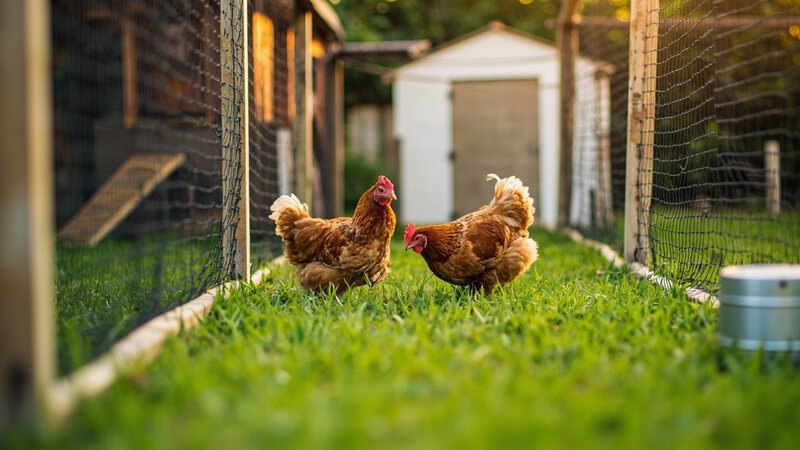
Free range chickens spend the day outdoors and sleep in a locked coop. Plan 8 sq ft of range per standard hen. Bury the fence 12 in. Bantams need half that ground. The coop floor stays 4 sq ft each.
Free range at a glance
Three numbers set up the whole plan. Area per hen, fence height, and the hour the flock comes back. Everything after the table starts there.
Our assumptions for the table: range area is 8 sq ft per standard hen and 4 sq ft per bantam. Penn State gives both numbers. The shape is an 8 ft wide rectangle. That is our guidance.
One long side is easy to walk. Fence length is the perimeter of that rectangle. We count daytime ground only.
The coop floor is a different number. It stays 4 sq ft per hen on the coop size calculator.
- Range area
- 8 sq ft per standard hen; 4 sq ft per bantam
- Range shape
- 8 ft wide rectangle (our guidance)
- Fence height
- 48 in netting
- Fence length
- 24 to 40 ft for 4 to 12 standard hens
- Coop side mesh
- ½ in welded hardware cloth
- Buried edge
- 12 in deep, turned out 6 in
- Out at
- after first light (our guidance)
- In at
- before dusk, then lock the doors
- Water
- 0.44 gal a day for 8 hens at 68°F; 0.85 gal at 89.6°F
- Feed
- about 3 lb a week for a 6 lb hen
Range area and burial: Penn State Extension. Mesh and dusk lock-up: Kentucky Extension ID-245. Water: Kentucky Poultry Production Manual, Chapter 12, Table 12.1. Feed: Minnesota Extension. Netting height and post spacing: maker listing.
| Hens | Range area | Suggested rectangle | Fence length | One 100 ft roll | Suits |
|---|---|---|---|---|---|
| 4 standard | 32 sq ft | 8 × 4 ft | 24 ft | Yes, 24 ft used | Narrow strip by the coop |
| 6 standard | 48 sq ft | 8 × 6 ft | 28 ft | Yes, 28 ft used | One family backyard |
| 8 standard | 64 sq ft | 8 × 8 ft | 32 ft | Yes, 32 ft used | Square range, simple to net |
| 10 standard | 80 sq ft | 8 × 10 ft | 36 ft | Yes, 36 ft used | Standard backyard flock |
| 12 standard | 96 sq ft | 8 × 12 ft | 40 ft | Yes, 40 ft used | Big yard or two ranges |
| 6 bantam | 24 sq ft | 8 × 3 ft | 22 ft | Yes, 22 ft used | Half the ground per bird |
Every cell in that table is one rate plus geometry. Multiply hens by 8 sq ft. Divide by 8 ft for the length. Then add both sides and double it.
One 100 ft roll covers every row here. A 25 × 25 ft square uses the same 100 ft of netting. That is the most ground one roll can fence.
The RentACoop roll is 48 in high and 100 ft long. Thirteen posts come built in, spaced 8.33 ft apart. The 10 hen row needs 36 ft. One roll leaves 64 ft spare.
Size the range for your flock
Measure the ground you have. Then pick the row that fits it. The hen count comes second. A range that is too small shows up as bare ground by the gate.
Ten standard hens need 80 sq ft. That is an 8 × 10 ft range with 36 ft of fence. Twelve hens need 96 sq ft. That is an 8 × 12 ft range with 40 ft of fence.
A 12 × 10 ft patch of yard gives you 120 sq ft. At 8 sq ft each, that holds 15 hens. The fence around it runs 44 ft. If your yard gives 80 sq ft, you are looking at 10 hens.
Now doubt the label. A box says 10 hens, and the range is 32 sq ft. At 8 sq ft each, that fits 4 hens. Divide the area by 8, never the other way round.
Set up the daytime range
The order below works for any yard. Measure first, then fence, then bury the edge, then walk it. If you already own netting, count its posts against your fence line.
- Measure the range and take the fence length from the table.
- Set the corner posts. Space the roll posts as the maker lists them.
- Walk the fence line in one loop. Leave one gate to the coop.
- Cover the coop side opening with ½ in welded hardware cloth.
- Bury the bottom edge 12 in. Turn it out 6 in at the base.
- Stretch netting over the top. Tie it down at every corner.
- Put the drinker in the shade. Keep it away from the feeder.
- Run one hen in the range for a day. Then you can check every corner for gaps.
The posts decide how the netting hangs. This roll carries 13 built-in posts at 8.33 ft. A 36 ft fence line takes about five of them, plus the corners.
Hardware cloth goes on the coop side only. The rest of the line can run on netting. The mesh keeps the hens in. It does not keep wild neighbours out.
Shade is the first addition. Put it far from the gate. Then the birds have somewhere to be. It is not the gate.
The day clock
Out after first light, in before dusk. That window is the point of free ranging. It is also the only part you control.
Kentucky Extension says most poultry can be trained to come in at night. Feed or water them indoors at dusk. Feed at the coop door, then open the gate, and keep that routine.
Same door, same path, every time, so you know where the flock is. Our guidance: a new route each evening puts birds in the wrong corner of the yard.
An automatic door closes the last gap. Our automatic chicken coop doors page compares the timing. It also shows the latches.
Water is the number to watch. It changes with the weather. Eight hens drink about 0.44 gal a day at 68°F. At 89.6°F they drink about 0.85 gal.
One gallon covers about 18 hen-days at 68°F. At 89.6°F it covers about 9. Put a second drinker in the range on a hot afternoon.
Feed does not change when the hens range. A 6 lb hen eats about 3 lb a week, by Minnesota Extension. Free ranging moves the feeder, not the amount in it.
Predators on the range
Four details matter once the hens are outside. The rest of the predator list stays on the predator-proof chicken coop page. Each weak spot there has its own fix.
Bury the bottom edge 12 in and turn it out 6 in. Animals dig at the base of a fence. The apron turns them away. Penn State asks for both numbers on the same line of wire.
Use ½ in welded hardware cloth on the coop side. A raccoon can grab birds and eggs through the wires of an enclosure. Plain chicken wire on the run wall is not enough.
Cover the top with netting to stop hawks and owls. Penn State and Oregon State both ask for a mesh or net roof over the run. Kentucky Extension says to keep the cover tight. Hawks find every loose corner.
Leave a shrub or a small shelter in the range for cover. Kentucky Extension also suggests moving perches out of the area. They sit 100 yards from the flock, and the flock uses them.
Lock the coop at dusk. Kentucky Extension puts it plainly: close and lock all the doors, and keep the flock inside a secured location at night.
An electric fence works as a second line, not the first one. Kentucky Extension sets it to stun rather than kill. That makes it safer for people and better at keeping predators off the range.
Range layouts by yard shape
The same 8 sq ft rule gives different numbers in different yards. Here are four shapes we see often, with the fence length each one needs.
| Yard shape | Ground | Hens at 8 sq ft | Fence length | Why it works | Watch out | |
|---|---|---|---|---|---|---|
| Narrow strip | 3 × 20 ft | 60 sq ft | 7 hens | 46 ft | Long fence for a small flock | Most netting goes on the long side |
| Square | 12 × 12 ft | 144 sq ft | 18 hens | 48 ft | Fewest feet of fence per hen | 18 hens want a bigger shed too |
| Yard corner | 10 × 10 ft | 100 sq ft | 12 hens | 20 ft | The coop and a wall close two sides | One gate on the open side |
| Garden bed | 4 × 12 ft | 48 sq ft | 6 hens | 32 ft | Keeps the hens off the beds | Move it as the plants grow |
A square wastes the least netting. A corner saves more, because the coop and a wall close two sides for you.
Watch the garden bed row. Six hens on 48 sq ft is a small flock in a small pen. It works only if you move it every week or two to fresh ground.
What to check on the label
Four numbers on the box. They decide if the fence works in your yard. Check them in this order, before you order a roll.
Fence length comes first. The roll in the box is 100 ft. The 10 hen row needs 36 ft. Match the length on the label against your row. Do that before you look at anything else.
Height comes next. This netting is 48 in high, which is 4 ft. Bantams fly well, so a low fence wants a net stretched over the top.
Hen counts are the least useful number on the box. Divide the range area by 8 yourself instead of counting the hens on the label.
Electric and non-electric are different products. This roll carries no current and needs no battery. Kentucky Extension has the note on electric fencing, on the predator-proof page.
Our own pick for the fence line is the RentACoop non-electric roll. The maker says the netting can be cut into two 50 ft sections. That suits a yard with two corners. Check the 100 ft figure on the listing against the fence length from the table above.
Common Questions
How much space do free range chickens need?
Give each standard hen 8 sq ft of daytime range and each bantam 4 sq ft, from Penn State. A 10 hen flock needs 80 sq ft, an 8 × 10 ft range with 36 ft of fence. The coop floor is a separate number: 4 sq ft per hen.
Do free range chickens still need a coop?
Yes. The hens sleep, roost and lay in the coop, and you lock the flock in every night. Only the daytime hours change. Kentucky Extension asks for the flock inside a secured location at night, with the doors closed and locked.
How do I stop the hens eating the garden?
Fence the range first, then choose when the hens go out and come back. A fence of 48 in netting around the daytime area keeps them off the beds. If you want the beds back, bring them in before dusk.
What time do I let the hens out and bring them in?
Out after first light and in before dusk. Kentucky Extension says most poultry can be trained to come in at night by feeding or watering them indoors at dusk. Bobcats are visual predators that hunt during the day, but especially in the twilight hours of dawn and dusk.
How long can the hens stay out?
As long as the light holds, in our guidance. Release after first light and bring them in before dusk. On a bad-weather day, shorten the day and leave them in the coop, where the space stays 4 sq ft per hen and you can still reach every bird.
Do the hens need feed and water outside?
Water, yes. Eight hens drink about 0.44 gal a day at 68°F and 0.85 gal at 89.6°F. One gallon covers about 18 hen-days when it is cool, and 9 when it is hot. Feed does not change: a 6 lb hen eats 3 lb a week.
Read next
- GuideChicken run ideas
- GuidePredator proof chicken coop
- GearAutomatic chicken coop doors
- CalculatorCoop size calculator
- GearChicken coops with run
- ListBest egg laying chickens
Sources
- Penn State Extension, Small Scale Poultry Housing (updated 2026): extension.psu.edu (8 sq ft of outside run per laying hen; 4 sq ft per bantam; bury the wire 12 in and toe it out 6 in; cover outside runs with mesh wire or netting for hawks and owls)
- University of Kentucky, ID-245 Predator Management for Small-scale Poultry Enterprises: publications.mgcafe.uky.edu (movable fences for free-ranging; lock the doors at night; feed indoors at dusk; ½ in welded hardware cloth; net the run and keep it secure; bobcats hunt during the day, especially in the twilight hours of dawn and dusk; perches 100 yards away; electric fence set to stun)
- University of Kentucky, Poultry Production Manual, Chapter 12 Introduction (Table 12.1 water consumption): afs.mgcafe.uky.edu (layer hens 5.55 gal per 100 birds a day at 68°F, 10.57 at 89.6°F; the 8 hen and hen-day figures are our count from those two numbers)
- Oregon State University Extension, EC 1644 Backyard chicken coop design (2014, reviewed 2023): extension.oregonstate.edu (add netting or wire over the top of the run)
- University of Minnesota Extension, Raising chickens for eggs (reviewed 2025): extension.umn.edu (3 to 5 sq ft of indoor space per bird, we use 4; a 6 lb hen eats roughly 3 lb of feed each week)
- Netting length, height, post spacing and material: maker listing on Amazon, ASIN B0B69MSBNZ, read 2026-11-02
- Range areas, fence lengths, yard shapes and the release time: our count from the Penn State rate, worked out on this page
How we pick and check numbers: How we research.