Ameraucana Chicken: Blue Eggs, Pea Comb and What 5.5 Pound Hens Need
Coopgauge is reader-supported. When you buy through links on this page, we may earn a commission.
Blue eggs from a breed with a written standard? The Ameraucana is the one. A standard hen weighs 5.5 lb, a rooster 6.5 lb, and the shell is blue.
Hatcheries estimate 180 to 200 eggs a year. One Townline line is reported near 250. The exception sits on the label: an Americana is not an Ameraucana.
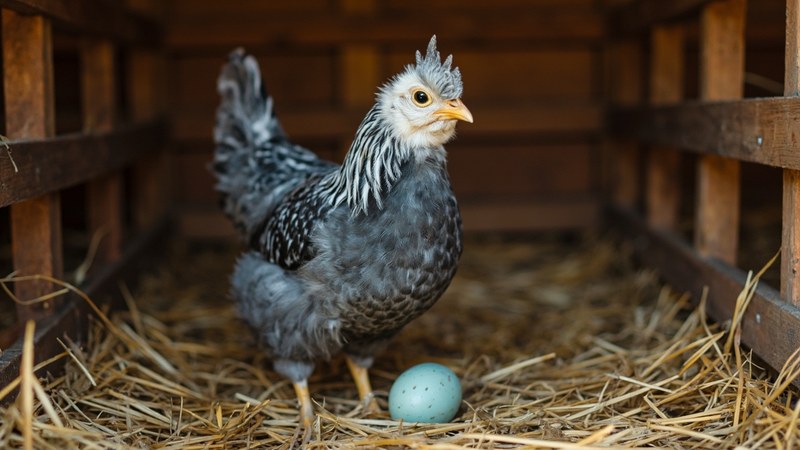
- Size class
- Large fowl, standard; a bantam line also exists
- Weight range
- Hen 5.5 lb; rooster 6.5 lb
- Eggs per year (range)
- About 180 to 200 (Cackle); about 250 (Townline line)
- Egg color
- Blue shell; a few light green
- Comb type
- Pea comb, small wattles
- Feather colors
- Ten standard varieties, from Black to Splash
- Cold & heat tolerance
- Good in cold; pea comb suits many climates
- Temperament
- Active and flighty; wary but calm
- Broodiness
- Non setter
- Space per bird
- 4 sq ft inside (standard)
Weights, comb, varieties and disqualifications: the Ameraucana Alliance standard. Egg count, egg size, broodiness and temperament: Cackle Hatchery. Start of laying and cold tolerance: Townline Hatchery. Space: our calculator.
What sets this bird apart from an Easter Egger? A written standard. The American Poultry Association recognized the Ameraucana in 1984, and the breed club still publishes that standard.
Araucana birds carry ear tufts and no tail. Ameraucana birds have muffs, a beard and a full tail.
So check four things before you trust a name. The comb is a pea comb, small and low. Muffs and beard cover the face, on hens as well as roosters.
The legs are slate grey, with four toes and no feathering. Ear tufts are a disqualification. That points to an Araucana or a cross.
| Variety | APA admitted |
|---|---|
| Black | 1984 |
| Blue | 1984 |
| Blue Wheaten | 1984 |
| Brown Red | 1984 |
| Buff | 1984 |
| Silver | 1984 |
| Wheaten | 1984 |
| White | 1984 |
| Self Blue | 2020 |
| Splash | 2023 |
Eight varieties were admitted in 1984. Self Blue joined in 2020 and Splash in 2023. The list in a hatchery catalogue is newer than most breed books.
Hatcheries and sellers call the Self Blue variety lavender. The breed club agrees in plain words: what they call self blue is really the lavender variety. That lavender gene was named in 1972. Buy lavender Ameraucanas and you are looking at the Self Blue line.
Free-range or confined?
The floor numbers matter more here than on most breeds. These birds are active, and they fly. Work from 4 sq ft of house floor and 8 sq ft of run per hen. Then adjust for a flock that ranges free.
| Setup | Fits an Ameraucana? | Space per bird | Notes |
|---|---|---|---|
| Coop with run | Yes | 4 sq ft inside, 8 sq ft run | Run needs a top; these birds fly |
| Mobile coop on wheels | Yes, for a small flock | same figures | Move it to fresh grass |
| Free range by day | Yes | 3 sq ft inside | Night housing still counts |
| Cold-climate coop | Yes | same figures | Keep vents high; pea comb, small wattles |
Our assumptions: 4 sq ft of house floor per standard hen, 8 sq ft of run, 8 in of roost per hen, and 1 nest box per 4 hens. The floor figure sits in the middle of the 3 to 5 sq ft range from Minnesota Extension.
| Hens | House floor (sq ft) | Run (sq ft) | Roost (in) | Nest boxes |
|---|---|---|---|---|
| 4 | 16 | 32 | 32 | 1 |
| 6 | 24 | 48 | 48 | 2 |
| 8 | 32 | 64 | 64 | 2 |
Six hens is the flock this page keeps returning to. Six Ameraucana birds need 24 sq ft of house floor and 48 sq ft of run. Add 48 in of roost bar and two nest boxes.
One figure changes when the flock ranges free. Oregon State gives 3 sq ft per bird when the birds have outdoor access. Six hens then drop to 18 sq ft inside.
The run still wants 48 sq ft. Measure the house first, then decide how many birds you can keep.
Coop & run setup
Set the roost 2 ft off the floor, with 8 in of bar per hen. Penn State gives 6 in for a standard hen. Oregon State gives 5 to 10 in, so 8 in sits inside both. Penn State also caps the perch at 4 ft.
Nest boxes go the other way. Give 1 box per 4 hens, about 12 in on every side. Keep them at least 2 ft off the ground, and never lower than the roost.
Penn State asks for 4 ft between the boxes and the roost, so hens do not sleep in them.
Ventilation matters because of the comb. A pea comb is a small comb, and Cackle Hatchery notes that this breed carries small wattles. That suits it to many climates. Keep vents high on the walls, and keep cold air off the roost.
The run needs more thought than the coop. Cackle Hatchery calls the breed active and flighty. Townline Hatchery calls its line wary but calm, and a good free-range bird.
Either way, you plan a mesh top, a covered side, and a ramp a 5.5 lb hen can walk up without stopping.
A wheeled house is worth it only if you move it. This one is 83.3 in long and rides on larger, wider metal wheels. You can shift the run to fresh grass and away from bare ground. The maker rates it for 4 to 8 birds.
The label says 4 to 8 chickens. The house section is 8.84 sq ft. At 4 sq ft per standard hen, that is two hens.
The maker counts smaller birds in that number. Penn State gives bantams 1 sq ft inside, and our calculator uses 2 sq ft. At either figure, 8.84 sq ft fits bantams.
For six standard Ameraucana hens you want 24 sq ft of floor. Look for a bigger house or a fixed coop. Keep this one for the birds that fly.
Our coop size calculator does the same arithmetic for your flock, so you can change the bird count.
For nest box sizes and heights, see the nesting box page. For a fixed coop instead of a mobile one, the chicken coop guide covers the floor plans.
Feeding
You feed this breed like any layer. Starter first, then grower, then a complete layer feed at 14 to 16% protein.
University of Maine says to make that switch no more than 2 weeks before the first egg. Townline Hatchery puts the first egg at about 22 weeks for its strain.
Amounts follow body weight. Minnesota Extension gives about 3 lb of feed a week for a 6 lb hen. A 5.5 lb hen eats a little under that, so six of them run 15 to 18 lb a week.
Weigh one bag and date it. That number tells you what the feeder has to hold. Match your bag size to it.
A 30 lb feeder covers that flock for 12 to 14 days. Six hens eat 15 to 18 lb a week, so one fill lasts a fortnight.
The 30 lb galvanized feeder in the box above is that size: 30 lb, six ports, and a lid that locks down.
Put oyster shell and grit in a second dish. Let the hens take what they need. University of Maine recommends oyster shell free choice for laying hens, whatever the calcium level in the bag.
Water comes first on the list of equipment. Give the flock constant access to clean, fresh water, and change it every day. In winter, check that the waterer does not freeze over. Our feeding guide covers the switch by week.
Hatching: broody hen or incubator?
Cackle Hatchery lists this breed as a non setter. So you plan on a machine rather than a hen on a nest. Texas A&M AgriLife Extension gives 21 days at 99.5 to 100°F for chicken eggs, whatever the shell color.
Those three numbers are the setting you program into the incubator. Next comes the brooder: heat source, feed, water and space per chick, week by week. Our brooder setup page has that table.
Compared with similar breeds
The Araucana is the closest standard breed. The difference is easy to name. Araucana birds have ear tufts and no tail. Ameraucana birds have muffs and a tail.
The Easter Egger is a cross rather than a breed. The Olive Egger is a cross that lays green eggs. Read both pages before you pick a blue-egg layer.
| Breed | Hen weight | Rooster weight | Eggs per year | Egg color | Comb | Broodiness | Standard breed? |
|---|---|---|---|---|---|---|---|
| Ameraucana | 5.5 lb | 6.5 lb | 180 to 200 | Blue, some light green | Pea | Non setter | Yes |
| Araucana | up to 4 lb | 5 lb | 150 to 200 | Blue | Pea | Setter | Yes |
| Easter Egger | 5.5 lb | not listed | 200 to 280 | Green, blue, pink | Small comb and wattles | Variable | No, a cross |
| Olive Egger | 4.5 to 5.5 lb | 5.5 to 6.5 lb | 180 to 220 | Olive green | Pea or single | Rarely broody | No, a cross |
The egg counts sit closer together than the birds do. Araucana and Ameraucana share the 150 to 200 band. The Olive Egger range runs to 220, and the Easter Egger range reaches 280. Two hatcheries put the Ameraucana in different places, so the chart shows both.
Weight is the practical difference for the coop. A 5.5 lb hen needs a 12 in nest box and 8 in of roost. An Araucana at 4 lb or less needs less of both. A mixed flock of blue-egg layers works on the same plan.
Where to get chicks
Most mail-order hatcheries sell this breed by variety color: blue, black, splash, lavender, buff. Farm feed stores sell birds under the name Americana. The breed club puts that name bluntly: there is no breed called Americana.
It is usually a misspelling of Ameraucana, or a cross sold with a famous word attached. So read the card before you order.
Is the comb a pea comb? Are there muffs and a beard? Is the tail complete? Are there ear tufts? Those four checks separate the standard bird from the look-alike.
Hens lay without a rooster. If you want fertile eggs, Townline Hatchery pairs one rooster with 6 to 10 hens. Cackle Hatchery gives 9 to 1. Measure your coop first. The table above tells you how many birds fit.
Common Questions
How many eggs does an Ameraucana lay a year?
Cackle Hatchery estimates 180 to 200 a year and calls the egg medium-large. Townline Hatchery gives about 250 blue eggs a year for its Americana strain, which is a different line. One hen lays 3 to 4 eggs a week, so a dozen takes a little over three weeks.
Are Ameraucana and Easter Eggers the same?
No. The Ameraucana is a standard breed with a written standard. It has a pea comb, a beard, a tail and no ear tufts. The Easter Egger is a cross, so the comb, size and egg color vary bird to bird. Buy the standard breed if the muffs matter to you.
How do I know I have a real Ameraucana?
Look at four things: a pea comb, muffs and beard around the face, a complete tail, and no ear tufts. The legs should be slate grey, with four toes and no feathering. Ear tufts and missing muffs are disqualifications. A bird with either one is an Araucana or a cross.
Do Ameraucana hens go broody?
Not often. Cackle Hatchery lists the breed as a non setter, so do not plan on a hen hatching a brood for you. If you want chicks, use an incubator. Texas A&M AgriLife Extension gives 21 days at 99.5 to 100°F for chicken eggs.
How much does an Ameraucana hen weigh?
5.5 lb for a standard hen, and 6.5 lb for a rooster. Those are the standard weights, through the breed club. Cackle Hatchery gives the same 5.5 and 6.5 lb, plus 4.5 lb for a pullet. Add 8 in of roost and a 12 in nest box per hen.
Is the Ameraucana a high-producing layer?
It sits in the middle of the range rather than at the top. The 180 to 200 estimate, and the 250 figure from one line, put it close to other blue-egg layers. The eggs are medium-large rather than extra large. Judge it on the blue shell and the pea comb.
Read next
Sources
- The Ameraucana Alliance, Ameraucana Standard (APA Standard of Perfection 1998): ameraucana.org. Standard weights rooster 6.5 lb, hen 5.5 lb, cockerel 5.5 lb, pullet 4.5 lb. Pea comb, small wattles, muffs and beard, four toes, legs not feathered. Ear tufts and missing muffs are disqualifications. Varieties: eight in 1984, Self Blue 2020, Splash 2023.
- The Ameraucana Alliance, Ameraucana Chickens, John W Blehm: ameraucana.org. Araucana has ear tufts and no tail. Ameraucana has muffs and a tail, and both have pea combs and blue eggs. The Easter Egg is a cross. Americana is not a breed name. Only blue and white are true shell colors. Self blue is the lavender variety, named 1972. APA recognized Ameraucana in 1984.
- Cackle Hatchery, Blue Ameraucana breed facts: cacklehatchery.com. Hen 5.5 lb, rooster 6.5 lb, pullet 4.5 lb, cockerel 5.5 lb. Blue shell, some light green. 180 to 200 eggs a year, an estimate, medium-large. Active and flighty. Non setter. 9 to 1. Roost 4 ft or more.
- Townline Hatchery, Araucana, Ameraucana strain: townlinehatchery.com. About 250 blue eggs a year. First egg at about 22 weeks. Excellent cold tolerance. Suited to free range. Wary but calm. One rooster to 6 to 10 hens.
- The Livestock Conservancy, Araucana chicken and Heritage Chicken Breed Comparison Chart 2026: livestockconservancy.org and livestockconservancy.org. Rooster 5 lb, hen up to 4 lb. 150 to 200 blue eggs, medium to large. Setters, docile.
- Oregon State University Extension, EC 1644 Backyard Chicken Coop Design, 2014, reviewed 2023: extension.oregonstate.edu. 3 sq ft per bird with outdoor access. 5 to 10 in of roost per bird. One nest box per 4 birds. Box 12 in on each side.
- Penn State Extension, Small Scale Poultry Housing, updated 2026: extension.psu.edu. 6 in of roost per standard hen. Perch no higher than 4 ft. Nest boxes at least 4 ft from the roost, and 2 ft off the floor. 8 sq ft of outdoor space per laying hen.
- University of Minnesota Extension, Raising chickens for eggs, reviewed 2025: extension.umn.edu. 3 to 5 sq ft of indoor space per bird. About 3 lb of feed a week for a 6 lb hen.
- University of Maine Cooperative Extension, Bulletin #2222 Nutrition for Backyard Chicken Flocks in Maine: extension.umaine.edu. Layer feed at 14 to 16% protein. Switch to layer feed no more than 2 weeks before laying. Oyster shell free choice.
- Texas A&M AgriLife Extension, POSC-PU-018 Incubating and Hatching Eggs, 2022: agrilife.org. 21 days at 99.5 to 100°F.
- Coop size, run area, roost and boxes for 4, 6 and 8 hens: our math, read 2026-11-02.
- Coop size, house and run area, perches, nesting boxes and footprint: maker listing on Amazon, ASIN B0H45N2ZWS, read 2026-11-12.
- Feeder capacity, ports, material and lid: maker listing on Amazon, ASIN B0DNXGNBYB, read 2026-11-02.
How we pick and check numbers: How we research.