Olive Egger Chicken: Green Eggs from a Hardy Cross
Coopgauge is reader-supported. When you buy through links on this page, we may earn a commission.
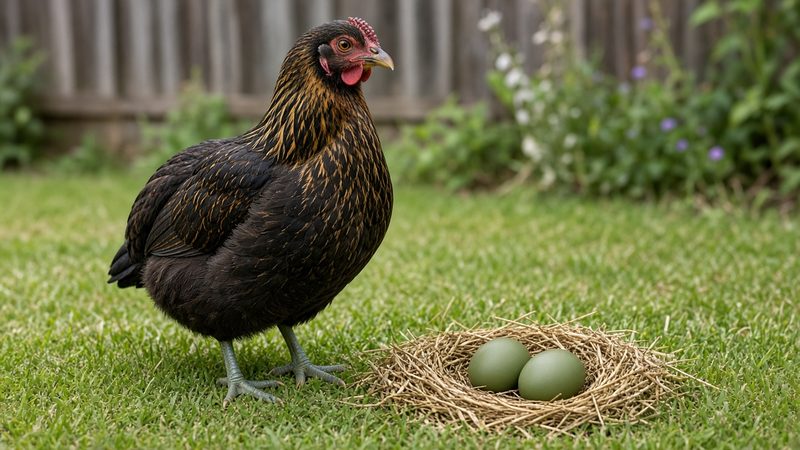
Olive Egger chickens suit keepers who want green eggs and a steady, hardy layer. Hens weigh about 4.5 to 5.5 lb and lay around 180 to 220 medium olive green eggs a year. They handle both cold and heat, and they rarely go broody.
- Size class
- Standard (crossbred)
- Weight range
- Hen 4.5 to 5.5 lb; rooster 5.5 to 6.5 lb
- Eggs per year (range)
- About 180 to 220
- Egg color
- Olive green; some green, brown or pink
- Comb type
- Pea or single (mixed parent lines)
- Feather colors
- Varied; no fixed standard
- Cold & heat tolerance
- Cold and heat hardy
- Temperament
- Calm, docile
- Broodiness
- Rarely broody
- Space per bird
- 4 sq ft inside (standard)
All fields except space: Townline Hatchery Olive Egger facts; Cackle Hatchery gives hen 5.5 lb and 180 to 200 eggs. Space: our calculator.
An Olive Egger is a cross, not a breed with a written standard. A blue egg layer is crossed with a dark brown egg layer. The brown pigment coats the blue shell, and the result is olive green. Townline Hatchery notes the shells can also run green, brown or even pink.
Because it is a cross, there is no APA class and no fixed look. Feathers and combs vary from bird to bird. Townline Hatchery says the maternal line carries a pea comb and the paternal line a single comb, so you may see either.
What stays steady is the egg. Every hen in an Olive Egger flock lays some shade of green. Next to brown and blue eggs, the carton looks like a paint chart. That is most of the reason keepers add two or three to a flock.
They are also easy hens. Calm, hardy and steady. Not fussy about weather. Not prone to sitting on eggs for weeks. For a first flock, that is a short list of worries.
Free-range or confined?
| Setup | Fits an Olive Egger? | Space per bird | Notes |
|---|---|---|---|
| Coop with run | Good | 4 sq ft inside, 8 sq ft run | Calm in a run |
| Free range by day | Good | same coop figures | Active forager |
| Hot or cold climate | Good | same | Townline: cold and heat hardy |
Olive Eggers fit almost any setup. Townline Hatchery lists them as calm and docile, and as hardy in both cold and heat. Cackle Hatchery calls them active. In practice, that means a hen that forages well but settles in a run without fuss.
Use the standard figures: 4 sq ft inside and 8 sq ft of run per hen. Four Olive Eggers need 16 sq ft of coop and 32 sq ft of run. Our coop size calculator covers mixed flocks too.
Coop & run setup
Olive Eggers need nothing special in the coop. Set the roost about 2 ft up with 8 in per hen, and vents high on the walls. Cackle Hatchery lists a roost height of 4 ft or more for its line, so these hens will use a higher perch if you offer one. Penn State caps perches at 4 ft.
Nest boxes are the part to get right. A green egg is the prize, and a clean box keeps it bright. Give 1 box per 4 hens, about 12 in each way, with 2 in of shavings. Our nesting box page covers height and placement.
A three-hole box covers a flock of 9 to 12 hens. The maker rates each compartment for 3 to 5 hens, which sits close to the extension figure of 1 box per 4. Metal boxes hose clean and stand up to years of use. Check the 3 compartments on the listing against your flock size.
Collect eggs daily. A green shell shows dust and scuffs. Fresh shavings keep it clean. Clean eggs need less work in the kitchen.
Feeding
Feed Olive Eggers like any layer. Chick starter first, then grower, then a complete layer feed when the first egg arrives. Townline Hatchery gives an average start of 20 to 22 weeks. University of Maine says to switch no more than 2 weeks before laying begins. Our feeding guide covers the switch.
Olive Eggers are mid-sized hens, so they eat a little less than a heavy Orpington. Minnesota Extension gives about 3 lb a week for a 6 lb hen. A 5 lb Olive Egger eats a bit under that. Keep the feeder full and let them eat freely.
Hatching: broody hen or incubator?
Olive Eggers are not reliable sitters. Townline Hatchery lists them as rarely broody, and Cackle Hatchery as variable. If you want chicks, an incubator or a broody hen of another breed is the safer plan.
Note that chicks from two Olive Eggers will not all lay olive eggs. The color comes from the cross. Texas A&M AgriLife Extension gives 21 days for chicken eggs at 99.5 to 100°F, whatever the shell color.
Compared with similar breeds
| Breed | Hen weight | Eggs per year | Egg color | Broodiness |
|---|---|---|---|---|
| Olive Egger | 4.5 to 5.5 lb | 180 to 220 | Olive green | Rarely broody |
| Easter Egger | 5.5 lb | 200 to 280 | Green, blue, pink | Variable |
| Marans (French Black Copper) | 6.5 lb | 200+ | Dark brown | Setter |
Olive Egger crosses
An F1 Olive Egger is the first cross: a blue-egg hen and a dark-brown-egg rooster, or the reverse. Townline Hatchery and Tractor Supply both describe that cross. Sapphire Olive Egger and Black Olive Egger are hatchery line names, not APA breeds. Ask the hatchery which parents it uses. The shell shade follows those parents.
Olive Egger vs Easter Egger
An Easter Egger lays blue, green or pink, and each hen keeps one color. An Olive Egger lays olive green because brown pigment covers a blue shell. Both are mixes, not APA breeds. Easter Eggers on the Cackle list lay 200 to 280 eggs. Olive Eggers on the Townline list lay 180 to 220.
Pros and cons
Pros. Hens weigh 4.5 to 5.5 lb, so four need 16 sq ft at 4 sq ft each. Townline lists 180 to 220 olive eggs a year. The same page calls them hardy in cold and heat, and rarely broody.
Cons. There is no written standard, so feather color and comb type vary. Egg shade varies with the parents. You cannot assume the chicks of two Olive Eggers will all lay olive eggs.
Where to get chicks
Olive Eggers are sold by most mail-order hatcheries as day-old chicks in spring. Each hatchery uses its own parent breeds, so egg shade and feather color vary from source to source. Read the listing for the parent breeds and the shell color range before you order.
Buy at least three hens. Chickens settle best in a small group. Ask whether the chicks are sexed, and check your local rules on roosters before you order a straight run.
Common Questions
What color eggs do Olive Eggers lay?
Olive green, per Townline Hatchery, with some hens laying other green, brown or pink shades. Shade varies with the parent breeds.
How many eggs does an Olive Egger lay?
About 180 to 220 a year by Townline Hatchery, or 180 to 200 by Cackle Hatchery.
Is an Olive Egger a real breed?
No. It is a cross between a blue egg layer and a dark brown egg layer, with no APA standard.
Do Olive Eggers go broody?
Rarely, per Townline Hatchery. Cackle Hatchery lists broodiness as variable.
Do Olive Egger roosters crow?
Yes. A rooster crows. We do not have a published volume for an Olive Egger rooster. Check town rules before you keep one.
Read next
- HubChicken breeds
- BreedEaster Egger chicken
- BreedMarans chicken
- ListBest egg laying chickens
- DataEgg color chart by breed
Sources
- Tractor Supply, Olive Egger Chicken Breed Guide: tractorsupply.com (cross of a blue egg layer and a dark brown egg layer)
- Townline Hatchery, Olive Egger breed facts: townlinehatchery.com (hen 4.5 to 5.5 lb, rooster 5.5 to 6.5 lb; 180 to 220 eggs; olive, possible green, brown, pink; medium 1.75 oz; starts 20 to 22 weeks; calm, docile; cold and hot hardy; rarely broody; pea or single comb; cross-breed, not APA)
- Cackle Hatchery, Olive Egger breed facts: cacklehatchery.com (hen 5.5 lb; 180 to 200 eggs; active; broodiness variable; roost 4+ ft)
- Cackle Hatchery, Easter Egger breed facts: cacklehatchery.com (Easter Egger hen 5.5 lb; 200 to 280 eggs)
- Cackle Hatchery, French Black Copper Marans breed facts: cacklehatchery.com (Marans hen 6.5 lb; 200+ eggs; setter)
- Penn State Extension, Small Scale Poultry Housing (updated 2026): extension.psu.edu (perch no higher than 4 ft; 2 in shavings)
- University of Maine Cooperative Extension, Bulletin #2222 Nutrition for Backyard Chicken Flocks in Maine: extension.umaine.edu (switch to layer within 2 weeks of laying; oyster shell free choice)
- Texas A&M AgriLife Extension, POSC-PU-018 Incubating and Hatching Eggs (2022): agrilife.org (21 days at 99.5 to 100°F)
- Compartments, hens per compartment, material: maker listing on Amazon, ASIN B0FPFHBBNG, read 2026-10-12
How we pick and check numbers: How we research.