Easter Egger Chicken: Blue and Green Eggs from a Friendly Forager
Coopgauge is reader-supported. When you buy through links on this page, we may earn a commission.
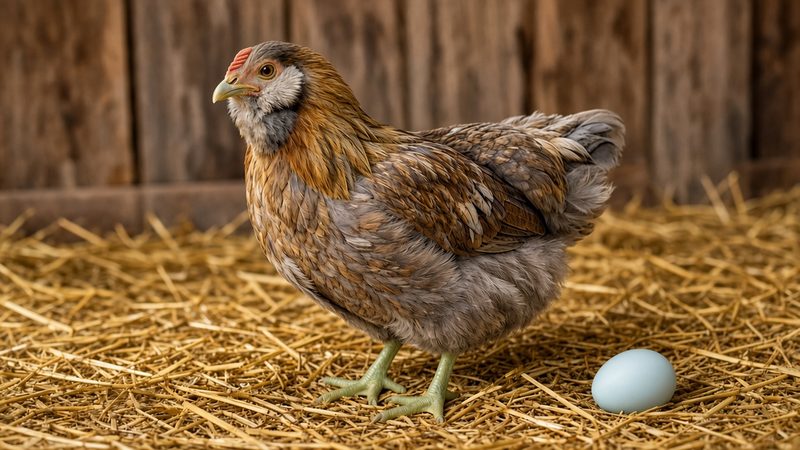
Easter Egger chickens suit keepers who want colored eggs from a friendly, easy hen. Hens weigh about 4 to 5.5 lb and lay around 200 to 280 eggs a year in blue, green or pink. They forage well, handle cold and heat, and seldom go broody.
- Size class
- Standard (mixed heritage; bantams exist)
- Weight range
- Hen about 4 to 5.5 lb; rooster 5 to 6.5 lb
- Eggs per year (range)
- About 200 to 280 (hatchery estimates)
- Egg color
- Blue, green, pink or tan; one color per hen
- Comb type
- Small comb and wattles
- Feather colors
- Many; no fixed standard
- Cold & heat tolerance
- Cold and heat hardy; better in cold
- Temperament
- Docile to active
- Broodiness
- Low to variable
- Space per bird
- 4 sq ft inside (standard)
Weight, eggs, egg color and broodiness: Cackle Hatchery and Tractor Supply. Comb, climate and temperament: Tractor Supply guide. Space: our calculator.
Easter Eggers are not a recognized breed. They are mixed birds with Ameraucana or Araucana blood, which carries the blue egg gene. Tractor Supply notes that this heritage makes them a little smaller than average hens. Their size suits a small coop well.
Each hen lays one color for life. One may lay sky blue, another sea green, another pinkish tan. Cackle Hatchery lists green, blue, pink and mixed shells. A flock of four can fill a carton with three or four shades.
That surprise is the fun of them. You do not know the color until the first egg lands. Tractor Supply puts their output around 280 large eggs a year, and Cackle Hatchery gives a range of 200 to 280. Either way, they are among the better layers in a backyard flock.
They are easy to live with, too. Tractor Supply calls them docile. They come in so many feather colors that every hen looks a little different. Children can tell them apart and name them, which makes them a family favorite.
Free-range or confined?
| Setup | Fits an Easter Egger? | Space per bird | Notes |
|---|---|---|---|
| Free range by day | Best fit | 4 sq ft inside | Strong forager |
| Mobile coop or tractor | Good | 4 sq ft inside | Move it before the grass is bare |
| Coop with run | Good | 4 sq ft inside, 8 sq ft run | Tractor Supply: works well in both |
Easter Eggers love to range. Tractor Supply says they work well in a pen or free range, and they spend the day scratching and searching. If you have a safe yard, a few hours out each day suits them well.
Range time does carry risk. Bring the flock in well before dusk, and give them cover from hawks in the open yard. A shrub, a table or a small shelter all help.
In a fixed coop, use the standard figures: 4 sq ft each inside and 8 sq ft of run. Five Easter Eggers need 20 sq ft of coop and 40 sq ft of run. Our coop size calculator covers any count.
Coop & run setup
A mobile coop is a natural fit for a forager. It gives the flock fresh grass while keeping them inside a frame at night. Move it every few days before the ground gets bare. Our chicken tractor guide covers move schedules and skirts.
Set the roost about 2 ft off the floor with 8 in per hen. Cackle Hatchery notes its Easter Eggers will roost 4 ft or higher if they can, but Penn State caps perches at 4 ft. Give 1 nest box per 4 hens.
The RUNSHED listing says 4 to 6 chickens and is 80 in long. Four Easter Eggers need 16 sq ft at 4 sq ft each. Measure the house floor before you count on 4. A mobile coop is a different tool. See the chicken tractor page for a coop you move. This RUNSHED coop stays put.
Small combs help in winter. Tractor Supply notes that Easter Eggers have smaller combs and wattles and tolerate cold better than heat. In summer, give them shade and airflow, and keep water cool and close.
Feeding
Feed Easter Eggers a complete layer feed from their first egg. University of Maine gives 14 to 16% protein for dual-purpose layers. Foraging adds variety, but it does not replace the feed. Keep oyster shell and grit in separate dishes.
A ranging flock still eats most of its diet from the feeder. Minnesota Extension gives about 3 lb a week for a 6 lb hen. A 5 lb Easter Egger eats a little less. Six hens go through roughly 15 to 18 lb a week. Our feeding guide and feeder page cover amounts.
A treadle feeder suits a flock that spends time outdoors. The lid opens when a hen steps on the plate. The one above holds 20 lb. Six hens at roughly 15 to 18 lb a week will empty a 20 lb fill in a little over a week.
Train the hens to the treadle over a few days. Prop the lid open at first, then lower it bit by bit. Most hens learn by watching the others.
Hatching: broody hen or incubator?
Most Easter Eggers do not sit. Tractor Supply says breeders largely bred broodiness out of the line, though results vary with the mix. Cackle Hatchery lists broodiness as variable. Plan on an incubator if you want chicks.
Chicks from Easter Eggers may lay different colors from their mothers. Texas A&M AgriLife Extension gives 21 days for chicken eggs at 99.5 to 100°F. Our brooder setup guide covers the weeks after.
Compared with similar breeds
| Breed | Hen weight | Eggs per year | Egg color | Broodiness |
|---|---|---|---|---|
| Easter Egger | 4 to 5.5 lb | 200 to 280 | Blue, green, pink | Low to variable |
| Olive Egger | 4.5 to 5.5 lb | 180 to 220 | Olive green | Rarely broody |
| Easter Egger bantam | 26 oz | 100 to 200 | Green, blue, pink | Setters |
Easter Egger vs Olive Egger vs Ameraucana
An Easter Egger is not a recognized breed. Tractor Supply and Cackle Hatchery both say so. It is a mix that carries the blue egg gene, and each hen lays one color for life: blue, green or pink. An Olive Egger is a cross of a blue-egg bird and a dark-brown-egg bird, and the shells run olive green. The Ameraucana is the recognized breed. Stores sometimes use the names as if they were the same bird. Read the label, then read the standard.
Pros and cons
Pros. Cackle Hatchery lists 200 to 280 eggs a year. Tractor Supply calls them docile and hardy in cold and heat. Hens weigh about 4 to 5.5 lb, so four need 16 sq ft at 4 sq ft each.
Cons. Egg color is not a choice you make. Each hen locks in one color. Broodiness is low on the Tractor Supply note, so do not count on a hen to sit. Feather color has no standard.
For tight spaces, the Easter Egger bantam weighs about 26 oz, per Cackle Hatchery, and needs half the coop floor. That 26 oz figure is a bantam figure, not the standard hen. Unlike the standard size, Cackle lists its bantams as setters.
For a calm, heavy hen next to your Easter Eggers, add an Orpington or a Barred Rock. Both lay brown eggs, which round out the color mix in the carton.
Where to get chicks
Easter Eggers are one of the most common chicks at farm stores each spring. Mail-order hatcheries sell them too, often as pullets. Some stores label them Americanas. The recognized breed is the Ameraucana, which has its own written standard.
Order pullets if you can. Sexed chicks spare you surprise roosters. Buy three or more, so the flock settles quickly.
Common Questions
What color eggs do Easter Eggers lay?
Blue, green, pink or tan. Each hen lays one color, and a flock often lays several.
How many eggs does an Easter Egger lay?
About 200 to 280 a year by Cackle Hatchery, and around 280 by Tractor Supply. Real flocks vary.
Are Easter Eggers good for beginners?
Yes. Tractor Supply calls them docile and hardy in cold and heat, and they fit a small coop.
Is an Easter Egger the same as an Ameraucana?
No. The Ameraucana is a recognized breed. Easter Eggers are mixed birds that carry its blue egg gene.
Do Easter Eggers lay every day?
Not as a rule. Cackle lists 200 to 280 eggs a year, which is about 4 to 5 a week, not 7. A hen also skips a day because each egg takes 24 to 26 hours. See how many eggs a day.
Read next
- HubChicken breeds
- BreedOlive Egger chicken
- ListBest egg laying chickens
- DataHow many eggs a day
- DataWhich hens lay blue eggs
Sources
- Cackle Hatchery, Easter Egger breed facts: cacklehatchery.com (hen 5.5 lb, rooster 6.5 lb; 200 to 280 eggs; green, blue, pink, multi; active; broodiness variable; roost 4 to 6 ft; not APA)
- Tractor Supply, Easter Egger Chicken Guide (PDF): tractorsupply.com (hens about 4 lb, roosters 5 lb; smaller due to Ameraucana and Araucana heritage; around 280 large eggs; broodiness largely bred out; heat and cold hardy, better in cold; smaller comb and wattles; docile; pen or free range)
- Cackle Hatchery, Easter Egger Bantam breed facts: cacklehatchery.com (bantam hen 26 oz; 100 to 200 eggs; setters)
- Townline Hatchery, Olive Egger breed facts: townlinehatchery.com (Olive Egger 4.5 to 5.5 lb; 180 to 220 eggs; rarely broody)
- Penn State Extension, Small Scale Poultry Housing (updated 2026): extension.psu.edu (perch no higher than 4 ft)
- University of Maine Cooperative Extension, Bulletin #2222 Nutrition for Backyard Chicken Flocks in Maine: extension.umaine.edu (dual-purpose layer protein 14 to 16%)
- University of Minnesota Extension, Raising chickens for eggs (reviewed 2025): extension.umn.edu (3 lb feed a week for a 6 lb hen)
- Texas A&M AgriLife Extension, POSC-PU-018 Incubating and Hatching Eggs (2022): agrilife.org (21 days at 99.5 to 100°F)
- RUNSHED 80 in coop with run, label says 4 to 6 chickens: maker listing on Amazon, ASIN B0H2DW68D8, title read 2026-10-23
- Feeder capacity and hens served: maker listing on Amazon, ASIN B00TXW0UQK, read 2026-10-12
How we pick and check numbers: How we research.