Polish Chicken: White Eggs from a Crested, Showy Hen
Coopgauge is reader-supported. When you buy through links on this page, we may earn a commission.
Polish chickens suit keepers who want white eggs and a show bird in one flock. A Polish hen weighs 4.5 lb and lays about 150 white eggs a year. The catch is the crest. Those feathers hide a bird's sight. A 4.5 lb Polish also flies well, so the run needs a roof.
- Size class
- Standard (APA class: Continental)
- Weight range
- Hen 4.5 lb, rooster 6 lb; bantam rooster 850 g, hen 740 g
- Eggs per year (range)
- About 150 to 200
- Egg color
- White
- Egg size
- Medium to large
- Comb type
- V comb, usually hidden by the crest; white earlobes, red wattles
- Feather colors
- 11 recognized varieties, admitted 1874 to 1996
- Cold & heat tolerance
- Handles heat and cold, but not extremes; prefers a dry, warm climate
- Temperament
- Calm, but flighty when disturbed
- Broodiness
- Non-setter
- Space per bird
- 4 sq ft inside, 8 sq ft run, our planning values; Penn State's minimum for a laying hen is 1.5 sq ft inside and 8 sq ft of run
Weights, eggs, egg size, comb, temperament, broodiness and roost height: Cackle Hatchery and The Livestock Conservancy. Bantam weights: the APA figures quoted by Wikipedia. Variety years: APA Recognized Breeds and Varieties. Space: Penn State and our calculator.
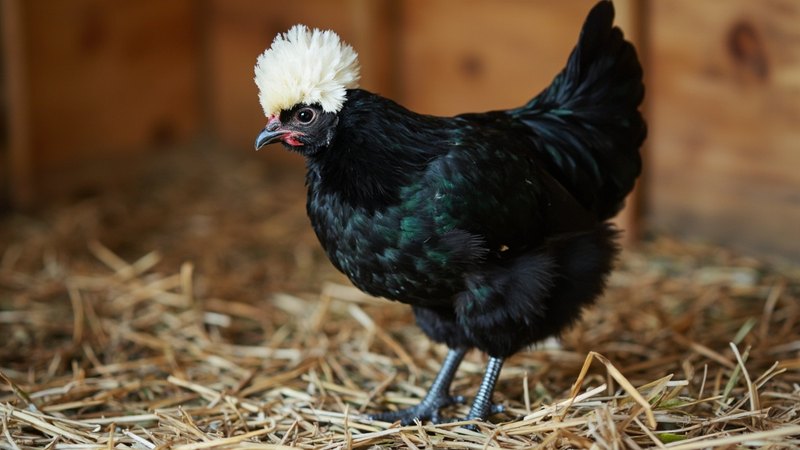
The crest is the whole look of the bird. Cackle Hatchery sells the White Crested Black variety. The body is glossy black, and the crest is mostly white.
The comb under it is a red V shape. Head feathers often hide it. The crest fills out as the bird grows.
Underneath the feathers the breed is ordinary. Gray legs, four toes, no leg feathering, white earlobes and red wattles, by the Livestock Conservancy. It lays white eggs, about 150 a year by that breed page. The 2026 breed chart rates the lay very good.
Free-range or confined?
| Setup | Fits Polish? | Space per bird | Notes |
|---|---|---|---|
| Covered run with a coop | Best fit | 4 sq ft inside, 8 sq ft run | A roof keeps a flighty bird in |
| Supervised yard time by day | With care | same coop figures | Speak before you approach |
| All-day free range | Not ideal | — | Light birds fly fences and roost in trees |
| Mixed flock, same size birds | Works | size for the largest bird | Add a second feeder |
Polish birds fly. The Livestock Conservancy calls the breed lightweight and says they are good flyers. A covered run is the honest answer for a yard with a fence line.
The same breed page notes that the crest hides their vision. Approach from the side, and speak before you reach.
Our assumptions for the table below. A standard Polish gets 4 sq ft of coop floor, the figure on our coop size calculator. Penn State gives 8 sq ft of run per bird.
Roost space is 6 in per bird. Nest boxes are 12 × 12 in. Two serve the first four hens, then one more for every four after that. Feeder space is 3 in per bird, and one nipple serves 6 to 8 birds.
A bantam Polish gets 2 sq ft inside and 4 sq ft of run. Add 4 in of roost and 1 in of feeder space. Penn State's own minimum for a bantam is 1 sq ft inside, so our figure leaves room.
| Flock | Coop floor | Run area | Roost length | Nest boxes | Nipples | Feeder space |
|---|---|---|---|---|---|---|
| 4 standard | 16 sq ft | 32 sq ft | 24 in | 2 | 1 | 12 in |
| 6 standard | 24 sq ft | 48 sq ft | 36 in | 2 | 1 | 18 in |
| 8 standard | 32 sq ft | 64 sq ft | 48 in | 3 | 1 | 24 in |
| 4 bantam | 8 sq ft | 16 sq ft | 16 in | 2 | 1 | 4 in |
| 6 bantam | 12 sq ft | 24 sq ft | 24 in | 2 | 1 | 6 in |
Every cell in that table is one rate times the hen count. Boxes run two for the first four hens, then one for every four after that. Nipples stay at one until you pass eight birds.
The run area is the number to check first. Divide it by 8 and you have the birds that fit outside. Our predator-proof guide covers the mesh, the skirt and the latches for that run.
Coop & run setup
Start with the door. The kits on our automatic door page start at an 8.2 × 9.6 in opening. A 4.5 lb hen walks through that without turning sideways.
Penn State asks for ramp slats three inches apart, or a textured surface. Either way, a Polish can grip the slope.
Keep the roost low. Penn State gives standard birds 6 in of roost each. Set the bar 18 to 24 in above the floor. Never more than 4 ft off the ground. Cackle Hatchery lists a Polish roost height of 2 to 4 ft. Our bar sits at the lower end. A light bird with a dense crest reaches a low roost more easily than a high one.
Nest boxes follow Penn State's numbers: 12 × 12 in each. Two for the first four hens, one more for every four after that. Keep them 2 ft off the floor and 4 ft from the roost. Our nesting box page has the layout.
Airflow matters as much as floor space. The Livestock Conservancy asks for a well-ventilated, dry coop. The same page says Polish prefer a dry, warm climate with shade in the heat. A covered run gives shade in July and a dry floor in the rain.
The listing above spans 119 × 119 in, about 98 sq ft, and says 10 to 16 chickens. Divide the area by the Penn State rate of 8 sq ft per bird. You get 12 birds in the run, not 16. Your 4 to 6 Polish clear the rate with room to spare.
The cover is the reason to like it. A waterproof, UV-resistant roof over a wire run keeps a flighty Polish where you put it. Check the footprint on the listing against the run area from the table above.
Feeding
Feed a Polish like any other layer. University of Maine says to switch from grower feed to layer feed when egg production begins. For light breeds, that switch lands around 20 to 22 weeks.
Keep scratch to what the flock clears in 20 to 30 minutes. Protein comes off the bag. That bulletin lists complete layer feeds at 20 to 22 percent.
Feeder space follows Penn State: 3 in per bird for a standard hen. A bantam gets 1 linear inch. Our feeding guide covers the feed changes. The feeder page covers sizing a feeder to the bird count.
Water is the part a Polish makes you think about. Penn State puts one nipple in front of every 6 to 8 birds. The nipple tip goes just above eye level, so the bird reaches up to drink. A crest stays above the rim instead of in the water. Our waterer page compares the drinker types.
The maker says this waterer suits up to 35 adult chickens. Penn State's rate is 1 nipple per 6 to 8 birds, so 3 nipples cover 18 to 24. Your 4 to 6 Polish will use one of them.
The other two numbers matter more. The 100 W element switches on below 40°F. The 16 ft cord detaches when the season turns.
Hatching: broody hen or incubator?
Polish do not sit. Cackle Hatchery lists the breed as non setters, and the Livestock Conservancy says they rarely go broody. To get chicks from your own flock, use an incubator.
Texas A&M AgriLife Extension gives 21 days at 99.5 to 100°F for chicken eggs. The table in that bulletin lists 58 percent humidity. Set the machine, then check it with a second thermometer. Count the days from the day the eggs go in.
The Livestock Conservancy adds one note on the chicks. Raised in elevated brooders, where they can see the activity around them, they turn calmer. Our brooder setup guide covers the box, the heat and the first weeks.
Compared with similar breeds
Polish varieties
| Variety | Beard | APA admitted | APA class |
|---|---|---|---|
| Non-Bearded White Crested | None | 1874 | Continental |
| Non-Bearded Golden | None | 1874 | Continental |
| Non-Bearded Silver | None | 1874 | Continental |
| Non-Bearded White | None | 1874 | Continental |
| Bearded Buff Laced | Bearded | 1883 | Continental |
| Bearded Golden | Bearded | 1883 | Continental |
| Bearded Silver | Bearded | 1883 | Continental |
| Bearded White | Bearded | 1883 | Continental |
| Non-Bearded Buff Laced | None | 1938 | Continental |
| Non-Bearded White Crested, blue | None | 1963 | Continental |
| Non-Bearded Black Crested | None | 1996 | Continental |
Eleven varieties sit in the Continental class. The admission years run from 1874 to 1996. Four bearded types came in 1883. The non-bearded buff laced came in 1938, the blue crested in 1963, and the black crested in 1996. A bearded Polish carries feathers on the face as well as on the head.
| Breed | Hen | Rooster | Eggs a year | Egg color | Comb | Broodiness | Who it suits |
|---|---|---|---|---|---|---|---|
| Polish, standard | 4.5 lb | 6 lb | 150 to 200 | White | V, under the crest | Non-setter | Show birds and white eggs |
| Polish, bantam | 740 g | 850 g | 150 to 200 | White | V, under the crest | Non-setter | Small yards, 2 sq ft each |
| Silkie | 2 to 2.5 lb | 2.5 to 3 lb | 100 to 120 | Cream, small | Walnut | Very broody | A hen that sits on eggs |
| Leghorn | 4.5 lb | 6 lb | 150 to 320 | White, large | Single | Not broody | More eggs, bigger eggs |
The Livestock Conservancy says a Polish is similar to a Leghorn in size and type. The weights match: 4.5 lb for a hen, 6 lb for a rooster, on both.
The eggs do not match. A Leghorn can reach 320 a year, and they come out large to extra large.
The Silkie is the other side of that trade. It is smaller, it lays fewer eggs, and it sits on them. If you want a hen to raise chicks, read the Silkie page. If you want the small version of this bird, our bantam guide has the space and weight figures.
Pros and cons
Pros. White eggs at about 150 to 200 a year. A 4.5 lb hen is easy to lift, so a child can hold one. A non-setter means no bird sits and stops laying. Eleven recognized varieties mean a mixed flock can carry several patterns.
Cons. The crest hides the bird's sight, so speak before you approach. At 4.5 lb the breed flies well, so a covered run is not optional. The lay is lower than a Leghorn's 320. The flock sits on the smaller side of the egg numbers.
Where to get chicks
Polish chicks come from hatcheries, farm supply stores and local farm markets in spring. Mail-order hatcheries list the color varieties separately, so pick the one you want early. Check the shipping weeks before you order.
Buy at least three. Chickens are social, and a trio settles faster than a pair. Ask whether the birds are sexed, and plan for a rooster if they are not.
Judge the crest later, not at day old. Cackle Hatchery notes that the crest becomes fuller and more defined as the bird grows. A chick with a small tuft turns into a full pom-pom. Check your own town rules before you order birds.
Common Questions
Do Polish chickens lay good eggs?
They lay white eggs, medium to large. The Livestock Conservancy breed page says about 150 a year. The 2026 breed chart puts the breed at 200 or more, and Cackle Hatchery rates production as good. The eggs are white, not tinted, so they look different from a brown egg layer's.
Can Polish chickens live with regular chickens?
Yes, with birds of a similar size. A 4.5 lb Polish mixes well with a 4.5 lb Leghorn. Keep the flock at one size, so the small birds are not pushed off the feeder. If the flock is mixed, you need a second feeder.
Do Polish chickens like to be held?
The Livestock Conservancy calls the breed friendly, and it is a calm bird. Talk to it before you reach for it. The crest blocks its sight, and a startled Polish flies off. Stand to one side, speak, then pick it up.
What is special about Polish chickens?
The crest. It is a dense crown of feathers on a bony bump on the skull. It hides the bird's sight. Underneath sits a red V comb, often invisible. The APA has recognized Polish varieties since 1874, and the 2026 breed chart lists the breed as recovering.
How big is a Polish chicken?
A standard hen weighs 4.5 lb and a rooster 6 lb, by Cackle Hatchery and the Livestock Conservancy. A bantam Polish is another size again: 740 g for a hen, 850 g for a rooster, on the APA figures. Plan 4 sq ft of floor for a standard bird, or 2 sq ft for a bantam.
Are Polish chickens broody?
No. Cackle Hatchery lists them as non setters, and the Livestock Conservancy says they rarely go broody. To get chicks, use an incubator: Texas A&M AgriLife Extension gives 21 days at 99.5 to 100°F for chicken eggs. The brooder setup page covers the weeks after the hatch.
Read next
- HubChicken breeds
- BreedSilkie chicken
- BreedBantam chickens
- CalculatorCoop size calculator
- GearChicken waterers
- GuideBrooder setup
Sources
- The Livestock Conservancy, Polish Chicken breed facts: livestockconservancy.org (white eggs, medium to large; male 6 lb, female 4.5 lb; about 150 eggs a year; calm but flighty when disturbed; non-setters; v-shaped comb, white earlobes, red wattles; gray legs, four toes; APA years 1874 to 1963)
- The Livestock Conservancy, Heritage Chicken Breed Comparison Chart (2026): livestockconservancy.org (Polish: Holland, recovering, eggs, M 6 / F 4.5 lb, white, very good 200+, docile, non-setters, hot and cold but not extremes; crest obscures vision, flighty, elevated brooders)
- Cackle Hatchery, White Crested Black Polish breed facts: cacklehatchery.com (Continental class; hen 4.5 lb, rooster 6 lb, pullet 4 lb, cockerel 5 lb; white shell; production good; egg size medium; docile and flighty; non setters; roost 2 to 4 ft; APA 1874)
- American Poultry Association, Recognized Breeds and Varieties (Sept 2012, archived PDF): web.archive.org (Polish varieties in the Continental class and their admission years: 1874, 1883, 1938, 1963, 1996)
- Wikipedia, Polish chicken: en.wikipedia.org (standard 2.75 kg male, 2 kg female; bantam 850 g male, 740 g female, quoting the APA; v-shaped comb)
- Penn State Extension, Small Scale Poultry Housing (updated 2026): extension.psu.edu (laying hens 1.5 sq ft inside, 8 sq ft of run; bantams 1 and 4)
- Penn State Extension, Small Scale Poultry Housing (updated 2026): extension.psu.edu (6 in of roost per bird, 18 to 24 in high; nests 12 × 12 in, two per four hens; 3 in of feeder space; 1 nipple per 6 to 8 birds; ramp slats 3 in apart)
- University of Maine Cooperative Extension, Bulletin #2222 Nutrition for Backyard Chicken Flocks in Maine: extension.umaine.edu (layer feed when egg production begins; scratch cleared in 20 to 30 minutes; layer feeds 20 to 22 percent protein)
- Texas A&M AgriLife Extension, POSC-PU-018 Incubating and Hatching Eggs (2022): agrilife.org (chicken eggs 21 days at 99.5°F, humidity 58)
- The Livestock Conservancy, Leghorn Chicken breed facts: livestockconservancy.org (male 6 lb, female 4.5 lb; 150 to 320 large to extra-large white eggs a year; very active; not broody)
- Townline Hatchery, White Silkie Bantam breed facts: townlinehatchery.com (female 2 to 2.5 lb, male 2.5 to 3 lb; 100 to 120 eggs a year; cream and tinted, small; walnut comb; very broody)
- VAGGER walk-in metal chicken run, 119 × 119 × 78 in, 98.3 sq ft from the dimensions, waterproof UV-resistant cover, 10 to 16 chickens on the label: maker listing on Amazon, ASIN B0HCCJ145F, read 2026-11-14
- Premier 1 all-season heated waterer, 3 gal, 3 nipples, 100 W thermostat on below 40°F: maker listing on Amazon, ASIN B07KRLX1MJ, read 2026-11-02
- Space table rates and the flock figures worked out from them: our calculation from the Penn State rates, on this page
How we pick and check numbers: How we research.