Chicken Fencing: Mesh Size, Height and Electric or Not
Coopgauge is reader-supported. When you buy through links on this page, we may earn a commission.
Chicken fencing splits on one question. Will the run stay put? A fixed run wants ½ in welded hardware cloth. A range you move wants electric poultry netting. Hex chicken wire holds hens. It does not stop a raccoon paw.
Penn State gives 8 sq ft of run per standard hen, and 4 sq ft per bantam. Bury the bottom 12 in and turn it out 6 in.
A flock locked in a solid coop at night only needs the fence by day. Kentucky Extension still wants the doors shut and locked after dusk.
Measure your perimeter first. Then match the roll. A label that says it holds 10 hens tells you nothing until the length is in feet.
Fencing types side by side
Five products share the words poultry fencing. They do not share a job. Mesh decides what fits through. Height decides what can step over. Power decides whether a second line is even possible.
| Type | Mesh | Common height | Holds hens | Stops | Movable | Source |
|---|---|---|---|---|---|---|
| ½ in welded hardware cloth | ½ in square | 48 in rolls | Yes | Raccoon paws. Weasels need ¼ in | No. Cut and staple | Kentucky ID-245 |
| 1 × 2 in poultry mesh | 1 × 2 in | Not stated | Yes | Hens, not a raccoon paw | No. Fixed wall | Oregon State EC 1644 |
| Hex chicken wire | hex, wider than ½ in | Not stated | Yes | Hens only. A paw reaches through | No. Fixed wall | Kentucky ID-245 |
| Non-electric poultry netting | plastic mesh, opening not printed | 48 in | Yes, for heavy or low birds | A visible line. Not a paw stop | Yes. Pull the posts | Maker listing |
| Electric poultry netting | 12 strands, verticals every 3 in | 48 in installed | Yes, if energized | Ground predators, as a second line | Yes. Step-in posts | Maker listing; Kentucky on the charge |
The fixed wall, the burial, and the latch live on the chicken run ideas page. The roof mesh lives on the chicken run cover page. Daytime fence length lives on the free range chickens page. This table only sorts the roll.
Life in years is not on any of these sources. Where a listing skips the number, the cell says Not stated. Do not fill it from a photo.
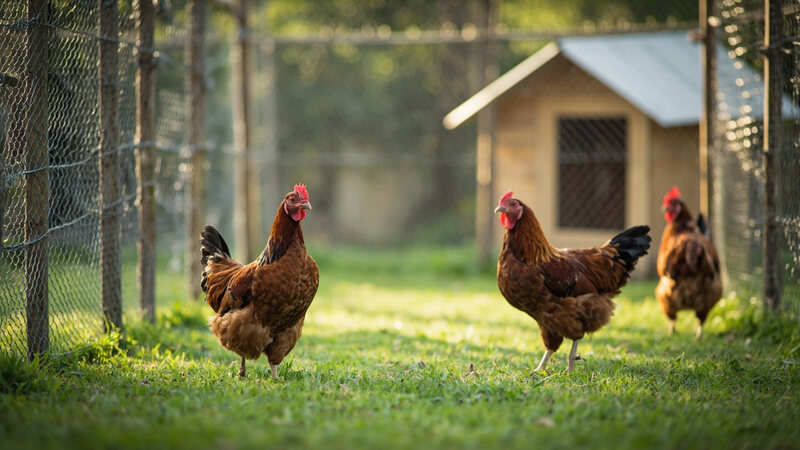
A fixed run: ½ in hardware cloth
A run that never moves is a wall job, not a netting job. Four to 12 standard hens is the usual band. At 8 sq ft each, that is 32 to 96 sq ft of floor. The wall still has to stop a paw, whatever the floor adds up to.
Kentucky Extension is blunt about chicken wire. A raccoon reaches through it. Welded hardware cloth at ½ in stops that paw. A weasel fits a ¼ in hole, so a weasel-prone yard drops to ¼ in. The same page uses that smaller mesh on a chicken tractor skirt.
Oregon State allows 1 × 2 in mesh fencing on run walls. One side is 1 in, the other is 2 in. The ½ in square is smaller on both sides. It holds hens. It does not meet the paw rule. Use it high on the wall if you must. Keep ½ in low, where a paw can reach.
Burial is not rewritten here. Penn State wants the wire 12 in down and turned out about 6 in. The steps, the trench, and the two-motion latch sit on the run ideas page. Link there, then come back for the roll.
Read the mesh before the slogan. A box that says predator proof still fails if the opening is hex, or 1 in, or anything over ½ in. You check the opening. You do not check the slogan.
The roll below is 48 in wide and 100 ft long, with ½ in by ½ in openings. The wire is 19 gauge, galvanized after the welds. One roll weighs 48 lb. Width of 48 in covers a low wall in one sheet. A taller frame needs a second course.
Check the listing for two numbers before you order. Mesh of ½ in, and a width of 48 in. Both are printed. You need both before one roll covers the wall you marked.
A 100 ft roll on a 6 × 8 ft run is more wire than the walls need. That spare is useful. It covers the buried apron, and a patch over any hex the kit shipped with. Cut it. Do not trust a second slogan.
Daytime range you move: electric poultry netting
A fence you shift every few days is a different product. Kentucky Extension lists movable fences for free-ranging birds, and notes they can be electric or not. The electric version is the one that adds a charge.
The charge has a narrow job. Kentucky says the current is set to stun. The same note calls the risk to people small, and the line better at keeping predators out.
Voltage is not printed in that note, and not in Penn State. Not stated. Do not invent a number.
Penn State records a second use. Some people run an electric wire about 1 ft outside the main fence, and about 4 in off the ground. That is a second line, not the first. The free-range page already says the same. This page adds the two distances.
Electric netting does not replace the night lock. It does not replace ½ in cloth on the coop wall. Hens still go into a secured spot at dusk, doors shut and locked. The net only covers the hours they are out.
The net below stands 48 in when set, and runs 164 ft. Twelve horizontal strands, 11 of them conductive. String verticals sit every 3 in. Double-spike posts come every 10 ft.
Setup needs no tools, the maker says. The energizer is sold separately, so a box with no charger is not a live fence.
A 164 ft roll is long for one small yard. Ten standard hens need 36 ft of fence on an 8 ft wide range, from the free-range table. One roll covers that line more than four times.
The extra length is for the next move, not a reason to skip the energizer.
Posts every 10 ft mean a 36 ft side wants about four posts, plus the corners. Count them on the listing before you assume the roll stands itself up. If your roll has no posts, that is a different purchase, covered further down.
A roll you cut to the yard: non-electric poultry netting
Some yards already have a coop wall. They only need the daytime circle, and they do not want a charger. That is the non-electric roll. Kentucky allows a movable fence with no current. The mesh then only holds birds. It does not stun anything.
Height on this roll is 48 in, which is 4 ft. Length is 100 ft. Thirteen posts come tied on, spaced 8.33 ft. The maker says you can cut the net into two smaller fences. Use the full roll, or split it. Either way the height stays 48 in.
Our assumptions for the length math. Penn State gives 8 sq ft per standard hen. We keep the range 8 ft wide, the same shape as the free-range page.
Fence length is then 2 × (8 ft + the long side). That gives 24, 28, 32, 36 and 40 ft for 4, 6, 8, 10 and 12 hens.
| Hens | Fence length | One 50 ft cut | Left over | Posts at 8.33 ft |
|---|---|---|---|---|
| 4 | 24 ft | Yes | 26 ft | 4 |
| 6 | 28 ft | Yes | 22 ft | 5 |
| 8 | 32 ft | Yes | 18 ft | 5 |
| 10 | 36 ft | Yes | 14 ft | 6 |
| 12 | 40 ft | Yes | 10 ft | 6 |
The new line is the 10 hen row. A label that offers two 50 ft cuts gives two fences of 36 ft, with 14 ft left on each. That leftover is the overlap at the coop, not spare hens. Two corners, two flocks, one roll.
Bantams change the height check. They fly, so 48 in of net wants a cover over the top. Roof mesh and the orange net note sit on the run cover page. Do not rebuild that roof here.
Check the box for the cut claim before you plan two ranges. This listing says the net can be cut into two smaller fences, and it ships one extra post for that split. If you cannot cut the roll, you get one fence, not two.
The same box lists no energizer and no battery. That absence is the point. If the label is silent on power, the roll is not electric. Do not read it as a charger you forgot to order.
A door in the fence line
A fence that holds hens still has to let a person in. The door is a separate part. Width, height, and whether it ships on the roll are the three checks. A roll with no door means a second purchase, or a gap you cut yourself.
The run ideas page asks for a latch that takes two motions to open. That rule is for a fixed gate on a framed run. Quote it, then stop. The hinge, the frame, and the latch hardware are built on that page, not this one.
An electric line needs a different door. The gate has to open without dropping the charge, or it needs an insulated handle you can trust. A plain mesh door on a live line either drops the charge or leaves you holding a hot strand. Those are not the same product.
The gate below is 48 in tall and 4 ft wide. It uses the same electrified mesh as the 48 in PoultryNet. A built-in handle locks into a docking station.
You open it without turning the energizer off. It weighs 4.7 lb, and the posts drive in with a mallet.
Four feet is wide enough for you and a bucket. It is tight for a wheelbarrow. Measure your barrow before you order. Widen the plan if the handles do not clear 4 ft.
A coop door is a third product again. It opens on a timer, for the birds, and it lives on the automatic chicken coop doors page. Do not hang a fence gate on the pop-hole, or a pop-hole door on the fence.
Posts and the buried edge
Netting without posts is a pile of mesh. A fixed run often ships the cloth and nothing to stand it on. Post height has to clear the roll, and the spacing has to match the sag you will accept.
Two burial numbers sit side by side. Penn State says at least 12 in down, turned out about 6 in. Oregon State says 6 in to 1 ft. We do not average them.
The deeper figure is the one drawn below. The shallower one is the Oregon floor, not a correction.
The electric offset is a Penn State note, not a rule we wrote. Some people run that wire 1 ft outside the main fence, 4 in off the ground. Draw it as their practice. The main fence still does the holding.
The posts below are 6 ft, which is 182.88 cm. A 48 in roll leaves about 24 in of post for the ground and the top tie.
Six posts come in the pack, in 2 mm Q235 steel with a powder coat. Twenty-four zip ties and 12 clips are in the same box.
Six posts at 8 ft spacing cover about 40 ft of wall, plus a corner share. A longer run needs a second pack. The electric net further up already carries its own posts, so you skip these if that is your roll.
Drive them until the anchor plate is under the surface, as the maker describes. No concrete mix is specified here, and none is needed for the check. Height and count are the two numbers on the label.
What to check on the label
Four numbers, in this order. Length, then height, then mesh, then hen count. Each one changes what the next number means. Skip the order and the roll looks fine until you unroll it.
Length comes first. Put the feet on the label against the fence length from your own row. Ten hens on an 8 ft wide range need 36 ft. A 50 ft cut covers that, with 14 ft left.
A short roll means a second roll. It does not mean the yard got smaller.
Height is next. Four feet, or 48 in, is the common band in the related searches, and it is the height on both netting rolls here. Bantams fly over a low net. Add a cover, and take the mesh choice from the run cover page.
Mesh is the paw check. At or under ½ in is the Kentucky figure for a raccoon paw. The 1 × 2 in opening is the Oregon State wall, and it is looser. Hex wire only holds hens. A slogan does not change the opening.
Hen count is the least useful line on the box. Divide the run area by 8 yourself. The free-range page already says this for range size. The same doubt applies to a fence roll. Ten hens on the label is not 10 hens in your yard.
Power is the last split. A label with no energizer is a plain roll. Read it as non-electric. The 100 ft net above is that case. Check the 100 ft figure on the listing against your row before you count it as two fences.
Read next
- HubCoops and runs
- RunsChicken run ideas
- RunsChicken run cover
- RunsFree range chickens
- CoopsChicken tractor
- GearAutomatic chicken coop doors
Sources
- Penn State Extension, Small Scale Poultry Housing (updated 2026): extension.psu.edu (8 sq ft of run per laying hen, 4 sq ft per bantam; bury wire at least 12 in and toe it out about 6 in; some people run an electric wire about 1 ft outside the main fence and about 4 in off the ground; mesh or netting over outside runs)
- Oregon State University Extension, EC 1644 Backyard chicken coop design (2014, checked again 2023): extension.oregonstate.edu (1 × 2 in mesh fencing on run walls; bury 6 in to 1 ft; netting or wire over the top)
- University of Kentucky, ID-245 Predator Management for Small-scale Poultry Enterprises: publications.mgcafe.uky.edu (raccoons reach through chicken wire; ½ in welded hardware cloth; a weasel fits a ¼ in hole; movable fences, electric or not; current set to stun; lock birds in a secured spot at night)
- Fence lengths of 24, 28, 32, 36 and 40 ft: our count from the Penn State 8 sq ft rate, on an 8 ft wide rectangle, same shape as the free range chickens page
- Two 50 ft cuts against a 36 ft line, leftover 14 ft: our math, 50 minus 36
- Mesh, roll size, gauge and weight: maker listing on Amazon, ASIN B0CJF6W4S2, read 2026-11-13
- Electric net height, length, strand count, vertical spacing and post spacing: maker listing on Amazon, ASIN B016IXLN08, read 2026-11-13
- Non-electric net height, length, post count and 8.33 ft spacing: maker listing on Amazon, ASIN B0B69MSBNZ, read 2026-11-13
- Gate height, width and the handle that leaves the energizer on: maker listing on Amazon, ASIN B076FC72QW, read 2026-11-13
- Post height, count, steel and clips: maker listing on Amazon, ASIN B0DF7MFQLY, read 2026-11-13
How we pick and check numbers: How we research.