Crested Chicken Breeds: 6 Breeds With a Feather Crest
Coopgauge is reader-supported. When you buy through links on this page, we may earn a commission.
Crested chicken breeds wear a tuft of feathers on the head, and that tuft changes how you house them. Six breeds have numbers you can check: Polish, Silkie, Houdan, Crèvecoeur, Sultan and Appenzeller Spitzhauben. On five of them the crest pushes the comb out of sight, and it covers the bird's eyes as well.
- Crested breeds with numbers
- 6
- Hen weight
- 2 to 2.5 lb (Silkie), up to 6.5 lb (Houdan)
- Rooster weight
- 6 lb (Sultan) to 8 lb (Houdan)
- Eggs a year
- 50+ (Sultan) to 200+ (Polish)
- Egg color
- White, or cream on the Silkie
- Comb
- V comb under the crest, walnut comb on the Silkie
- Brooding
- Non-setter (Polish) to very broody (Silkie)
- Floor per bird
- 4 sq ft standard, 2 sq ft bantam
- Run per bird
- 8 sq ft standard, 4 sq ft bantam, covered
Weights, eggs, comb, brooding: Livestock Conservancy chart and breed pages, Hoover's. Silkie: Townline and Cackle. Space: our calculator, Penn State.
The crest is structural, not decoration. It sits on a bony prominence on the skull. The Livestock Conservancy says the feathers of a Polish can fall over the eyes and impede vision.
That fact sets up the page: 8 sq ft of covered run per standard bird, a low roost bar, and a flock planned around sight.
Crested breeds compared
Six rows, and no single source for them. Each row carries the comb and crest, the weight, the eggs, the egg size, the brooding and the space one bird needs. The rows are not ranked: a 6.5 lb Crèvecoeur and a 4.5 lb Polish both need 8 sq ft of covered run.
| Breed | Comb and crest | Hen / rooster | Eggs a year | Egg color and size | Brooding | Space per bird | Source |
|---|---|---|---|---|---|---|---|
| Polish | V comb under the crest | 4.5 / 6 lb | 200+ (chart); about 150 (breed page); 100 (hatchery) | White, medium to large | Non-setters | 4 sq ft + 8 sq ft, covered | Livestock Conservancy p.7 + breed page; Hoover's |
| Silkie | Walnut comb and crest together; feathered feet | 2 to 2.5 / 2.5 to 3 lb | 100 to 120 | Cream or tinted, small, about 1.5 oz | Very broody | 2 sq ft + 4 sq ft, covered | Townline, Cackle |
| Houdan | V comb in America; crest and beard; five toes | 6.5 / 8 lb (chart); 5.5 / 7 lb (breed page) | 150 to 230 (breed page); chart says Fair | White, large (breed page); small to medium (chart) | By strain; the chart notes setters | 4 sq ft + 8 sq ft, covered | Livestock Conservancy p.4 + breed page |
| Crèvecoeur | V comb mostly hidden; crest, beard, small wattles | 6.5 / 8 lb | about 150 (chart); 120 to 150 (breed page); 200 (hatchery) | White to tinted, medium to large | Non-setters (chart); moderately broody (breed page) | 4 sq ft + 8 sq ft, covered | Livestock Conservancy p.3 + breed page; Hoover's |
| Sultan | V comb, crest, beard, muffs, feathered shanks | 4 / 6 lb | 150 to 200 (chart); 50+ (breed page) | White, large (chart); small (breed page) | Variable (chart); non-setters (breed page) | 4 sq ft + 8 sq ft, covered | Livestock Conservancy p.9 + breed page |
| Appenzeller Spitzhauben | V comb, pointed crest; black and white speckled | 4 to 5 lb | 155 | White, medium | Rarely broody | 4 sq ft + 8 sq ft, covered | Hoover's Hatchery |
Two sources often print different numbers for the same bird, so both stay in the row. The Houdan row shows 6.5 lb for the hen on the chart and 5.5 lb on the breed page card. The Polish row carries three rates: 200+, about 150 and 100.
The run above is a walk-in metal pen with a waterproof cover, and it is the piece these flocks need most. The Livestock Conservancy says Crèvecoeur are usually kept in covered pens. Hoover's Hatchery notes that a Polish's feathers limit its eyesight.
Check the floor before the hen count on the label. The listing calls it a home for 5 to 10 chickens. The footprint is 84 by 79.2 in, or 46.2 sq ft. Divide by 8 sq ft per bird and you get 5, not 10.
Six standard crested birds need 48 sq ft of run, so the pen is short for six. Check the 84 in length on the listing against the run area in the flock table below.
Crest types: what the feather crest replaces
| Breed | Comb | Crest and other head marks | Source |
|---|---|---|---|
| Polish | Red V comb, may not be visible | Crest on a bony prominence; may be bearded | Livestock Conservancy |
| Crèvecoeur | Small V comb, mostly hidden by the crest | Large globular crest, beard, small wattles | Hoover's; Livestock Conservancy |
| Houdan | V comb in America, historically leaf-shaped | Crest and beard, five toes | Livestock Conservancy |
| Sultan | V comb | Crest, beard, muffs, feathered shanks, five toes | Livestock Conservancy |
| Appenzeller Spitzhauben | V comb | Pointed crest, black and white speckled | Hoover's Hatchery |
| Silkie | Walnut comb | Crest and comb together, feathered feet | Townline, Cackle |
Five of the six hide a V comb under the feathers. The Silkie is the exception, with a walnut comb and a crest side by side, at half the size.
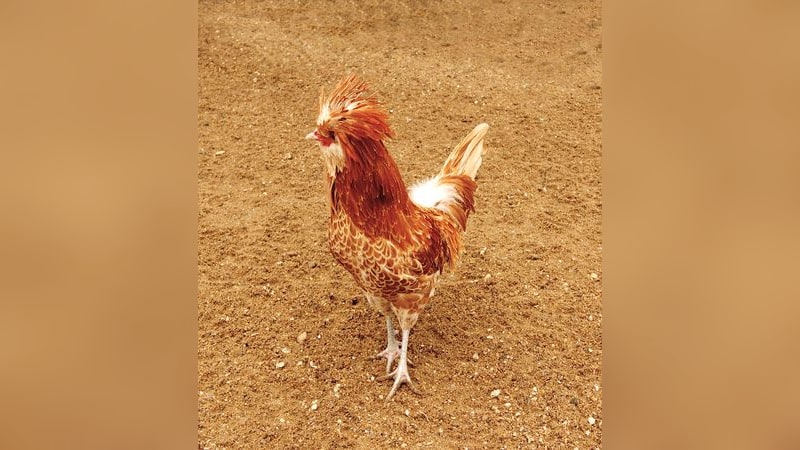
Our assumptions
Every cell in the flock table below is our arithmetic, so here are the rates. A standard crested bird gets 4 sq ft of coop floor and 8 sq ft of run, the plan on our coop size calculator. Penn State gives 8 sq ft of run for a laying hen and 4 sq ft for a bantam.
The Silkie is a bantam, so it gets half: 2 sq ft inside and 4 sq ft of run.
Roost space is 8 in of bar per standard hen and 4 in per bantam. Penn State gives 6 in for a standard bird, Oregon State gives 5 to 10 in, so 8 in sits in the middle. Bars go 18 to 24 in off the floor and never more than 4 ft up. A bantam bar sits 12 to 18 in up, and a Silkie pole about 1 ft off the ground.
Nest boxes follow Penn State: 2 for the first 4 hens, then 1 more for every 4, each about 12 by 12 by 12 in and at least 2 ft off the floor. Oregon State counts 1 per 4 hens, so we use the larger count.
Water is 1 nipple per 6 to 8 birds. Feeder space is 3 in per standard hen and 1 in per bantam. Both are Penn State figures.
By flock size
Six standard crested birds need 24 sq ft of coop floor and 48 sq ft of covered run, plus 48 in of roost bar, 2 nest boxes and 1 nipple drinker. The run figure is the number to plan against, because the crest makes an open run a poor fit.
| Flock | Coop floor | Run area | Roost bar | Nest boxes | Nipples | Feeder space |
|---|---|---|---|---|---|---|
| 4 standard | 16 sq ft | 32 sq ft | 32 in | 2 | 1 | 12 in |
| 6 standard | 24 sq ft | 48 sq ft | 48 in | 2 | 1 | 18 in |
| 8 standard | 32 sq ft | 64 sq ft | 64 in, two bars | 3 | 1 | 24 in |
| 10 standard | 40 sq ft | 80 sq ft | 80 in, two bars | 4 | 2 | 30 in |
| 4 bantam (Silkie) | 8 sq ft | 16 sq ft | 16 in, 12 to 18 in up | 2 | 1 | 4 in |
| 4 standard + 2 bantam | 20 sq ft | 40 sq ft | 32 in standard + 8 in bantam | 3 | 1 | 14 in |
Read the run column first. Eight standard crested birds want 64 sq ft, and 64 in of bar needs two roosts, because a bar is 4 ft long. The mixed row changes the plan: 2 bantam birds add 4 sq ft of floor and 8 sq ft of run, with a lower bar at 12 to 18 in up. A mixed flock needs two bars, because a Silkie roosts lower.
The drawings show why the run has to be covered. A bird that cannot see above the fence line does not notice what is looking down at it. The three heads are the same breeds as the table.
The bars are why the table carries a source column. Polish reads 200+ on the chart, about 150 on the breed page and 100 at Hoover's. The Houdan row has no number on the chart, only Fair. A flock that lays 100 eggs a year still needs the same roof and roost.
Crested and non-crested
| Point | What the crest changes | Source |
|---|---|---|
| Sight | The crest feathers can fall over the eyes and impede vision | Livestock Conservancy |
| Startle | Polish are easily surprised and a bit nervous, so talk before you approach | Livestock Conservancy |
| Flight | Lightweight crested birds are good flyers and can roost in trees | Livestock Conservancy |
| Run | Crèvecoeur are usually kept in covered pens | Livestock Conservancy |
| Roost | Keep the bar low: 18 to 24 in up, never over 4 ft; a bantam bar 12 to 18 in up, a Silkie 1 ft | Our roost page; Oregon State |
| Mixed flock | Crèvecoeur do not do well in mixed flocks because of their crests | Livestock Conservancy |
| Chicks | Raising chicks in elevated brooders so they can see human activity better calms them | Chart p.7 |
| Eggs | White eggs on most of them; the Silkie lays cream or tinted eggs | Chart; Townline |
| Brooding | Non-setters on the Polish, very broody on the Silkie, by strain on the Houdan | Chart |
| Space per bird | 4 sq ft inside and 8 sq ft of run for a standard bird, 2 sq ft and 4 sq ft for the Silkie | Our calculator; Penn State |
| Climate | Polish prefer a dry, warm climate and a dry, ventilated coop | Livestock Conservancy |
Most of these rows are setup rows, not behavior rows. The crest does not change how many eggs a hen lays. It changes the roof over her head, the height of the bar, and whether she settles in a mixed flock.
One number travels across the table: 8 sq ft of covered run per standard bird. Every other figure follows from it. Add a Silkie and the floor drops to 2 sq ft, but the run still needs a roof.
Common Questions
What chicken breeds are crested?
Six breeds here have published weights and egg rates: Polish, Silkie, Houdan, Crèvecoeur, Sultan and Appenzeller Spitzhauben. The Wikipedia list is longer, with names such as Brabanter. For those we found no published weight or egg count, so they stay off the table.
What is a crested chicken?
A crested chicken has a tuft of upward-pointing feathers on its head. On five of the breeds here the tuft hides a V comb. The Silkie is the exception, with a walnut comb and a crest together. The breed page says the crest sits on a bony prominence on the skull.
Do crested chickens need a covered run?
Yes, and the number is 8 sq ft of run per standard bird. The Livestock Conservancy says Crèvecoeur are usually kept in covered pens. Six birds need 48 sq ft of run, 24 sq ft of floor and 48 in of bar.
Are crested chickens flighty?
Lightweight crested birds fly. The Livestock Conservancy calls the Polish a lightweight breed and a good flyer, and says the birds can be found in the branches when it is time to roost. A Polish hen weighs 4.5 lb.
Are crested chickens broody?
It depends on the breed. The Polish is a non-setter and will not sit. The Silkie is very broody. The Houdan may or may not be broody, by strain, and the Sultan is listed as variable. Crèvecoeur are moderately broody.
How much space does a crested flock need?
4 sq ft of coop floor and 8 sq ft of covered run for each standard crested bird. A Silkie needs 2 sq ft and 4 sq ft, a bantam. Six birds take 24 sq ft of floor and 48 sq ft of run.
Read next
- HubChicken breeds
- BreedPolish chicken
- BreedSilkie chicken
- CalculatorCoop size calculator
- DataChicken roost bar
- DataNesting boxes for chickens
Sources
- Livestock Conservancy breed chart (2026 PDF): livestockconservancy.org
Crevecour p.3: F 6.5, M 8 lb, white, medium to large, about 150 a year, non-setters. Houdan p.4: F 6.5, M 8 lb, white, small to medium, fair, setters.
Polish p.7: F 4.5, M 6 lb, white, medium to large, 200+, non-setters, elevated brooders. Sultan p.9: F 4, M 6 lb, white, large, 150 to 200, variable brooding.
- Livestock Conservancy, Polish breed page: livestockconservancy.org
Crest on a bony prominence on the skull. Feathers can fall over the eyes and impede vision. Easily surprised, a bit nervous. Red V comb, may not be visible. About 150 medium-to-large white eggs a year. Non-setters. Dry, warm climate, dry coop.
- Livestock Conservancy, Houdan breed page: livestockconservancy.org
F 5.5 lb, M 7 lb, white, large. 150 to 230 eggs a year. May or may not be broody, by strain. V comb in America. Crest and beard, five toes. Large crests block the view of predators of them.
- Livestock Conservancy, Crèvecoeur breed page: livestockconservancy.org
F 6.5 lb, M 8 lb, white to tinted, medium to large. 120 to 150 eggs a year. Moderately broody. Poor in mixed flocks. Usually in covered pens.
- Livestock Conservancy, Sultan breed page: livestockconservancy.org
F 4 lb, M 6 lb, white, small. 50+ eggs a year, non-setters. V comb, crest, beard, muffs. Feathered shanks, five toes.
- Hoover's Hatchery, Polish & Crested: hoovershatchery.com
Polish varieties: 100 small white eggs a year, 4 to 5 lbs, V comb, rarely broody. Appenzeller Spitzhauben: 155 medium white eggs, 4 to 5 lbs, V comb, rarely broody, roosts in trees. Crevecoeur: 200 large white eggs, 6 to 8 lbs, occasionally broody, V comb hidden by the crest.
- Townline and Cackle, Silkie facts, on our Silkie page: coopgauge.com/breeds/silkie/
Hen 2 to 2.5 lb, rooster 2.5 to 3 lb. 100 to 120 eggs a year. Cream or tinted, small, about 1.5 oz. Walnut comb, very broody.
- Wikipedia, Crested chickens: en.wikipedia.org
Crest definition and the list of crested breeds: Brabanter, Padovana, Polverara, Kraienkopp. Read 2026-11-12.
- Penn State Extension, Small Scale Poultry Housing: extension.psu.edu
8 sq ft of run for a laying hen, 4 sq ft for a bantam. 6 in of roost per standard bird, 4 in for a bantam, 18 to 24 in up, never over 4 ft. Bantams 12 to 18 in up. 2 nest boxes for the first 4 hens, then 1 per 4. 1 nipple per 6 to 8 birds. 3 in of feeder space.
- Oregon State Extension, EC 1644 coop design: extension.oregonstate.edu
5 to 10 in of roost per bird. 1 nest box per 4 hens. Silkie pole 1 ft off the ground.
- Run size, cover and label count: maker listing on Amazon, ASIN B0GX5Q2SNR, read 2026-11-12.
How we pick and check numbers: How we research.