Orpington Chicken: A Big, Gentle Hen for Cold Yards
Coopgauge is reader-supported. When you buy through links on this page, we may earn a commission.
Orpington chickens suit keepers who want a big, gentle hen that shrugs off cold. Hens weigh about 8 lb by the APA standard and lay roughly 150 to 280 light brown eggs a year. They go broody and make good mothers.
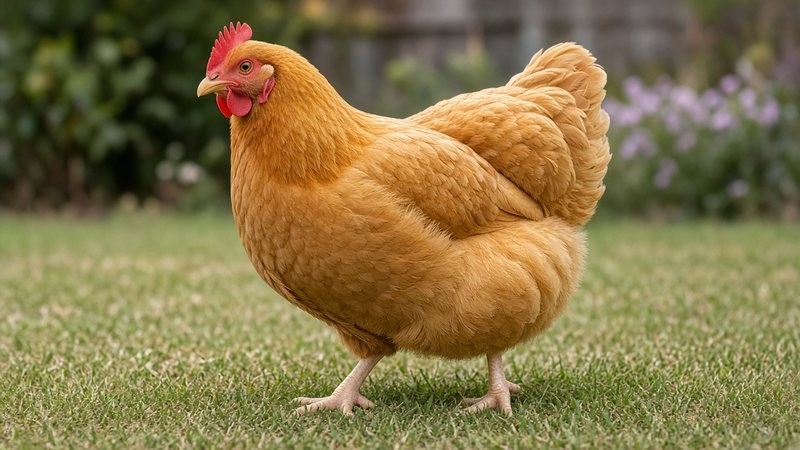
- Size class
- Large (APA English class)
- Weight range
- Hen 8 lb; rooster 10 lb (APA standard)
- Eggs per year (range)
- About 150 to 280 (hatchery estimate)
- Egg color
- Light to dark brown, large
- Comb type
- Single (rose in some countries)
- Feather colors
- Buff, Black, Blue, White and others
- Cold & heat tolerance
- Cold hardy
- Temperament
- Calm, gentle
- Broodiness
- Broody; a sitter and good mother
- Space per bird
- 5 sq ft inside (large breed)
Weight, comb, colors, cold endurance, temperament and broodiness: Oklahoma State Breeds of Livestock (APA standards). Eggs and egg size: Cackle Hatchery. Space: our calculator.
William Cook bred the Orpington in Orpington, Kent, in the late 1800s. Oklahoma State notes he wanted a dual-purpose bird for eggs and the table. The breed spread fast, and the Buff Orpington is now a common hen in American backyards.
The Livestock Conservancy says Cook introduced the breed in 1886. Within ten years it was well known in England. It reached America by 1891. The Buff came first to the APA standard, in 1902, per Cackle Hatchery.
Orpingtons look bigger than they are. Oklahoma State says their soft, loose feathers mask the true size of the bird. Those same feathers help them handle cold better than most breeds. Minnesota Extension agrees: it calls the Orpington's heavy size ideal for cold weather. A big body holds heat, too.
Temper is the other draw. Oklahoma State calls them calm and gentle. Cackle Hatchery lists its Buff Orpingtons as docile. The Livestock Conservancy describes a calm, friendly disposition. That makes them a classic family hen.
Egg size is a plus. The Livestock Conservancy lists large to extra large brown eggs. Cackle Hatchery lists its production line as large and light brown. The hatchery sells both a production line and an exhibition line, so ask which one you are buying.
Free-range or confined?
| Setup | Fits an Orpington? | Space per bird | Notes |
|---|---|---|---|
| Coop with run | Good | 5 sq ft inside, 10 sq ft run | Oklahoma State: does well confined |
| Free range by day | Good | same coop figures | Active forager |
| Cold climate | Best fit | same | Soft feathers hold warmth |
Orpingtons do well either way. Oklahoma State calls them an active fowl that does well free range or confined. Plan the large-breed figures from our calculator: 5 sq ft each inside and 10 sq ft of run. Six Orpingtons need 30 sq ft of coop and 60 sq ft of run.
Watch the flock mix. Oklahoma State notes that their docile nature means bossier breeds can push them around. Pair them with other calm hens, such as Barred Rocks or Easter Eggers.
Give a big flock space to spread out at the feeder. Two feed stations stop one hen from guarding the food. A calm breed eats calmly when it does not have to push.
Coop & run setup
Size everything up a little for an Orpington. Give 10 in of roost per hen. Cackle Hatchery lists a roost height of 2 to 4 ft for the breed. Penn State advises against any perch above 4 ft. A heavy hen lands hard, so lower is kinder. A wide, flat roost bar suits big feet. Heights are on the roost bar page.
Nest boxes should be a size up too. Penn State says to increase the nesting space for larger birds, so the hen can enter and sit comfortably. A 12 in box is the floor for standard hens; give Orpingtons a little more. Sizes are on the nesting box page. Four Orpingtons need 20 sq ft of house floor at 5 sq ft each. Measure the floor. A label that names a hen count is not that measurement.
Feeding
Orpingtons eat a complete layer feed from the first egg. University of Maine gives 14 to 16% protein for dual-purpose layers. Heavy hens eat more than light ones; Minnesota Extension gives about 3 lb a week for a 6 lb hen, so an 8 lb Orpington eats a little more.
Big, calm hens can get lazy and plump on scratch. Keep scratch to a handful the flock clears in 20 to 30 minutes, as University of Maine suggests. Our feeding guide covers amounts by flock size.
Set out oyster shell in its own dish for laying hens. Keep fresh water close all day. A big hen drinks a lot, so check the waterer twice a day in summer.
Hatching: broody hen or incubator?
Orpingtons sit often for a standard-size hen. Oklahoma State says the hen tends to go broody and is a good mother. Cackle Hatchery lists them as setters. If you want chicks, an Orpington hen will often do the job for you.
Give a broody hen her own large box in a quiet corner or a separate pen, with feed and water close by. Eggs take 21 days at 99.5 to 100°F in an incubator, per Texas A&M AgriLife Extension; a hen keeps her own schedule.
The box above measures 14.3 × 15.7 in across. That is roomier than the 12 in standard box. That gives a big hen space to turn and settle on a clutch. Its plastic body hoses clean between hatches.
Not every keeper wants chicks. If a hen sits with no eggs to hatch, pick up eggs often and keep the nest boxes clear at night. Some hens stay set for a while, so patience helps. She will lay again once she is done.
Compared with similar breeds
| Breed | Hen weight | Eggs per year | Egg color | Broodiness |
|---|---|---|---|---|
| Orpington (Buff) | 8 lb | 150 to 280 | Light brown | Setter |
| Australorp | 6.5 lb | about 250 | Brown | Setter |
| Barred Rock | 7.5 lb | about 200 | Brown | Setter |
Orpington vs Australorp
The Livestock Conservancy chart lists the Australorp hen at 6.5 lb and about 250 brown eggs a year, and calls it a setter that handles cold and heat. An Orpington hen is 8 lb by the APA figure and lays 150 to 280 light brown eggs by the Cackle estimate. Both sit. The Australorp is lighter and the chart gives it a higher egg count.
Pros and cons
Pros. Hens weigh 8 lb, so the body is large for a cold yard. Cackle Hatchery lists 150 to 280 light brown eggs a year. Oklahoma State calls them calm, and calls the hen a sitter.
Cons. Four birds need 20 sq ft of floor at 5 sq ft each. The 150 to 280 range is wide, so ask which line you are buying. Oklahoma State notes that bossier breeds can push a gentle Orpington aside.
Where to get chicks
Buff Orpingtons are sold by nearly every hatchery and farm store in spring. Black, Blue and White lines come from mail-order hatcheries. The Livestock Conservancy notes Cook also bred Jubilee and Spangled types. Choose sexed pullets if roosters are not allowed where you live; an Orpington rooster weighs about 10 lb.
Common Questions
How many eggs does an Orpington lay?
About 150 to 280 light brown eggs a year by the Cackle Hatchery estimate. Lines and seasons vary.
How big do Orpingtons get?
The APA standard is 8 lb for hens and 10 lb for roosters, per Oklahoma State.
Are Orpingtons good in cold weather?
Yes. Oklahoma State notes their soft feathering helps them endure cold better than other breeds, and Minnesota Extension calls their heavy size ideal for cold weather.
Do Orpingtons go broody?
Often. Oklahoma State calls the hen a sitter and a good mother.
What color eggs do Orpingtons lay?
Light to dark brown, and large. Cackle Hatchery lists its Buff line as light brown. The Livestock Conservancy lists large to extra large brown eggs.
Read next
Sources
- Oklahoma State University, Breeds of Livestock: Orpington Chickens (APA standard weights): breeds.okstate.edu (bred by William Cook, Orpington, Kent, late 1800s; dual purpose; soft feathering masks size, better cold endurance; active, free range or confined; calm, gentle, bullied by aggressive breeds; single or rose comb; broody, good mother, sitter; APA hen 8 lb, cock 10 lb; Black, Blue, Buff, White; brown eggs)
- Cackle Hatchery, Buff Orpington breed facts: cacklehatchery.com (150 to 280 eggs; light brown, large; docile; setter; roost height 2 to 4 ft; APA 1902)
- The Livestock Conservancy, Orpington chicken breed facts: livestockconservancy.org (introduced 1886; reached America by 1891; Black, White, Buff, Jubilee, Spangled, Blue, Cuckoo; large to extra large brown eggs; market weight 7 to 8.5 lb; calm, friendly)
- University of Minnesota Extension, Raising chickens for eggs (reviewed 2025): extension.umn.edu (3 lb feed a week for a 6 lb hen; Orpington hen about 8 lb, heavy size ideal for cold weather)
- The Livestock Conservancy, Plymouth Rock chicken breed facts: livestockconservancy.org (Plymouth Rock hen 7.5 lb; around 200 eggs)
- The Livestock Conservancy, Heritage Chicken Breed Comparison Chart (2026): livestockconservancy.org (Cochin hen 8.5 lb; up to 140 eggs; setters)
- Penn State Extension, Small Scale Poultry Housing (updated 2026): extension.psu.edu (larger nests for larger birds; perch no higher than 4 ft; large chickens 2 sq ft inside, 10 sq ft outside)
- University of Maine Cooperative Extension, Bulletin #2222 Nutrition for Backyard Chicken Flocks in Maine: extension.umaine.edu (dual-purpose layer protein 14 to 16%; scratch cleaned up in 20 to 30 minutes)
- Texas A&M AgriLife Extension, POSC-PU-018 Incubating and Hatching Eggs (2022): agrilife.org (21 days at 99.5 to 100°F)
- The Livestock Conservancy, Heritage Chicken Breed Comparison Chart (2026): livestockconservancy.org (Australorp about 250 brown eggs; hen 6.5 lb; setter; cold and heat)
- Nest box inside size: maker listing on Amazon, ASIN B0DG2K2Q1B, read 2026-10-12
How we pick and check numbers: How we research.