Barred Rock Chicken: A Calm, Cold-Hardy Brown Egg Layer
Coopgauge is reader-supported. When you buy through links on this page, we may earn a commission.
Barred Rock chickens suit keepers who want a calm, hardy hen that lays well for years. Hens weigh about 6 to 7.5 lb and lay around 200 large brown eggs a year by The Livestock Conservancy figure. They handle cold winters well.
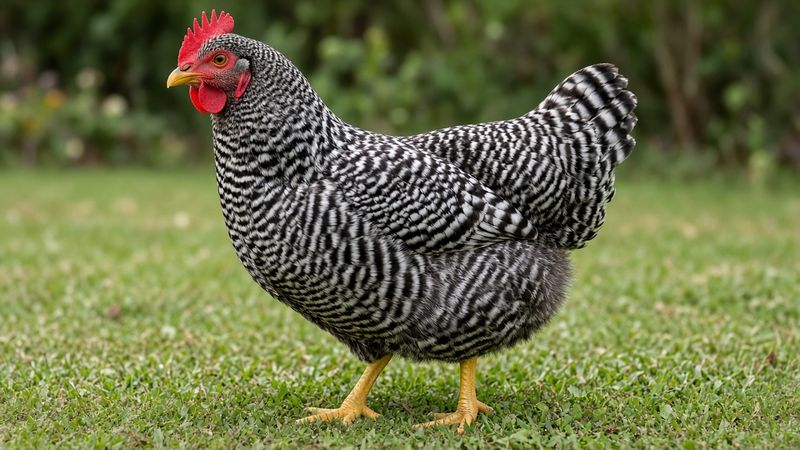
- Size class
- Standard (APA American class)
- Weight range
- Hen 6 to 7.5 lb; rooster 8 to 9.5 lb
- Eggs per year (range)
- About 120 to 280, by line; around 200 typical
- Egg color
- Brown, large
- Comb type
- Single
- Feather colors
- Black and white barred
- Cold & heat tolerance
- Cold hardy
- Temperament
- Calm, docile; hens quiet
- Broodiness
- Setter; goes broody at times
- Space per bird
- 4 sq ft inside (standard)
Weight, eggs and temperament: The Livestock Conservancy, Cackle Hatchery (exhibition line) and Townline Hatchery (production line). Cold hardiness: The Livestock Conservancy. APA class and broodiness: Cackle Hatchery. Space: our calculator.
The Barred Rock is the barred color of the Plymouth Rock, one of the oldest American breeds. Cackle Hatchery notes the APA recognized it in 1874. The Livestock Conservancy calls it an outstanding farm chicken, known for hardiness, docility and steady brown eggs.
Egg counts depend on the line. Cackle Hatchery puts its exhibition-type birds at 120 to 180 eggs a year. Townline Hatchery puts its production line at 200 to 280. The Livestock Conservancy gives around 200, with strong laying for the first few years and a slow decline after.
That makes the Barred Rock a fine all-round hen. It lays well, stays calm and lives through a hard winter. Many keepers start with a few Barred Rocks and keep adding them. They also mix well with almost any other breed in the coop.
The look is easy to spot. Black and white bars run across every feather, and the comb is a single red blade with five points, per The Livestock Conservancy. Beak, legs and feet are yellow. In a mixed flock, the Barred Rock is the bird you can find from across the yard.
Hens are quiet, by the Townline Hatchery notes. Roosters are another story. Townline says they are loud and can be bossy, so think twice before keeping one in town.
Free-range or confined?
| Setup | Fits a Barred Rock? | Space per bird | Notes |
|---|---|---|---|
| Free range by day | Best fit | 4 sq ft inside | Townline: preferred for free range |
| Coop with run | Good | 4 sq ft inside, 8 sq ft run | Calm in confinement |
| Cold climate | Good | same | The Livestock Conservancy: cold hardy |
Barred Rocks like room to roam. Townline Hatchery lists them as preferred for free range, and they are good foragers. They are also calm enough to live in a run without stress. Either setup works.
Use the standard figures: 4 sq ft each inside and 8 sq ft of run. Six Barred Rocks need 24 sq ft of coop and 48 sq ft of run. Large, heavy hens like these appreciate the full figure, not the bare minimum. Our coop size calculator handles any count.
Coop & run setup
A standard coop fits a Barred Rock. Set the roost about 2 ft up with 8 in per hen. See the roost bar page. Use 1 nest box per 4 hens, about 12 in on each side. See the nesting box page. Penn State caps perches at 4 ft, which matters for a heavy hen that lands hard.
Cold hardiness lets you keep the coop simple in winter. The Livestock Conservancy notes cold hardiness and early feathering. Vent high, close drafts at roost level and keep the bedding dry. A dry coop matters more than a warm one.
Summer needs more thought than winter. A heavy hen in dark feathers feels the heat. Give the run shade and the coop airflow. Keep water close and full.
The RUNSHED listing says 4 to 6 chickens and is 80 in long. Four Barred Rocks need 16 sq ft at 4 sq ft each. Measure the house floor before you count on 4. The label is not the count.
Feeding
Feed Barred Rocks a complete layer feed from the first egg. University of Maine gives 14 to 16% protein for dual-purpose layers like these. Townline Hatchery puts maturity at about 22 weeks, so the switch usually lands around then.
Heavy hens eat steadily. Minnesota Extension gives about 3 lb a week for a 6 lb hen. A 7 lb Barred Rock eats a little more. Ten hens go through roughly 30 to 35 lb a week. Our feeding guide and feeder page cover the amounts and the hardware.
A large gravity feeder saves daily trips with a bigger flock. The one above holds 50 lb and feeds three hens at once. That covers 10 Barred Rocks for over a week. Keep it under a roof so rain stays out.
Fill it from a clean, dry bin. Let the hens empty it now and then, so old feed does not cake at the bottom. University of Maine suggests letting birds clean out the feeder about once a week.
Hatching: broody hen or incubator?
Cackle Hatchery lists its Barred Plymouth Rocks as setters. The Livestock Conservancy also names broodiness among the breed traits. Some hens sit, and production lines sit less often. A broody Barred Rock is a calm, steady mother.
For an incubator, Texas A&M AgriLife Extension gives 21 days for chicken eggs at 99.5 to 100°F. Our brooder setup guide covers the chicks after the hatch.
Compared with similar breeds
| Breed | Hen weight | Eggs per year | Egg color | Broodiness |
|---|---|---|---|---|
| Barred Rock | 7.5 lb | about 200 | Brown | Setter |
| Buff Orpington | 8 lb | 150 to 280 | Light brown | Setter |
| Marans (French Black Copper) | 6.5 lb | 200+ | Dark brown | Setter |
The Buff Orpington is the closest match: heavy, calm and a steady brown egg layer. The Marans is a little lighter and lays darker eggs. All three share a coop well and handle cold the same way.
Barred Rock vs Plymouth Rock
A Barred Rock is a Plymouth Rock. Barred is one feather color of that breed. Cackle Hatchery notes the APA recognized the Barred Plymouth Rock in 1874, in the American class. Other Plymouth Rock colors exist. The barred bird is the variety most farm stores sell under the shorter name.
Pros and cons
Pros. The Livestock Conservancy lists around 200 large brown eggs a year and calls the hen calm. Hens weigh about 7.5 lb on that page, or 6 to 7 lb on the Townline production line. They are cold hardy, by the Conservancy.
Cons. Egg counts swing by line, from 120 to 180 on Cackle’s exhibition birds to 200 to 280 on Townline’s production birds. You need 4 sq ft of floor each. Townline says roosters can be loud and bossy.
Barred Rocks are often mixed up with Dominiques. Both have barred feathers. Cackle Hatchery points to the comb as the clearest difference: the Barred Rock has a single comb, the Dominique a rose comb.
Where to get chicks
Barred Rocks are one of the most common chicks at farm stores each spring. Every large mail-order hatchery sells them, often in both production and exhibition lines. Pick a production line for more eggs, or an exhibition line for the show standard.
Buy at least three. Ask for sexed pullets if roosters are not allowed where you live. A trio of hens settles faster than a pair, and three Barred Rocks lay enough brown eggs for most families.
Common Questions
How many eggs does a Barred Rock lay?
Around 200 large brown eggs a year by The Livestock Conservancy figure. Production lines from Townline Hatchery reach 200 to 280; exhibition lines from Cackle Hatchery lay 120 to 180.
Are Barred Rocks good for beginners?
Yes. They are calm, cold hardy and easy to keep, per The Livestock Conservancy.
How big do Barred Rocks get?
Hens weigh about 6 to 7.5 lb and roosters 8 to 9.5 lb.
Is a Barred Rock the same as a Plymouth Rock?
Yes. Barred is one color of the Plymouth Rock breed. Cackle Hatchery lists the APA recognition in 1874.
Are Barred Rocks bullies?
Hens are calm and quiet, by The Livestock Conservancy and Townline Hatchery. Townline says roosters can be bossy. Give each hen 8 in of roost and a second feeder so every bird can eat.
Read next
Sources
- The Livestock Conservancy, Plymouth Rock chicken breed facts: livestockconservancy.org (hen 7.5 lb, male 9.5 lb; around 200 large brown eggs, strong for the first few years then a slow decline; calm, docile; early feathering; cold hardiness; hardiness, docility, broodiness)
- Cackle Hatchery, Barred Plymouth Rock (exhibition type) breed facts: cacklehatchery.com (hen 7.5 lb, rooster 9.5 lb; 120 to 180 eggs; brown, large; setter; APA 1874; American class)
- Townline Hatchery, Barred Rock breed facts: townlinehatchery.com (female 6 to 7 lb, male 8 to 9.5 lb; 200 to 280 eggs; maturity 22 weeks; quiet hens; preferred for free range)
- Cackle Hatchery, Buff Orpington breed facts: cacklehatchery.com (Buff Orpington hen 8 lb; 150 to 280 eggs)
- Cackle Hatchery, French Black Copper Marans breed facts: cacklehatchery.com (Marans hen 6.5 lb; 200+ eggs)
- Penn State Extension, Small Scale Poultry Housing (updated 2026): extension.psu.edu (perch no higher than 4 ft)
- University of Maine Cooperative Extension, Bulletin #2222 Nutrition for Backyard Chicken Flocks in Maine: extension.umaine.edu (dual-purpose layer protein 14 to 16%)
- University of Minnesota Extension, Raising chickens for eggs (reviewed 2025): extension.umn.edu (3 lb feed a week for a 6 lb hen)
- Texas A&M AgriLife Extension, POSC-PU-018 Incubating and Hatching Eggs (2022): agrilife.org (21 days at 99.5 to 100°F)
- RUNSHED 80 in coop with run, label says 4 to 6 chickens: maker listing on Amazon, ASIN B0H2DW68D8, title read 2026-10-23
- Feeder capacity and ports: maker listing on Amazon, ASIN B083L6SW22, read 2026-10-12
How we pick and check numbers: How we research.