How to Introduce New Chickens to a Flock: Quarantine, a Divider, Then the Merge
Coopgauge is reader-supported. When you buy through links on this page, we may earn a commission.
Do not tip new chickens straight into an established coop. To introduce new chickens to your flock, run three phases in order: 2 to 4 weeks of quarantine, then a divider both flocks can see through, then the merge. Every phase ends at a number or a countable check. If a check fails, you go back one phase and repeat it. Adding chickens to an existing flock without those steps hands one stranger to a settled order, and that is the case the flock sorts hardest.
The calendar runs the first phase. The tape measure sizes the pen. A fence runs the second phase, and your morning walk runs the third.
- Quarantine
- 2 weeks minimum, 4 weeks adequate
- Pen distance
- far enough apart that the pens share no air stream
- Divider phase
- no fixed week count in our sources (Not stated); the gate is size
- First full contact
- earliest at the end of week 2 (our arithmetic)
- New birds' age
- fully feathered, near adult size; chicks hit that at about 6 to 8 weeks
- Quarantine pen
- 4 sq ft shelter + 8 sq ft run per standard bird
- How many at once
- one group together, never one bird
Quarantine weeks: Extension Foundation biosecurity page, University of Arizona Extension and UF/IFAS Extension Polk County, read 2026-11-27. Age, size gate, shared air and the group rule: Arizona Extension and Extension Foundation, normal behaviors. Pen area: this site's coops hub standard. Floor: 4 sq ft, the middle of Minnesota Extension's 3 to 5 sq ft range. Run: Penn State's 8 sq ft per laying hen.
How long to quarantine new chickens
Plan 2 to 4 weeks before any bird crosses a fence. Two weeks is the floor, by eXtension's biosecurity page. Write the dates down first.
Four weeks is the figure Arizona Extension calls adequate. UF/IFAS Extension Polk County asks for at least 30 days. Circle 30 days on the calendar and you satisfy all three sources.
Quarantine means three separations. The new birds live somewhere else. They eat and drink from their own kit. Your scoop, scraper and bucket stay on one side of the line.
The pens also need distance. Arizona Extension sets the bar at no shared air stream between the two groups. In a backyard that usually means a pen at the far end of the yard, not the neighboring stall.
What you watch is countable. Does each bird eat her share? Does she drink? Does she walk the pen like the others?
Those three checks, once a day, are the whole list. The calendar does the rest. No row of the list asks you to guess how a bird feels.
The pen needs its kit before the birds arrive. Here is your list, sized for a small starter group.
- A quarantine pen or a transition house: a crate-and-fence pen, or a movable coop. The chicken tractor page sizes those at 4 sq ft of house per hen.
- A second feeder and a second waterer, hung and filled just for the new group.
- A second tool set: scoop, scraper, bucket, boot brush. None of it crosses back to the old flock's side.
- Bedding to start: pine shavings about 4 in deep, the floor depth our bedding page works out.
- A spot far enough from the old run that the two pens share no air stream.
The set in the box above is that second kit in one purchase. A 6.6 lb feeder and a 3.17 quart fountain, listed with hooks that hang both above the bedding, so shavings stay out of the feed.
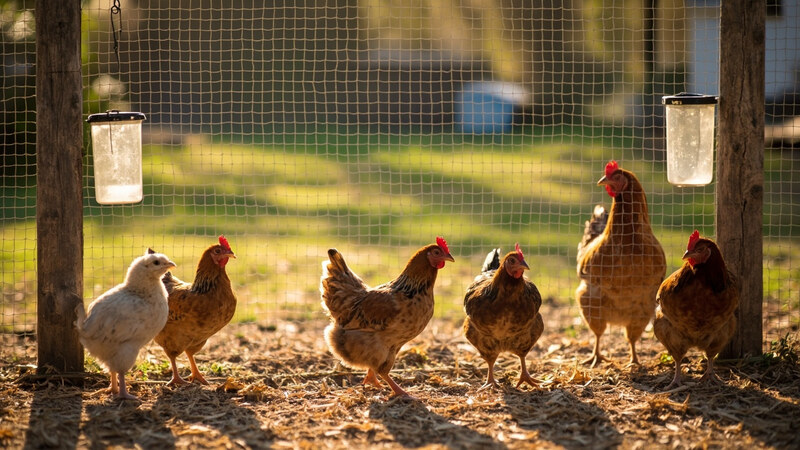
How big the quarantine pen should be
Size the pen by the same standard as any coop: 4 sq ft of shelter and 8 sq ft of run per standard bird.
That is the figure our coops hub carries. The floor is the middle of Minnesota Extension's 3 to 5 sq ft range, at 4. The 8 sq ft of run is Penn State's number for laying hens. Bantams take about half, so 2 and 4 sq ft per bird.
| New birds | Shelter (sq ft) | Run (sq ft) | What works as the pen |
|---|---|---|---|
| 2 | 8 | 16 | a dog crate plus a 4 × 4 ft fence pen |
| 4 | 16 | 32 | a movable coop; those are sized for 3 to 6 hens |
| 6 | 24 | 48 | a 6 × 8 ft house with its own 48 sq ft run |
Now read the label against the floor. A box that says 4 hens is a claim about the photo, not about square feet.
The floor is what you measure. At 4 sq ft a hen, an 18 sq ft floor fits 4 standard birds, and only if the run outside holds 32.
One more account: the pen borrows space the old flock was already using. Ten old hens still need their 40 sq ft inside and 80 sq ft out.
Our 10-chickens plan page draws that floor out. Check it before the divider goes up, not after.
The divider phase: side by side, no contact
Quarantine ends with a fence between the two groups, not a door. The divider stands inside the run. Each flock keeps its own side, sees the other, and touches nothing.
Build the divider from 1/2 in hardware cloth, the same mesh our run cover page fixes for run walls. Posts and zip ties hold a cut panel upright. The line goes up in an afternoon.
How long does this phase run? The extension pages we read set no week count for it. So your calendar stays open here.
Arizona Extension gates the merge on size instead. The new birds go through once they match the hens, size for size. Until then the fence stays.
The fence lets two flocks get used to each other without contact. Contact stays at zero. Arizona Extension counts that as the whole job of the barrier.
Your stations sit close to the line. One feed and one water pair on each side. Both flocks learn the same canteen row.
Arizona Extension recommends spare feeders, waterers and roost space through this stretch. Spacing the stations is how you follow that advice before the merge.
The roll above cuts to panel size with scissors or wire cutters. One 36 in by 100 ft roll builds the divider line and leaves stock for run-wall repairs.
Merge steps, in order
Six steps take the divider down. The first two happen before any bird moves. Take them in order.
- Pick the day. It should be warm and dry, with the coming night above 50 °F for young birds, the same figure Arizona Extension sets for chicks moving into a coop.
- Spread the stations first. Two feed points and two water points at opposite ends stop a queue at one corner.
- Take the divider down in daylight, then stay there yourself. Arizona Extension says to supervise the first contact and step in when a chase keeps rerunning.
- Move at dusk instead on a hot or busy day, the usual order for introducing new chickens at night. Set each new bird on the roost after dark; chickens crowd together to sleep and wake around each other.
- Be back at the run at first light. Count birds at the stations, because a new bird missing from feed and water is the flag to act on.
- Fall back when a gate fails. A bird that skips the stations for a full day goes back behind the divider, and you repeat the merge a few days later.
The dusk order in step 4 earns its keep because the roost ends the day settled. Chickens carry a built-in wish to perch, by eXtension's behavior page.
It is a habit, not a guarantee. The first-light walk in step 5 is the check that catches a bad fit, so count dawn as the real step.
Keep the second feed-and-water set out through the first week. The feeder and waterer set from the first box holds the new birds' station apart while the two groups settle.
What normal pecking looks like and when to slow down
Some pecking is not a fault. It is the flock writing its order down.
Arizona Extension calls short pecking and squawking ordinary while the order forms. The job is telling the ordinary from the not-yet.
Two ground rules sit under the table. No merge promises a peaceful coop.
When a check fails, the only move this page gives is back behind the divider. Nothing else is on the menu.
| Row | What you count |
|---|---|
| Normal ordering | short chases that end, then both birds back at the stations within the hour |
| Watch window | the first 7 days after the merge, one morning walk a day |
| Fall-back signals | one bird skips feed and water for a full day; one bird off the roost two nights in a row; a chase that reruns all morning |
| The move | back behind the divider for a few days, then steps 2 to 5 again |
Row three is counts, not impressions. A day off the stations is a number, and two nights off the roost is a number.
Numbers end the wait-one-more-day argument. You decide on the count, not on a mood. When the count trips, the merge goes back a phase.
Variations: rooster, winter, pullets and flock size
Four situations bend your schedule without breaking it. Each row in the table changes one step, and each number has a home page.
| Situation | What changes | Where the number lives |
|---|---|---|
| Rooster in the flock | run the full divider phase, and add the group together; male birds sort harder, because fights between males run more violent | Extension Foundation, normal behaviors |
| Cold months | stage the divider inside a covered run, and merge on a day whose night stays above 50 °F | 50 °F night: Arizona Extension; winter numbers: our winter coop page |
| Young pullets | wait for full feathering at about 6 to 8 weeks, then match the flock's size before the divider drops | 6 to 8 weeks: Arizona Extension |
| How many at once | add a group of 2 or more, never a single bird | Extension Foundation, normal behaviors |
| Already mixed | start the phases late rather than never, with the quarantine first | 2-week minimum: Extension Foundation |
The pullet row is where the hatch page hands off. That page ends at day 21; this row covers the weeks after.
Winter is the other bent case. A covered run hosts the divider, and the cold-weather numbers stay on the winter coop page, one link back in the table.
Common Questions
Can you just put new chickens in the coop with your flock?
You can, though the phases you skip still come due. Quarantine runs 2 to 4 weeks with its own pen and kit. The divider follows, then the merge, each with a gate to pass. Straight-in mixing hands one stranger to a settled order, and that is the hardest version for the flock to sort.
How long until new chickens are accepted by the flock?
Count in phases, not one number. Quarantine takes 2 to 4 weeks by the extension figures. The divider runs until the new birds match the flock size for size, with no week count in our sources. After the merge, the order forms over days of short chases and station trades, watched with one morning walk a day.
Should you introduce new chickens at night?
It is the keeper convention, and the behavior behind it checks out: chickens crowd together on the roost overnight and spread out about two hours before light. After dark, set each newcomer on the perch and let the group wake around her. Then stand there at first light, because the habit carries no guarantee.
How long should you quarantine new chickens?
Two weeks is the minimum, four is adequate, and 30 days is the conservative read: eXtension, Arizona Extension and UF/IFAS in that order. Run the three separations the whole time: a separate pen, separate feed and water, separate tools. Check eating, drinking and movement once a day through the window.
Read next
Sources
- University of Minnesota Extension, Raising chickens for eggs (read 2026-11-27): extension.umn.edu (a minimum of 3 to 5 square feet of indoor space per bird; this site's 4 sq ft floor figure is the middle of that range), as carried on our coops hub
- Penn State Extension, Small Scale Poultry Housing (read 2026-11-27): extension.psu.edu (about 8 sq ft of outside run per laying hen, its Table 1 row), as carried on our coops hub
- Extension Foundation, Small and backyard poultry, Biosecurity for small poultry flocks (read 2026-11-27): poultry.extension.org (new birds quarantined at least two weeks before they join. Birds set apart during that window stay out of the flock. Tools and chores move one direction, from the old flock to the new birds.)
- University of Arizona Extension, New chicks and old flocks (read 2026-11-27): extension.arizona.edu (4 weeks quarantine adequate, chicks included. The two groups kept far enough apart to share no air stream. Chicks fully feathered at about 6 to 8 weeks. They move to the coop when nights stay about 50 °F or above. The barrier comes down once the young birds match the hens in size. Pecking and squawking ordinary while the order forms. Spare feeders, waterers and roost space help.)
- UF/IFAS Extension Polk County, Backyard Chickens: Biosecurity (read 2026-11-27): blogs.ifas.ufl.edu (quarantine and observe new birds for at least 30 days when introducing them)
- Extension Foundation, Small and backyard poultry, Normal behaviors of chickens in small and backyard poultry flocks (read 2026-11-27): poultry.extension.org (a bird entering a pen triggers ordering. A group returned together re-forms an order. Single birds draw the old order's pecks. Fights between males run more violent. Chickens seek perches and crowd together overnight. They spread out about two hours before light.)
- This site's chicken tractor page: chicken tractor (4 sq ft of house per hen; sizes for 3 to 6 hens; read 2026-11-27)
- This site's bedding page: chicken coop bedding (about 4 in of pine shavings to start; read 2026-11-27)
- This site's run cover page: chicken run cover (1/2 in mesh for run walls; read 2026-11-27)
- This site's 10-chickens plan: 10-chickens coop plan (40 sq ft of coop floor plus 80 sq ft of run for 10 hens; read 2026-11-27)
- Set contents, feeder and fountain capacities, hanging hooks and tray build: maker listing on Amazon, ASIN B0C32VY5VS, read 2026-11-27
- Mesh size, roll size, wire gauge and galvanized finish: maker listing on Amazon, ASIN B0D3KW3D6X, read 2026-11-27
- The three-phase order, the merge steps, the pen-size arithmetic and the fall-back rule: our structure. The inputs behind them are the sources above.
How we pick and check numbers: How we research.