Winter Chicken Coop: Drafts, Insulation, Ventilation and Heat
Coopgauge is reader-supported. When you buy through links on this page, we may earn a commission.
Most winter chicken coops do not need a heater. Minnesota Extension puts the band where most poultry hold their own heat at 60 to 75 °F. A coop needs a heat source below 35 °F. Seal the drafts, keep 4 to 6 in of bedding and leave one vent open.
- Comfort band
- 60 to 75 °F
- Add heat below
- 35 °F
- Vent
- 1 inlet low, 1 outlet high
- Bedding
- 4 to 6 in deep
- Roost
- 12 in up, 9 in per hen
- Door board
- 6 to 8 in
Comfort band, heat threshold, bedding, roost and door board: Minnesota Extension. Vent: Wisconsin Livestock Extension.
The exception is a small flock in a hard freeze. Wisconsin Livestock Extension says a large flock makes enough heat for itself and a small flock does not. By our own split, 2 to 4 hens can need heat where 8 hens do not. The numbers below assume 6 hens in a 4 × 6 ft coop.
Winter setup table
| Job | What to check | Number to hold | Where it comes from |
|---|---|---|---|
| Seal the drafts | Roof edge, seams, door frame | every gap closed | UMN |
| Insulate the roof | Attic or roof deck | settles from R-19 to R-10 | MSU P4155 |
| Move the air | Low inlet, high outlet | 1 in, 1 out | Wisconsin |
| Deep bedding | Floor pack, stirred | 4 to 6 in deep | UMN, UNH |
| Water | Stand, and a spare on hand | 1 lb feed, 2 lb water | Wisconsin |
| Heat | Panel at roost height | below 35 °F | UMN |
| Light | Timer on the lamp | about 14 hours a day | UMN |
| New openings | Mesh on vents, apron | ½ in mesh, 12 in | Kentucky ID-245 |
Work down the rows in order. Sealing and insulating cost nothing to run, so they come first. The heater sits near the bottom. Use it only if your coldest night drops under 35 °F.
The panel above is the one item here you may need to buy. It runs 200 W and measures 15.9 × 5.5 × 12.4 in. That mounts on the wall of a 4 × 6 ft coop with 6 hens. The listing states UL certification with a cut-off past 45°.
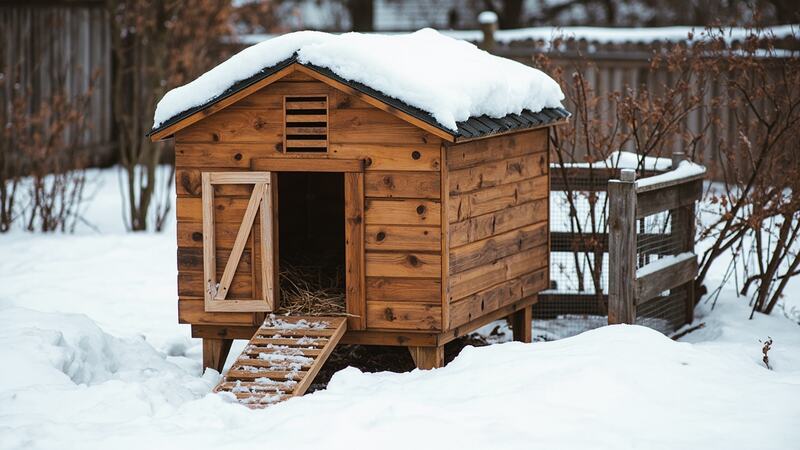
Seal the drafts, then insulate
A draft-free coop is the cheapest heat there is. Minnesota Extension puts the money in the right order. Close the gaps, insulate what is left, then decide about a heater. A heater in a leaky coop works harder and costs more.
- Walk the coop in daylight. Mark every gap you can see, along the roof edge and the wall seams.
- Look at the door frame, the pop door and the ends of the roost boards. That is where the air slips in.
- Close the gaps with a strip and a length of wood. Do it before you insulate, so the cold stays out.
- Insulate under the roof deck or in the attic, not the walls first. It does the same work.
- Seal the face of the insulation. Nothing gets in behind it, and nothing pulls it down.
- Check the roof from inside on a wet day. Then mesh any opening you added for the winter.
Minnesota Extension notes that sealing holes blocks cold air and rodents at the same time, so step 3 does two jobs. Poultry housing guidance from poultry.extension.org covers the other half. Insulation under the roof works as well as insulation in the walls. A new build puts it right under the roof.
Sealing the face of the insulation is not optional. Minnesota Extension says to close the layer off completely. Otherwise birds pick at it and rats find their way in. Where a coop has no attic, an inside layer does the same job. Fix it under the roof deck.
Check what you already own before buying more. MSU Extension notes that blown-in cellulose settles over the years. It drops from an R-19 level to about R-10. UNH Extension also asks for a sound roof. A leak wets the insulation and the floor under it.
Keep the air moving
Sealing a coop shut is the classic winter mistake. Wisconsin Livestock Extension wants air to come in low and leave high. One inlet and one outlet, with the outlet often a roof vent. Minnesota Extension adds the detail. A south-facing window cracked open a little, with coarse burlap over the opening.
The burlap is not decoration. It takes the worst of the wind and lets the air move. When the weather turns mild, open the door and the windows instead. If you see moisture on the window or on the wall, add more air, not less.
The reason to keep air moving is the litter underfoot. Minnesota Extension says chicken manure is 70% water, so that moisture has to leave the coop. Ventilation and cleaning are the two handles on it. Sealing the walls takes away one of them.
Bedding, roosts and the floor
Bedding is the warmest thing you already own. Minnesota Extension says to lay 4 to 6 in of straw or shavings on the floor. Stir the pack and add fresh material on top as it dirties. A 6 to 8 in board across the door keeps it inside. The bedding page has the volume table.
Roosts matter in the cold because the birds pile up on them. Minnesota Extension puts the roost at least 12 in off the floor. Allow 9 in of bar per hen. Use 2 × 4 or 2 × 2 boards rather than metal. The roost bar page has the full height table.
Feed changes in the cold too. Minnesota Extension says hens may eat up to 25% more feed in cold weather. Keep grit on offer, and scratch grains to one handful per 10 hens. Light runs about 14 hours a day.
| Setup | Deep bedding and what to watch |
|---|---|
| Kit coop with a pull-out tray | No. A shallow tray cannot hold a deep pack |
| Walk-in coop, solid floor | Yes. Add the 6 to 8 in door board |
| Chicken tractor | Partly. The grass takes the pack, so move the house |
Water that stays liquid
Water is the part of a winter coop that fails quietly. Minnesota Extension says frozen water is the first thing to sort out. It lists three ways to do it. A heated plastic bucket, a heated base under the bowl, or a half-covered heated dog bowl.
Set the waterer on a stand so the birds do not scratch bedding into it. Keep the heating element off the bedding. Minnesota Extension also says to keep a second waterer on hand. Swap it in when the first one freezes. The heated waterer page puts the models side by side.
Without power, Wisconsin Livestock Extension says an insulated container holds warm water for a few hours. You change the water twice a day when you cannot heat it. A hen drinks about 2 lb of water for each 1 lb of feed it eats.
Heat, and when to skip it
The 35 °F rule does the deciding. Above it, a 4 × 6 ft coop with 6 hens holds the 60 to 75 °F band on its own. Give it 4 to 6 in of bedding. Below it, add a heat source at roost height.
| Flock | Coldest night | Add heat? | Then buy |
|---|---|---|---|
| 6 hens, 4 × 6 ft coop | above 35 °F | No | Nothing. Seal drafts, bedding, 1 vent |
| 6 hens, 4 × 6 ft coop | below 35 °F | Yes | A 200 W radiant panel on a timer |
| 2 to 4 hens, small coop | below 35 °F | Yes, insulate first | A 200 W panel and a thermostatic plug |
A radiant panel suits a wooden coop. The 200 W panel listed above runs without a bulb. Nothing hangs over the birds on a cord. Minnesota Extension lists radiant heaters as brood plates, panels and hanging units. Buy one approved for use around poultry.
Set the panel at the height of the lowest roost board and hang a thermometer there. Minnesota Extension says to put the heat source at nest box height or at the lowest roost. Hang a thermometer at each of those heights.
Read the dial for what it is. The listing gives a 122 to 191 °F setting range. That range belongs to the panel, not to your coop. Minnesota Extension is direct about radiant heat. It warms the birds, not the air around them. The thermometer at roost height is the number to trust.
| Run time | A night | 30 nights |
|---|---|---|
| 200 W panel, 4 h a night | 0.8 kWh | about 24 kWh |
| 200 W panel, 24 h a day | 4.8 kWh | about 144 kWh |
Run the panel on a timer and the night figure is the one that matters. Minnesota Extension notes that a thermostat, built in or added, saves energy. Our chicken coop heater page compares 5 heaters by watts, panel size and running cost.
If you use a bulb instead, Minnesota Extension has a short list. Never hang a lamp by its cord. Add a cage or shade over the bulb. Keep the cord away from the birds, the water and the bedding. Let an electrician wire a permanent circuit. A panel avoids most of that list.
Common Questions
Do chickens need a coop in winter?
They need a dry, draft-free place to roost. UNH Extension says a winter coop needs no drafts, apart from the vent. It also needs a roof that keeps rain out. Minnesota Extension puts the comfort band at 60 to 75 °F.
How cold is too cold in a chicken coop?
Minnesota Extension says most poultry hold their own heat between 60 and 75 °F. You add a heat source below 35 °F. Flock size moves that line: a big flock makes its own heat, a small one does not.
How do I keep chickens warm without electricity?
Seal the gaps, insulate under the roof, keep 4 to 6 in of bedding and leave one vent open. Minnesota Extension says closing holes blocks the cold, and poultry.extension.org says roof insulation works like wall insulation.
How do I stop the water freezing without power?
Wisconsin Livestock Extension says an insulated container holds warm water for a few hours, and that you change the water twice a day without power. Keep a second waterer ready and swap when the first one freezes.
What is the difference between a bulb heater and a panel heater?
A bulb gives off light as well as heat. Minnesota Extension says to shade the bulb. Keep the cord away from the birds, the water and the bedding. Never hang a lamp by its cord.
Read next
- HubChicken coops
- CalculatorCoop size calculator
- GearChicken coop heaters
- GearHeated chicken waterers
- DataEggs per day
Sources
- Minnesota Extension, Caring for chickens in cold weather: extension.umn.edu (60 to 75 °F; 35 °F; bedding 4 to 6 in; door board 6 to 8 in; roost 12 in up, 9 in per hen; feed +25%; 14 h light; manure 70% water; heat at roost height; radiant types; bulb rules; vent and burlap)
- Wisconsin Livestock Extension, Preparing for Winter: livestock.extension.wisc.edu (1 inlet and 1 outlet; window cracked or roof vent; a large flock makes its own heat, a small one cannot; warm water a few hours; change water twice a day; 2 lb water per 1 lb feed)
- UNH Extension, Caring for backyard chickens in winter: extension.unh.edu (no drafts apart from the vent; sound roof; small breeds can take insulation plus a safety-rated heater)
- Poultry Extension, Auburn, Insulation for poultry housing: poultry.extension.org (insulation under the roof equals wall insulation; new builds insulate under the roof; hard board over it)
- MSU Extension, P4155 Chicken houses ready for winter: canr.msu.edu (blown-in insulation settles, R-19 down to about R-10)
- University of Kentucky, ID-245 Predator Management: publications.mgcafe.uky.edu (½ in welded hardware cloth; bury it at least 12 in)
- Panel watts, size, UL certification, 45° cut-off and 122 to 191 °F setting range: maker listing on Amazon, ASIN B0H1C7JV51, read 2026-11-02
How we pick and check numbers: How we research.