Marans Chicken: Dark Brown Eggs from a Hardy, Heavy Hen
Coopgauge is reader-supported. When you buy through links on this page, we may earn a commission.
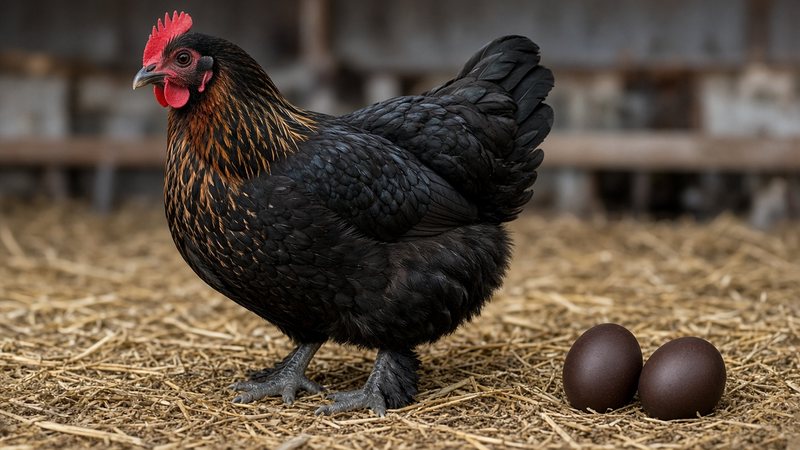
Marans chickens suit keepers who want the darkest brown eggs in the coop. Hens weigh 6.5 to 7 lb on the Cackle lines and lay roughly 180 to 200 or more large eggs a year. They are winter hardy, handle confinement well and may go broody.
- Size class
- Standard (large fowl)
- Weight range
- Hen 6.5 to 7 lb; rooster 8 to 9 lb
- Eggs per year (range)
- About 180 to 200+ (hatchery estimates)
- Egg color
- Dark chocolate brown
- Comb type
- Single
- Feather colors
- Black Copper, Wheaten, White (APA); Cuckoo and others
- Cold & heat tolerance
- Winter hardy
- Temperament
- Docile to active; not especially docile per Oklahoma State
- Broodiness
- Setter to variable, by line
- Space per bird
- 4 sq ft inside (standard)
Weight, eggs, egg color, temperament and broodiness: Cackle Hatchery (French Black Copper and Cuckoo Marans). Comb, colors, hardiness: Oklahoma State Breeds of Livestock. Space: our calculator.
The Marans comes from the town of Marans in western France. Oklahoma State calls it a chocolate egger, kept for its deep brown shells. The Black Copper variety lays the darkest eggs. Cackle Hatchery rates its French Black Copper line at #5 to #8 on the Marans egg color scale.
Shell color varies from hen to hen and through the year. If dark eggs are your goal, buy from a hatchery that lists the shade range of its line.
Marans are a working hen, not a show piece. They lay well, eat steadily and stand up to cold. Oklahoma State describes them as large, heavy birds kept for laying. The eggs are large, too, which makes them a good kitchen bird as well as a pretty one.
Expect a range of shades in one flock. Two hens of the same line can lay quite different browns. Most keepers collect a basket that runs from medium to very dark. Every one of them is a Marans egg.
Free-range or confined?
| Setup | Fits a Marans? | Space per bird | Notes |
|---|---|---|---|
| Coop with run | Good | 4 sq ft inside, 8 sq ft run | Oklahoma State: deals with confinement well |
| Free range by day | Good | same coop figures | Heavy body, a steady forager |
| Cold climate | Good | same | Winter hardy |
Marans do well either way. Oklahoma State notes that they deal with confinement well, so a coop and run suits them. They are also heavy, steady foragers on a lawn by day. Plan the standard figures: 4 sq ft each inside and 8 sq ft in the run.
Six Marans need 24 sq ft of coop and 48 sq ft of run. Our coop size calculator runs any count. Winter hardiness makes them a sound pick for northern yards.
Give them shade in summer. Heavy, dark-feathered hens feel the heat. A roof over part of the run and good airflow in the coop go a long way.
Coop & run setup
Standard coop figures fit a Marans. Set roosts about 2 ft off the floor with 8 in of bar per hen. Penn State warns against any perch more than 4 ft up, which matters for a heavy hen. Give each hen a share of 1 nest box per 4, about 12 in on each side.
Nest boxes matter more with dark eggs. A clean, padded box keeps the shells clean and unbroken, which is half the point of keeping Marans. Penn State suggests 2 in of clean pine shavings and a front lip of 3 to 4 in. Our nesting box page has the full spec.
A three-box unit covers 12 hens at 1 box per 4. The compartments above are 12 × 12 in, which matches the extension size for standard hens like Marans.
Collect eggs daily. A dark egg left in the box gets dull with dust and scuffs. Fresh shavings each week keep the color bright and the shells clean.
Feeding
Feed Marans like any dual-purpose layer. Start chicks on starter, then grower, then layer feed when the first egg appears. University of Maine gives 14 to 16% protein for dual-purpose layers. Put oyster shell out in a separate dish.
Heavy hens eat a little more than light ones. Minnesota Extension gives about 3 lb of feed a week for a 6 lb hen, so a 7 lb Marans hen eats a bit more. A 25 lb bag lasts six Marans about a week and a half. Our feeding guide has the amounts by flock size.
The feeder above holds 25 lb. Minnesota Extension gives about 3 lb a week for a 6 lb hen, so six hens eat about 18 lb a week. A 25 lb feeder covers that week with some left. Store feed dry and use it within a month in summer, per University of Maine.
Hatching: broody hen or incubator?
Broodiness varies by line. Cackle Hatchery lists its French Black Copper Marans as setters and its Cuckoo Marans as variable. Oklahoma State notes that Marans show brooding behavior well. Some hens sit, and some never do.
If a hen goes broody and you want chicks, move her to a quiet pen with a nest box, feed and water. If you do not want chicks, collect eggs often and keep her out of the nest box for a few days.
Dark shells do not change incubation. Texas A&M AgriLife Extension gives 21 days for chicken eggs at 99.5 to 100°F. Our brooder setup guide covers the chicks after the hatch.
Compared with similar breeds
| Breed | Hen weight | Eggs per year | Egg color | Broodiness |
|---|---|---|---|---|
| Marans (French Black Copper) | 6.5 lb | 200+ | Dark brown #5 to #8 | Setter |
| Cuckoo Marans | 7 lb | 180+ | Dark brown #3 to #6 | Variable |
| Buff Orpington | 8 lb | 150 to 280 | Light brown | Setter |
| Easter Egger | 5.5 lb | 200 to 280 | Green, blue, pink | Variable |
Pair Marans with an Easter Egger or Olive Egger for a basket of brown, blue and green eggs. An Orpington adds a calm, heavy hen that lays light brown eggs. All three live well together in a standard coop.
Marans also mix well with a Barred Rock. Both are hardy and steady, and the two egg colors are easy to tell apart. That helps if you want to know which hen is laying.
Marans varieties
Black Copper is the APA variety Cackle rates at egg color #5 to #8, with hens at 6.5 lb. Cuckoo is another Cackle line, hens at 7 lb, with shells at #3 to #6. Midnight Majesty is a hatchery color line, not an APA variety. Ask the hatchery which line you are ordering.
Pros and cons
Pros. French Black Copper hens weigh 6.5 lb and lay 200 or more eggs a year, by Cackle Hatchery. Shells on that line run #5 to #8, the dark end of the scale. Oklahoma State says they deal with confinement well.
Cons. Cuckoo shells are lighter, #3 to #6, so not every Marans egg is the darkest brown. Broodiness varies by line. Oklahoma State says they are not especially docile, while Cackle calls its French Black Copper line docile.
Where to get chicks
Most large mail-order hatcheries sell Marans as day-old chicks in spring, often in several colors. Check the listed shell shade before you order, since it varies by line. Local farm stores sometimes carry Marans in their spring chick runs too.
Order a few more than you need. Many hatcheries sell Marans as straight run, so some chicks will be roosters. Ask before you order, and check that your town allows roosters at all.
Common Questions
What color eggs do Marans lay?
Dark chocolate brown. Cackle Hatchery lists #5 to #8 on the Marans color scale for its French Black Copper line and #3 to #6 for Cuckoo Marans. Shade also shifts by hen and by season.
Why are Marans eggs so expensive?
Dark-shell lines are fewer than common brown-egg lines, and hatcheries price each line on its own list. We do not publish a price here. Read the hatchery catalog for the line you want, and compare the listed shell shade, not a single number.
How many eggs does a Marans lay?
About 180 to 200 or more a year by hatchery estimates. Oklahoma State gives about three large eggs a week.
Are Marans good in cold weather?
Yes. Oklahoma State notes winter hardiness. Give them a dry, draft-free coop with vents above the roost.
Are Marans friendly?
Cackle Hatchery lists its French Black Copper line as docile. Oklahoma State notes they are not especially docile, so temper varies by line.
Read next
- HubChicken breeds
- ListBest egg laying chickens
- BreedBarred Rock chicken
- BreedOrpington chicken
- DataNine shell colors
Sources
- Cackle Hatchery, French Black Copper Marans breed facts: cacklehatchery.com (hen 6.5 lb, rooster 8 lb; 200+ eggs; dark brown #5 to #8; large; docile; setter; APA 2011)
- Cackle Hatchery, Cuckoo Marans breed facts: cacklehatchery.com (hen 7 lb, rooster 9 lb; 180+ eggs; #3 to #6; variable broodiness)
- Oklahoma State University, Breeds of Livestock: Marans Chickens: breeds.okstate.edu (from Marans, France; chocolate eggers; typically 7 to 8 lb; three large eggs a week; APA White, Wheaten, Black Copper; single comb; winter hardiness; confinement well; not especially docile; brooding behavior)
- Cackle Hatchery, Buff Orpington breed facts: cacklehatchery.com (Buff Orpington hen 8 lb; 150 to 280 eggs; light brown; setter)
- Cackle Hatchery, Easter Egger breed facts: cacklehatchery.com (Easter Egger hen 5.5 lb; 200 to 280 eggs; variable)
- Penn State Extension, Small Scale Poultry Housing (updated 2026): extension.psu.edu (2 in shavings; 3 to 4 in lip)
- University of Maine Cooperative Extension, Bulletin #2222 Nutrition for Backyard Chicken Flocks in Maine: extension.umaine.edu (dual-purpose layer protein 14 to 16%; storage)
- University of Minnesota Extension, Raising chickens for eggs (reviewed 2025): extension.umn.edu (3 lb feed a week for a 6 lb hen)
- Texas A&M AgriLife Extension, POSC-PU-018 Incubating and Hatching Eggs (2022): agrilife.org (21 days at 99.5 to 100°F)
- Compartment size and count: maker listing on Amazon, ASIN B0GHR4ZQWM, read 2026-10-12
- RentACoop treadle feeder, 25 lb: maker listing on Amazon, ASIN B07MQW8MQK, title read 2026-10-23
How we pick and check numbers: How we research.