Meat Chicken Breeds: Live Weight, Weeks and Space Compared
Coopgauge is reader-supported. When you buy through links on this page, we may earn a commission.
Counting a meat bird in months is how a batch ends up too big for the space. Meat birds are a week count. A Cornish Cross reaches about 5.25 lb live weight at week 6. A slower cross needs 8 to 9 weeks for the same weight. Each bird eats 15 to 16 lb of feed and 3.6 to 4.5 gal of water. One exception: meat lines lay 50 to 80 eggs a year, dual-purpose lines 120 to 280.
- Lines compared
- 10 lines (7 from the chart, 3 from our breed cards)
- Fastest to target weight
- Cornish Cross, week 6 at about 5.25 lb live
- Slowest to the same weight
- slower crosses, week 8 to 9
- Feed per bird
- 15 lb fast, 16 lb slow
- Water per bird
- 3.6 gal fast, 4 to 4.5 gal slow
- Pasture space
- 1.5 sq ft per bird, tractor moved daily
- Coop floor if kept over winter
- 4 sq ft standard, 5 sq ft large, plus 8 or 10 sq ft of run
- Eggs a year
- 50 to 80 meat line, 120 to 280 dual-purpose
- Roost per bird
- 10 in, large breed
- Brooding before pasture
- about 2 weeks
Weeks, feed, water, pasture space and brooding: University of Maine Bulletin #2214. Weights, eggs and brooding: The Livestock Conservancy chart, 7 rows, and our breed cards, 3 rows. Coop floor, run and roost: our calculator.
Meat breeds compared
The Cornish Cross is not one breed. The University of Maine calls it a hybrid of a commercial Cornish chicken and a White Plymouth Rock chicken.
The table starts with the Cornish, the breed behind most of those crosses, then the heritage lines that share the same barn. Weights are adult weights, rooster first.
| Breed | Purpose | Rooster / Hen | Eggs a year | Egg color | Brooding | Growth | In a coop | Source |
|---|---|---|---|---|---|---|---|---|
| Cornish | Meat | 10.5 / 8 lb | 50 to 80 | Tinted | Non-setter | Broiler type, quick to weight | 4 sq ft in, 8 sq ft run | Livestock Conservancy |
| Delaware | Eggs, meat | 8.5 / 6.5 lb | 150 to 200 | Brown | Setter | Bred for quick broiler growth | 4 sq ft in, 8 sq ft run | Livestock Conservancy |
| Sussex | Meat, eggs | 9 / 7 lb | about 200 | Tan to brown | Setter | Good all-around table bird | 4 sq ft in, 8 sq ft run | Livestock Conservancy |
| Jersey Giant | Meat, eggs | 13 / 10 lb | 175 to 185 | Brown | Setter | Heavy bird for cooler climates | 5 sq ft in, 10 sq ft run | Livestock Conservancy |
| Java | Meat, some eggs | 9.5 / 7.5 lb | 150+ | Brown | Setter | Slower growth | 4 sq ft in, 8 sq ft run | Livestock Conservancy |
| Buckeye | Meat, eggs | 9 / 6.5 lb | 120 to 150 | Brown | Variable | Excellent broilers | 4 sq ft in, 8 sq ft run | Livestock Conservancy |
| Australorp | Eggs, meat | 8.5 / 6.5 lb | 250 | Brown | Setter | Productive and fast growing | 4 sq ft in, 8 sq ft run | Livestock Conservancy |
| Rhode Island Red | Meat and eggs | 8 to 8.5 / 6 to 6.5 lb | 200 to 280 | Brown | Occasional | Layer type, 6.5 lb hen | 4 sq ft in, 8 sq ft run | Breed cards on this site |
| Orpington | Meat and eggs | 10 / 8 lb | 150 to 280 | Light brown | Setter | Fatten easily | 5 sq ft in, 10 sq ft run | Breed cards on this site |
| Plymouth Rock | Meat and eggs | 8 to 9.5 / 6 to 7.5 lb | about 200 | Brown | Setter | Standard dual-purpose | 4 sq ft in, 8 sq ft run | Breed cards on this site |
The Purpose column follows the chart on its seven rows. We group the Orpington, the Rhode Island Red and the Plymouth Rock as meat and eggs, from their breed cards.
The two heaviest lines set your floor space. A Jersey Giant hen weighs 10 lb and an Orpington hen 8 lb, so both take 5 sq ft inside and 10 sq ft of run.
The egg column changes the plan for the rest of the year. A meat line gives 50 to 80 eggs. The dual-purpose lines give 120 to 280, and most of them sit on the nest.
The feeder in the box holds 50 lb. Six meat birds eat about 90 lb of feed to target weight, so that is 2 fills. Twelve birds eat about 180 lb, so it is 4 fills.
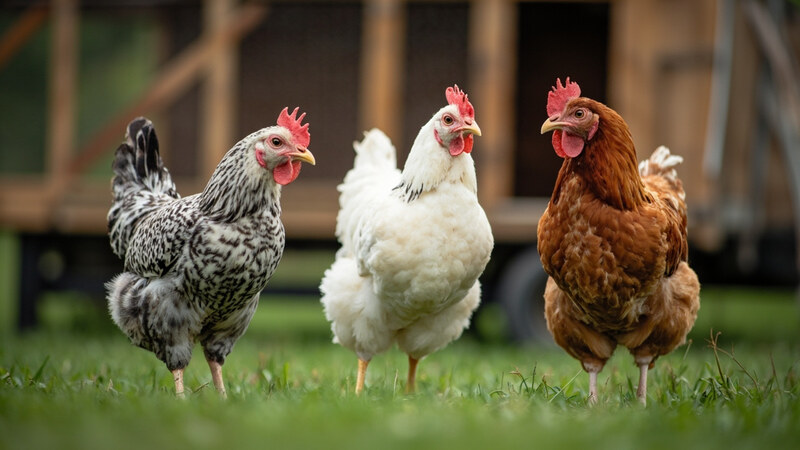
Our assumptions
- Weights are adult weights: rooster first, then hen.
- Weeks mean the same target live weight of about 5.25 lb, not each maker's best age.
- Feed is the total a bird eats to that weight, not a daily figure.
- Water is the total a bird drinks over the same period.
- The grow ration is 20% crude protein starter/grower for both crosses.
- Pasture space is 1.5 sq ft per bird, and the tractor moves every day.
- The 5 sq ft and 10 sq ft run rule is our calculator's large-breed rule.
- A line with no published figure stays out of the tables instead of getting a guess.
| Line | Weeks to about 5.25 lb live | Feed per bird | Water per bird | Grow ration | Source |
|---|---|---|---|---|---|
| Cornish Cross | 6 weeks | 15 lb | 3.6 gal | 20% crude protein starter/grower | UMaine #2214 |
| Freedom Rangers, Imperials, Kosher Kings | 8 to 9 weeks | 16 lb | 4 to 4.5 gal | 20% crude protein starter/grower | UMaine #2214 |
Two numbers set the calendar. Week 6 or week 9 sets the end date. The feed total sets how many bags you buy, and it does not change when the flock is bigger.
The Maine bulletin also puts forage in the diet. On grass pasture, forage is about 3.6% of a bird's dry matter, or roughly 1 lb per bird.
Space per bird
Three housing systems, three different numbers. The pasture figure is per bird inside a tractor that moves every day. The coop figures are per bird in a building that does not.
This is where a label misleads. A 5.5 by 10 ft A-frame holds 36 birds on pasture, and those same 36 birds would need 180 sq ft of coop floor at the large-breed rule.
| System | Space per bird | What a group needs | Source |
|---|---|---|---|
| Pasture tractor, moved daily | 1.5 sq ft | 36 birds in a 5.5 × 10 ft A-frame; 80 birds in a 10 × 12 ft cage | UMaine #2214 |
| Fixed coop, birds kept inside | 5 sq ft of floor | 6 birds need 30 sq ft; 12 birds need 60 sq ft | Our calculator, our math |
| Kept on for eggs after the grow period | 5 sq ft inside, 10 sq ft of run, 10 in of roost, 1 nest box per 4 birds | 12 birds need 3 nest boxes | Our calculator |
Read the two numbers side by side. A 55 sq ft tractor carries 36 birds on grass. A 60 sq ft coop floor carries 12 of them indoors. That is the same footprint and a third of the birds.
The 1.5 sq ft figure is a pasture number, and it only holds while the tractor moves. Our tractor page has the frames and the daily move.
Feed and water per batch
Feed is bought by the bag, so the bag count follows the bird count. Six birds eat about 90 lb on the fast line and 96 lb on the slow one. Twelve birds eat 180 lb and 192 lb.
Water is the number people leave out. Six fast birds drink 21.6 gal over the grow period, and twelve drink 43.2 gal. The slower line needs 4 to 4.5 gal a bird instead of 3.6.
The 50 lb feeder in the box above takes 2 fills for six birds and 4 for twelve on the fast line. Check the capacity on the listing before you order.
| Birds | Feed, fast line | Feed, slow line | Water, fast line | Water, slow line | Weeks to target weight |
|---|---|---|---|---|---|
| 6 | 90 lb | 96 lb | 21.6 gal | 24 to 27 gal | 6 weeks fast, 8 to 9 slow |
| 12 | 180 lb | 192 lb | 43.2 gal | 48 to 54 gal | 6 weeks fast, 8 to 9 slow |
| 24 | 360 lb | 384 lb | 86.4 gal | 96 to 108 gal | 6 weeks fast, 8 to 9 slow |
The chart has two points because two are published. University of Maine gives the week 6 weight for the Cornish Cross and the week 8 weight for the Freedom Rangers. The weeks between are not in our sources.
That is the whole calendar. Six weeks or nine, then the birds come out of the pasture and the numbers stop.
Meat and eggs in one flock
One flock can do both jobs, but the lines sit at opposite ends of the egg range. A meat line gives 50 to 80 eggs a year. The dual-purpose lines give 120 to 280.
Brooding is the other half of the decision. A non-setter keeps laying through the year. A setter stops and sits on the nest, which matters when the same flock has to give eggs all year.
| Line | Eggs a year | Egg color | Brooding | Hen weight | Use |
|---|---|---|---|---|---|
| Cornish | 50 to 80 | Tinted | Non-setter | 8 lb | Meat |
| Delaware | 150 to 200 | Brown | Setter | 6.5 lb | Eggs, meat |
| Orpington | 150 to 280 | Light brown | Setter | 8 lb | Meat and eggs |
| Sussex | about 200 | Tan to brown | Setter | 7 lb | Meat and eggs |
| Rhode Island Red | 200 to 280 | Brown | Occasional | 6 to 6.5 lb | Meat and eggs |
| Australorp | 250 | Brown | Setter | 6.5 lb | Eggs, meat |
The Australorp is the clearest split. At 250 eggs a year it is an egg bird that also carries meat weight, while the Cornish at 50 to 80 is the other way round.
Our egg laying page has the Sussex, Delaware, Orpington and Australorp sorted by egg count, and the breeds hub has the rest of the flock choices.
Where to get chicks
Chicks usually come from hatcheries, farm supply stores or local breeders. Which one you use does not change the numbers here. It changes what you learn before the birds arrive.
Ask four questions. Which line is it, a Cornish Cross or a heritage cross? What is the hatch date, because the week count starts at hatch? Are the chicks roosters or straight-run? How many birds are in the batch?
Then measure. The first 2 weeks are brooder time by the Maine timeline, and the brooder needs floor before the tractor appears. Our brooder setup page has that math.
Common Questions
Which meat chicken grows fastest?
The Cornish Cross. It reaches about 5.25 lb live weight at week 6, by University of Maine Bulletin #2214. A slower cross such as the Freedom Ranger needs 8 to 9 weeks for the same weight, so the batch is ready later.
How much space does a meat chicken need?
On pasture, 1.5 sq ft per bird, and the tractor moves every day. A 5.5 by 10 ft A-frame holds 36 birds. In a fixed coop, our calculator's large-breed rule is 5 sq ft of floor and 10 sq ft of run per bird.
Do meat chickens lay eggs?
A meat line lays 50 to 80 eggs a year, by The Livestock Conservancy chart. The dual-purpose lines lay 120 to 280 eggs a year, and the Australorp alone lays about 250 brown eggs.
Which chickens give meat and eggs together?
The Sussex, Delaware, Orpington, Rhode Island Red and Australorp. Their hens weigh 6 to 8 lb, and they lay 150 to 280 eggs a year. The egg laying page has the Sussex, Delaware, Orpington and Australorp sorted by egg count.
How much feed and water does one meat chicken use?
15 lb of feed and 3.6 gal of water on the fast line. The slower lines use 16 lb and 4 to 4.5 gal for the same target weight. Both sets of figures come from University of Maine Bulletin #2214.
Read next
- HubChicken breeds
- ListBest egg laying chickens
- GuideChicken tractor
- CalcCoop size calculator
- GuideBrooder setup for the first two weeks
Sources
- University of Maine Cooperative Extension, Bulletin #2214 A Quick Guide to Raising Pastured Broilers in Maine (Colt W. Knight, 2020; page revised 2024): extension.umaine.edu (Cornish Cross as a hybrid of a commercial Cornish and a White Plymouth Rock; slower breeds Freedom Rangers, Imperials and Kosher Kings, 2 to 3 weeks behind; 20% crude protein starter/grower; 15 lb and 16 lb of feed and 3.6 gal and 4 to 4.5 gal of water per bird; 1.5 sq ft per bird on pasture; the 10 by 12 by 2 ft tractor holds 80 birds and the 5.5 by 10 by 5.5 ft A-frame holds 36; 2 weeks brooding; forage about 3.6% of dry matter, about 1 lb per bird)
- The Livestock Conservancy, Heritage Chicken Breed Comparison Chart (2026): livestockconservancy.org (Purpose, adult weights, egg counts and colors, brooding and growth notes for Cornish, Delaware, Sussex, Jersey Giant, Java, Buckeye and Australorp)
- Breed cards published on this site: Orpington (Cackle Hatchery eggs 150 to 280; Oklahoma State weights, hen 8 lb, rooster 10 lb), Rhode Island Red (Cackle and Townline weights, 200 to 280 eggs), Plymouth Rock (Livestock Conservancy page, Cackle and Townline cards, about 200 eggs)
- Coop space and roost rules: our calculator, from Minnesota Extension (3 to 5 sq ft inside), Penn State (8 sq ft of run, 10 sq ft for large chickens) and Oregon State (5 to 10 in of roost, 1 nest box per 4 birds)
- Our math: the flock sizes, the feed and water totals, the feeder fills and the areas in the tables above
- Feeder capacity, ports and body: maker listing on Amazon, ASIN B0FN71G3X4, read 2026-11-12
How we pick and check numbers: How we research.