Rhode Island Red Chicken: Brown Eggs, Single or Rose Comb and What 6.5 Pound Hens Need
Coopgauge is reader-supported. When you buy through links on this page, we may earn a commission.
Two egg counts float around the Rhode Island Red. The flock you build depends on which one you trust.
A modern production hen weighs about 6.5 lb and lays 200 to 280 brown eggs a year. The Livestock Conservancy gives the older type 200 to 300. Breeding for eggs since the 1940s made this bird smaller and less broody.
- Size class
- Standard, with a bantam line
- Weight range
- Hen 6 lb, rooster 8 lb, market weight 5.5 to 7.5 lbs; hen about 6.5 lbs and rooster about 8.5 lbs on one breed card; hen 5.5 to 7 lb and rooster 7.5 to 8.5 lb on a hatchery page; hen 3 kg (6.6 lb) and rooster 3.9 kg (8.6 lb) in metric
- Eggs per year (range)
- 200 to 280 on the hatchery cards; 200 to 300 for the old type on the breed page and in the encyclopedia entry
- Egg color
- Brown, and light brown on one hatchery page
- Egg size
- Large
- Comb type
- Single or rose comb; both sit in the American class
- Feather colors
- Deep red to nearly black with dark tail feathers; the exhibition line is darker
- Cold & heat tolerance
- Hardy in cold weather; the breed keeps laying in marginal conditions
- Temperament
- Calm, hens quiet; some roosters aggressive at times
- Broodiness
- Occasional; strains selected for egg output sit less
- Space per bird
- 4 sq ft inside, 8 sq ft of run (our calculator)
Weight, egg size, egg color, comb, temperament, broodiness and the old-type egg count: The Livestock Conservancy breed page. Eggs per year, the 6.5 and 8.5 lb weights, the 1 to 10 mating ratio, the exhibition line and the Cold Hardy field: Cackle Hatchery breed card. The 5.5 to 7 lb and 7.5 to 8.5 lb weights, the 21 to 22 week maturity and the light brown shells: Townline Hatchery. The 3 kg and 3.9 kg weights, the dark tail feathers and the single or rose comb: Wikipedia. Space: our calculator.
The bird came together in the 1880s and 1890s in Rhode Island and Massachusetts. Its ancestors include the Malay, the Shanghai, the Java and the Brown Leghorn. It was kept for eggs and meat from the start.
The standard settled on two combs, and the single comb came first. Cackle Hatchery sells the single comb as its production line. The rose comb joined a year later. Both sit in the American class.
So a pen can hold both kinds. A buyer who expects one shape will misjudge the other.
Three features separate a real Rhode Island Red from a generic red hen.
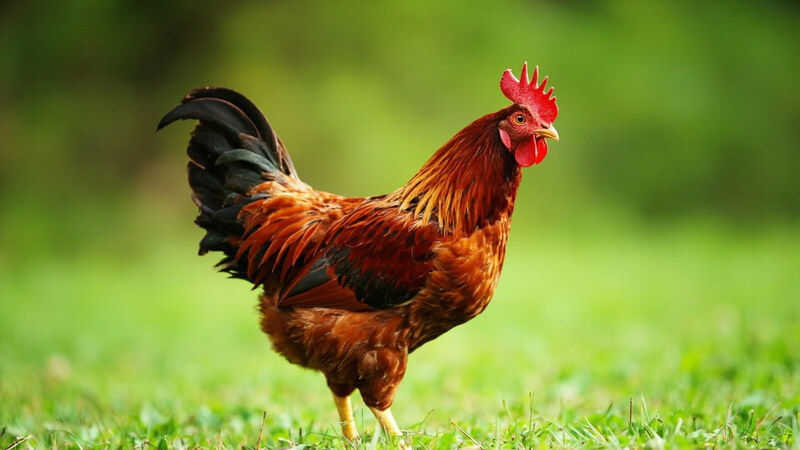
Wikipedia records the plumage as deep red to nearly black, with dark tail feathers. Townline Hatchery calls the adult bird solid dark red with darker tail feathers. Yellow skin and yellow legs run with it. The comb is either single or rose.
One bird is easy to mix up. The Livestock Conservancy chart our egg color page is built from lists Rhode Island White, not the Red.
That row gives a 6.5 lb hen and an 8.5 lb rooster. It also lists brown eggs and a non-setter. The white bird on that chart is the Rhode Island White, not the Red.
| Comb | Class | Admitted |
|---|---|---|
| Single | American | 1904 |
| Rose | American | 1905 |
| Single | Bantam | 1940 |
| Rose | Bantam | 1952 |
Free-range or confined?
A Rhode Island Red works in a coop with a run. It works on wheels, and it works free range by day. The Livestock Conservancy calls the breed hardy. It says the hens keep laying in marginal conditions.
That is where the space rule matters. A 6.5 lb hen is a standard bird. She takes 4 sq ft of floor and 8 sq ft of run. The 8 lb Orpington takes 5 sq ft, and this hen does not. Pick the row that matches your yard. The run matters as much.
| Setup | Fits a Rhode Island Red? | Space per bird | Notes |
|---|---|---|---|
| Coop with a run | Good | 4 sq ft inside, 8 sq ft run | Run needs wire mesh all round |
| Mobile coop on wheels | Good | same figures | Wheels let you move the run to fresh grass |
| Free range by day | Good | 3 sq ft inside | Oregon State gives 3 sq ft with outdoor access |
| No outdoor access | Not our default | 8 to 10 sq ft inside | Oregon State figure for a flock with no run |
Our assumptions for both tables are simple. Give 4 sq ft of coop floor per standard hen. Give 8 sq ft of run.
Give 8 in of roost bar each. Give 1 nest box per 4 hens. The 3 sq ft row applies when your flock has outdoor access all day.
| Hens | Coop floor | Run | Roost bar | Nest boxes |
|---|---|---|---|---|
| 4 | 16 sq ft | 32 sq ft | 32 in | 1 |
| 6 | 24 sq ft | 48 sq ft | 48 in | 2 |
| 8 | 32 sq ft | 64 sq ft | 64 in | 2 |
Six Rhode Island Red hens need a 4 × 6 ft house and a 6 × 8 ft run. Divide any floor by 4 and you get the bird count that floor holds.
The coop size calculator does the same arithmetic. It adds the run, the roost bar and the boxes. The floor is the number that counts.
Coop & run setup
Give each hen 8 in of roost bar. That figure is our own, the one our calculator uses. Oregon State allows 5 to 10 in of pole per bird. Our 8 in sits inside that range. If you build the house yourself, set the roost first and work down.
Set the bar 18 to 24 in off the floor. Never go above 4 ft. Penn State gives the height and the limit. Our roost bar page has the heights and the spacing.
Nest boxes come next. Put in 1 box per 4 hens, about 12 × 12 × 12 in each. Oregon State gives the box size and the count.
Penn State wants the boxes at least 4 ft from the roost. Hens do not sleep in them then. Box sizes are on our nesting box page.
Cold weather is a question of structure for this breed. The plumage lies close to the body. The comb comes in a low rose shape or a taller single shape.
Block the drafts at the roof edge. Minnesota Extension puts the bedding at 4 to 6 in on the floor. Wisconsin Livestock Extension wants one vent inlet low and one outlet high. Equipment for the cold months is on our winter chicken coop page.
Roosters need a plan. The Livestock Conservancy says some roosters are aggressive at times. Cackle Hatchery says the same. Mixing works best when the birds share a size class and a temperament. Pair a Rhode Island Red with hens of about 6.5 lb.
One more number before the birds arrive. You do not need a rooster for eggs. For fertile eggs, Cackle Hatchery gives one rooster for 10 hens. Townline Hatchery gives one for 6 to 10 hens.
The label says 10 to 15 hens. The house floor is 28.3 sq ft. At 4 sq ft per standard hen, that is 7 hens.
The run is 58.8 sq ft. Divide it by 8 sq ft per hen and you get 7 hens again.
Check the 28.3 sq ft house floor on the listing. Compare that with 4 sq ft per 6.5 lb hen. Then measure your own floor the same way.
The house carries four perches and one nesting box in four sections. A flock of 6 wants 48 in of roost bar and 2 nest spaces. The four sections give more nesting space than that. The listing prints a perch size of 35.4 by 19.7 in. It does not say whether that is one perch or all four, so measure the bar against 48 in.
Feeding
A Rhode Island Red starts on starter feed, moves to grower, then goes onto layer feed. University of Maine allows that switch up to 2 weeks before laying starts. Townline Hatchery puts maturity at 21 to 22 weeks. Plan the change by age, not by calendar.
Give the layer feed 14 to 16% protein. University of Maine gives that figure for dual-purpose layers like this one. It applies from the first egg onward. Switch the feed before the first egg, not after.
Now the amount. Minnesota Extension puts a 6 lb hen at 3 lb of feed a week. Scale that to 6.5 lb. You get about 3.25 lb a week for that hen.
So six Rhode Island Red hens eat roughly 19 to 20 lb of feed a week. Our feeding guide has the step by step. Your feeder size follows from that.
Keep grit and oyster shell in their own dishes, free choice. Let each hen take what she needs. The grit and oyster shell page covers the amounts.
Water matters more in summer than in winter. Keep it cold, change it every day, and check the drinker before you leave the yard. The waterer page compares the sizes, and the feeder page does the same for feed.
Hatching: broody hen or incubator?
Three sources put broodiness in the same middle place. The Cackle Hatchery breed card lists it as occasional.
The Livestock Conservancy says most hens are peaceful and can become broody. The exception is the strains heavily selected for egg production. The same page notes the breed has been less broody since the 1940s.
So plan for a hen that may sit, and keep the boxes working for the rest of the flock. One box per 4 hens means a sitting hen takes one of two boxes in a flock of six.
A hen on the nest stops laying, and the egg count drops for as long as she sits.
Give her a low, quiet corner of the house. The incubator route has numbers. Texas A&M gives a 21 day cycle at 99.5 to 100 °F. Humidity runs 55 to 60%, with 5 turns a day.
Work out the batch size before you buy the machine. A 6.5 lb hen lays 200 to 280 eggs a year. That is one egg every 1.3 to 1.8 days. Compare the two numbers. Count the eggs before you order.
Over a 21 day cycle, that is 12 to 16 eggs from one hen. That is the batch to plan for. Our hatching page walks the whole cycle.
The machine in the box takes 20 eggs and turns them every 60 minutes. One hen fills 12 to 16 of those positions in a 21 day cycle.
Check the 20 egg positions on the listing. Compare that with the 12 to 16 eggs one hen gives you in a cycle. Two hens fill 24 to 32, so a second hen means a second cycle.
Its listing says turning stops 3 days before the hatch day. Water goes in through external ports, so you do not open the lid. The humidity display shows what the air is doing. The incubator page compares machines by egg count.
The chicks are out. The next job is heat. Our brooder setup page has the week by week table and the floor space each chick needs.
Compared with similar breeds
The Rhode Island Red sits with the standard brown egg birds. The table below puts four neighbours beside it. Read the weight column first, because that column decides the space figure. Your floor math comes from it. Then check the egg column. Start with the weight.
| Breed | Hen | Rooster | Eggs a year | Egg color | Comb | Broodiness | Sq ft each | Standard breed |
|---|---|---|---|---|---|---|---|---|
| Rhode Island Red | 6 to 6.5 lb | 8 to 8.5 lb | 200 to 280 | Brown | Single or rose | Occasional | 4 | Yes, since 1904 |
| Barred Rock | 6 to 7.5 lb | 8 to 9.5 lb | About 200 | Brown | Single | Setter | 4 | Yes, since 1874 |
| Wyandotte | 6.5 lb | 8.5 lb | 180 to 260 | Brown | Rose | Setter | 4 | Yes, since 1883 |
| Orpington | 8 lb | 10 lb | 150 to 280 | Light brown | Single | Setter | 5 | Yes, since 1902 |
| Leghorn | 4.5 lb | 6 lb | 250 to 300 | White | Single | Non-setter | 4 | Yes, since 1874 |
Three differences are worth naming. The Barred Rock is the closest neighbour, and it is the heavier bird. Its hen runs 6 to 7.5 lb, against 6 to 6.5 lb here. It lays about 200 eggs a year.
The Leghorn sits at the other end of the scale. It is a 4.5 lb white egg bird at 250 to 300 eggs. It never sits on the nest.
The Wyandotte shares the brown eggs and the standard size. Its comb is a low rose shape that lies flat on the head. The Orpington is the heavy one at 8 lb, so it takes 5 sq ft each.
One more difference is the egg count itself. The Rhode Island Red is the only bird in this table with two ranges. The line you buy decides which one you get.
Where to get chicks
Mail-order hatcheries list the breed by line. Cackle Hatchery runs a production line and an exhibition line as separate pages. A farm feed store sells the same bird by breed name. Ask which line you are buying.
Three checks on the box. The plumage should be deep red to nearly black, with dark tail feathers. The legs and skin are yellow. The comb is single or rose, and both sit in the standard. You can check all three in the pen.
The two lines differ in color and in output. Cackle Hatchery says the exhibition birds are darker and lay slightly fewer eggs. The production birds are the ones selected for egg output.
Chicks look different from adults. Townline Hatchery describes them as darker red with a little yellow on the belly. Two dark lines run down the back.
You do not need a rooster for eggs. Cackle Hatchery gives a 1 to 10 ratio. Townline Hatchery gives one rooster for 6 to 10 hens.
Do not mix the bird up with the Rhode Island White. The Livestock Conservancy chart our egg color page is built from lists the White. That is the row to read.
Before the birds come, measure the coop. Six Rhode Island Red hens need 24 sq ft of floor and 48 sq ft of run. Measure yours, then buy the house first and the birds after.
Common Questions
How many eggs does a Rhode Island Red chicken lay a year?
Two figures are published, and they describe different birds. Cackle Hatchery and Townline Hatchery both give 200 to 280 eggs a year for the modern production line. The Livestock Conservancy gives 200 to 300 for the old type, and Wikipedia quotes the same number. One hen works out at about 3.8 to 5.4 eggs a week, so six hens give roughly 23 to 32. Our eggs per day page explains why a hen lays at most one egg a day.
What color are Rhode Island Red eggs, and how big are they?
Brown. The Livestock Conservancy lists brown eggs at Large size, and the Cackle breed card gives the same shell color and the same egg size. Townline Hatchery calls them light brown. The Livestock Conservancy chart our egg color page is built from lists a Rhode Island White, and no Rhode Island Red row.
How much does a Rhode Island Red hen weigh?
About 6.5 lb for the hen and 8.5 lb for the rooster, by the Cackle Hatchery breed card. The Livestock Conservancy breed page gives 6 lbs and 8 lbs, with a market weight of 5.5 to 7.5 lbs. Townline Hatchery gives a range of 5.5 to 7 lb for the hen and 7.5 to 8.5 lb for the rooster. Wikipedia converts 3 kg and 3.9 kg, which lands at 6.6 lb and 8.6 lb.
Do Rhode Island Red hens go broody?
Sometimes. The Cackle Hatchery breed card lists broodiness as occasional. The Livestock Conservancy says most hens are peaceful and can become broody, except within the strains that have been heavily selected for egg production, and that the breed has been less broody since the 1940s. A hen on the nest stops laying while she sits, so keep one nest box per 4 hens and the rest of the flock keeps laying.
Are Rhode Island Red chickens good in cold weather?
Yes. Cackle Hatchery lists the breed as cold hardy, Townline Hatchery says it takes any climate, and The Livestock Conservancy says the hens keep laying in marginal conditions. Most of the work sits on the house: block the drafts at the roof edge, run one vent inlet low and one outlet high, and lay 4 to 6 in of bedding on the floor. Minnesota Extension and Wisconsin Livestock Extension give those numbers. The rose comb is the smaller shape.
Is a Rhode Island Red single comb or rose comb, and which came first?
Both sit in the American class of the APA standard. The single comb was admitted in 1904 and the rose comb in 1905, and the bantam class followed with a single comb in 1940 and a rose comb in 1952. Wikipedia gives 1906 for the rose comb, which differs from the association's own list. Cackle Hatchery sells the single comb as its production line.
Read next
- HubChicken breeds
- ListBest egg laying chickens
- BreedBarred Rock chicken
- BreedWyandotte chicken
- DataEgg color chart
- CalculatorCoop size calculator
- GuideEgg incubators
- GuideHow to hatch chicken eggs
Sources
- The Livestock Conservancy, Rhode Island Red – Non Industrial Chicken: livestockconservancy.org (Status Graduated 2023; Use Eggs, Meat; Egg Color Brown; Egg Size Large; Weight Male 8 lbs / Female 6 lbs; Market Weight 5.5 to 7.5 lbs; Temperament Calm; 200 to 300 eggs a year, the first eggs at about six months; single comb 1904 and rose comb 1905 admitted to the APA standard; developed in Rhode Island and Massachusetts in the 1880s and 1890s from the Malay, Shanghai, Java and Brown Leghorn; since the 1940s selected for egg production, so smaller, lighter in color and less broody, with the old type larger, darker and more broody; most hens peaceful and able to become broody except within strains heavily selected for egg production; some roosters aggressive at times; known for its hardiness and still laying in marginal conditions)
- The Livestock Conservancy, Heritage Chicken Breed Comparison Chart (2026): livestockconservancy.org (the chart lists Rhode Island White and not Rhode Island Red: United States, Watch, Eggs and Meat, Brown, Large to Extra Large, Docile, Non-Setters, M 8.5 lbs / F 6.5 lbs; the confusion note on this page, not a source for the numbers above)
- Cackle Hatchery, Rhode Island Red breed card: cacklehatchery.com (APA 1904; Egg Shell Color Brown; Eggs per Year about 200 to 280; Egg Production Good; Egg Size Large; Broodiness Occasional; Hen Weight about 6.5 lbs; Rooster Weight about 8.5 lbs; Mating Ratio 1 to 10; Roost Height Medium; Origin United States; Cold Hardy; production type and exhibition type, with the exhibition birds darker and laying slightly fewer eggs; plumage rich red to dark mahogany with yellow skin; some roosters aggressive; the single comb is the production line)
- Townline Hatchery, Rhode Island Red: townlinehatchery.com (rooster 7.5 to 8.5 lb, hen 5.5 to 7 lb; matures at 21 to 22 weeks; 200 to 280 large light brown eggs a year; tolerates any climate; cockerels can be aggressive; one rooster for 6 to 10 hens for fertile eggs, and no rooster needed for eggs; chicks darker red with a little yellow on the belly and two dark lines down the back, adults solid dark red with darker tail feathers)
- Wikipedia, Rhode Island Red: en.wikipedia.org (rooster 3.9 kg (8.6 lb) and hen 3 kg (6.6 lb); yellow skin, brown eggs, comb single or rose; plumage deep red to nearly black with dark tail feathers; comb and wattles bright red, beak red horn, eyes red-brown, legs yellow; old type 200 to 300 eggs a year; selected for egg production since 1940; the encyclopedia gives 1906 for the rose comb, which differs from the association list, so the 1905 figure stands here)
- American Poultry Association, Recognized Breeds and Varieties (September 2012, archived copy): web.archive.org (American class: Rhode Island Red Single Comb 1904, Rose Comb 1905; bantam class: Rhode Island Red Single Comb 1940, Rose Comb 1952, Clean Legged)
- Comparison rows: Barred Rock, Wyandotte, Orpington and Leghorn breed pages on this site, Barred Rock, Wyandotte, Orpington and Leghorn, which cite The Livestock Conservancy, Cackle Hatchery, Townline Hatchery and Oklahoma State
- Oregon State University Extension, EC 1644 Backyard chicken coop design (2014, reviewed 2023): extension.oregonstate.edu (3 sq ft per bird with outdoor access, 8 to 10 sq ft without; 5 to 10 in of roost per bird; 1 nest box per 4 birds; box 12 × 12 × 12 in)
- Penn State Extension, Small Scale Poultry Housing (updated 2026): extension.psu.edu (roost 18 to 24 in high and never over 4 ft; nest boxes at least 4 ft from the roost; 8 sq ft of run per laying hen)
- University of Minnesota Extension, Raising chickens for eggs (reviewed 2025): extension.umn.edu (3 to 5 sq ft of indoor space per bird; 3 lb of feed a week for a 6 lb hen; the 3.25 lb and 19 to 20 lb figures on this page are our arithmetic)
- University of Maine Cooperative Extension, Bulletin #2222 Nutrition for Backyard Chicken Flocks in Maine: extension.umaine.edu (dual-purpose layer protein 14 to 16%; switch to layer feed up to 2 weeks before laying)
- Minnesota Extension, Caring for chickens in cold weather: extension.umn.edu (bedding 4 to 6 in on the floor)
- Wisconsin Livestock Extension, Preparing for Winter: livestock.extension.wisc.edu (one vent inlet and one vent outlet, one low and one high)
- Texas A&M AgriLife Extension, POSC-PU-018 Incubating and Hatching Eggs (2022): agrilife.org (21 days at 99.5 to 100 °F, 55 to 60% humidity, 5 turns a day)
- PawHut 212 inch chicken coop with run, 10 to 15 hens on the label, 28.3 sq ft house floor with 4 perches, 58.8 sq ft run, one nesting box in 4 sections; printed dimensions: overall 212.2 × 75.2 × 87.4 in, main house 67.7 × 63 × 85.6 in, run box 130.7 × 67.7 × 85.6 in, nesting box 65.7 × 14.2 × 25.1 in, perch size 35.4 × 19.7 in: maker listing on Amazon, ASIN B0HSS77D7N, read 2026-11-26
- 20 egg incubator with humidity display, built-in candler, automatic turning every 60 minutes with an auto-stop 3 days before the hatch day, external water refill, 6.8 lb: maker listing on Amazon, ASIN B0DLWDCHJD, read 2026-11-11
How we pick and check numbers: How we research.