Chicken Coop Ideas That Fit Your Yard, Flock and Weather
Coopgauge is reader-supported. When you buy through links on this page, we may earn a commission.
Pick a coop idea by three things: how many hens, how much yard and what weather. Plan 4 sq ft of floor and 8 sq ft of run per standard hen. Raise the coop at least 1 ft, face windows south and close the flock in every night.
Coop ideas by setup
| Idea | Hens | Coop floor | Run | Best for |
|---|---|---|---|---|
| Raised kit coop with run | 2–4 | 8–16 sq ft | 16–32 sq ft | Small town yards |
| Built 4 × 6 ft coop | 6 | 24 sq ft | 48 sq ft | Suburban lots |
| Walk-in shed coop | 10–20 | 40–80 sq ft | 80–160 sq ft | Larger flocks, cold winters |
| Chicken tractor | 3–6 | 4 sq ft each | the grass under it | Lawns you can move across |
| Open-sided summer coop | any | 4 sq ft each | 8 sq ft each | Hot climates |
| Bantam mini coop | 3–6 | 2 sq ft each | 4 sq ft each | Tiny yards, children |
Every idea on the list uses the same floor math. Minnesota Extension gives 3 to 5 sq ft of indoor space per bird, and we use 4. Penn State gives 8 sq ft of outside run per laying hen. Oregon State gives 3 sq ft inside with a run, or 8 to 10 sq ft if hens never go out.
Start with the row that matches your flock, then adjust for weather and yard. The coop size calculator does the sums for any count and body size.
The chart shows how fast the floor grows. Doubling the flock doubles the floor. That is why the jump from a kit to a built coop comes at about five hens. Past that, most kits are simply too small.
Small yard: a raised kit coop
For two to four hens in a town yard, a raised kit coop with an attached run is the simple start. Oregon State says to raise the coop at least 1 ft off the ground, which keeps rats and snakes out from under it and gives hens a shady spot.
Read the floor area, not the hen count on the box. Divide the house floor by 4 sq ft. Most small kits fit fewer hens than they claim. Our coop buying guide lists the floor area of each one.
The RUNSHED listing says 4 to 6 chickens and is 80 in long overall. At 4 sq ft each, 4 hens need 16 sq ft of house floor. Measure that floor. The label is not the count. The run adds daytime space for a small flock that stays home most of the day.
Suburban lot: a built 4 × 6 ft coop
Six hens need 24 sq ft of floor. That is a 4 × 6 ft house. It cuts cleanly from standard 4 × 8 ft sheets. Add 48 in of roost on the back wall and 2 nest boxes on the side, one per 4 hens, as Oregon State suggests.
Penn State says windows on the south side give light and warmth in winter and airflow in summer. Put the pop door on a side wall with a short ramp to the run. Our coop plans give the full cut list.
Cold winters: a walk-in coop
In cold places, hens spend more time inside. A bigger house pays off. A walk-in shed lets you stand up to clean and store feed under the same roof. Penn State suggests space for a couple of metal cans of feed and spare shavings.
Oregon State says coops do not need insulation, as long as there are no drafts. Put vents high on the wall, above the roost, so stale air leaves without blowing on sleeping hens. Deep litter bedding adds a little warmth to the floor as it composts.
Hot summers: shade and airflow
In hot places, airflow matters more than walls. Shade matters too. An open-sided coop with hardware cloth on the open walls keeps predators out and lets air move. Build on high, well-drained ground, as Penn State advises, and put the run in shade.
Penn State warns that dampness and the smell of ammonia mean too little ventilation. Passive vents in walls, gables or eaves are enough for most backyard coops, by Oregon State. Keep water close and in the shade.
Lawn keepers: a chicken tractor
A chicken tractor is a small coop and run on wheels. Minnesota Extension says moveable shelters cut cleaning time; you move the house when manure builds up, and the lawn gets fed. Plan the same 4 sq ft per hen in the sleeping box.
Tractors suit flat yards and small flocks. Move them every day or two, and park them on level ground at night so no gap opens under the frame. Our chicken tractor guide covers sizes and frames.
Tiny yards: a bantam mini coop
Bantams need about half the floor of a standard hen. We plan 2 sq ft each inside and 4 sq ft of run. Penn State gives bantams 4 in of roost, set 12 to 18 in up. A small kit coop that is too tight for standard hens often suits three or four bantams well.
Bantams are light and easy for children to hold. They fly better than heavy hens, so give the run a mesh roof. Our bantam page compares the common breeds.
Before you build any of these, check your town rules. Many towns limit flock size or ban roosters. Some set a distance from the property line. A quick call to the town office saves a costly move later. Talk to the neighbors, too, and share a few eggs.
Mix and match ideas as your flock grows. Many keepers start with a kit coop, then build a larger house a year later. The kit becomes a broody pen or a quiet spot for new birds. Nothing goes to waste.
Steps for any coop
- Count your hens, then add one or two for next year.
- Work out floor at 4 sq ft and run at 8 sq ft per standard hen.
- Pick a high, dry spot near the house, with shade in summer.
- Raise the house at least 1 ft and face windows south.
- Wrap openings in ½ in hardware cloth and bury run mesh 12 in.
- Fit 8 in of roost per hen and 1 nest box per 4 hens.
- Put a latch that takes two motions on every door.
Oregon State suggests building close to the house or where people walk often, which keeps wild visitors away. It also suggests a motion light outside the coop and no large plants right beside it. Kentucky Extension sets the mesh: ½ in hardware cloth, buried at least 12 in.
Build for easy cleaning, too. Penn State reminds keepers to set nests, roosts and feeders where you can reach them. A coop you can clean in ten minutes is a coop that stays clean.
Low-cost ideas
Start smaller than the flock you hope to have, then add a run bay later. Reuse a sound shed door, hinges and latches you already own. Raise the house on blocks you have, at least 1 ft, and face a window south. Skip a price list. Measure floor, roost and boxes first, then buy only the piece that is short.
Inside the coop
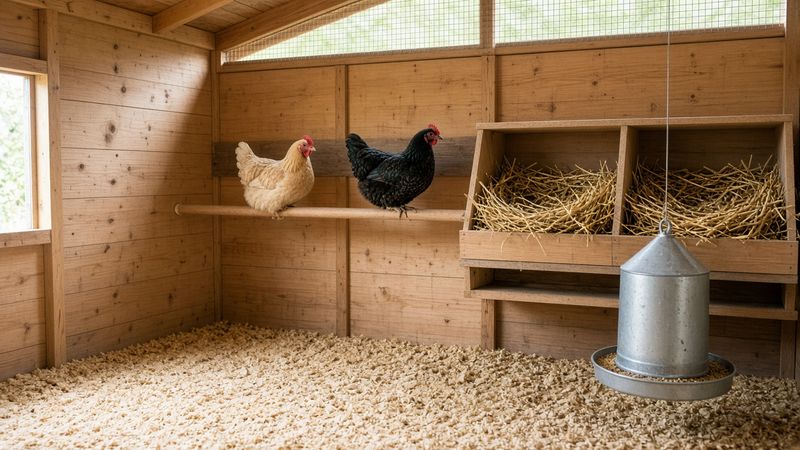
The inside decides whether the floor number works. Give each standard hen 8 in of roost. Our roost bar page sets the height. Plan 1 nest box per 4 to 5 hens. The nesting box page has the 12 in size. Bedding goes on the floor. The bedding guide covers the mix.
A droppings board under the roost makes the night mess easy to scrape off. Put the people door wide enough for you, and the pop door low enough for the hens. Set vents high, above the roost, so air leaves without a draft on the birds. Run ideas live on the chicken run ideas page. A built coop is on the DIY coop page, and mesh is on the predator-proof page.
Paint helps the wood last. Light colors stay cooler in summer sun. Oregon State notes that wood coated in latex-based paint is easy to clean. Paint the outside before the hens move in, and let it dry fully.
Plan where the bedding goes, too. Spent shavings and manure make good compost. Put the compost bin a short walk from the coop door, so clean-out day is quick. Our bedding guide covers the mix.
Common Questions
How big should a chicken coop be?
Plan 4 sq ft of floor and 8 sq ft of run per standard hen; 2 and 4 sq ft for bantams.
Which way should a chicken coop face?
Put windows on the south side for winter light and warmth, per Penn State.
Does a chicken coop need insulation?
Not usually. Oregon State says coops do not need insulation if they are free of drafts.
How high off the ground should a coop be?
At least 1 ft, by Oregon State.
Read next
- HubChicken coops and runs
- PlansChicken coop plans
- DataChicken roost bar
- DataNesting boxes
- GuideChicken run ideas
- GuidePredator proof chicken coop
Sources
- University of Minnesota Extension, Raising chickens for eggs (reviewed 2025): extension.umn.edu (3 to 5 sq ft indoor per bird; moveable shelters, move when manure builds up)
- Penn State Extension, Small Scale Poultry Housing (updated 2026): extension.psu.edu (8 sq ft run per laying hen; bantams 4 in roost, 12 to 18 in high; south windows; high, well-drained site; feed storage cans; ventilation, dampness and ammonia; easy access)
- Oregon State University Extension, EC 1644 Backyard chicken coop design (2014, reviewed 2023): extension.oregonstate.edu (raise at least 1 ft; latex-painted wood easy to clean; 3 sq ft with run, 8 to 10 without; no insulation if draft free; passive ventilation; near the house; motion light; no large plants; 1 nest box per 4 birds)
- University of Kentucky, ID-245 Predator Management for Small-scale Poultry Enterprises: publications.mgcafe.uky.edu (½ in hardware cloth; bury at least 12 in)
- Coop length and hen count: maker listing on Amazon, ASIN B0H2DW68D8, read 2026-10-12
How we pick and check numbers: How we research.