Brahma Chicken: A Heavy Brown-Egg Layer for Cold Yards
Coopgauge is reader-supported. When you buy through links on this page, we may earn a commission.
Pick a brahma chicken for a hard winter and brown eggs from a big, calm bird. A Light hen weighs 9.5 lb by the APA standard, the shell is brown, and the count runs 150 to 200 eggs a year. The catch is size: a 9.5 lb hen wants more floor, a bigger nest box and a low roost. Dark and Buff birds run lighter: 8.5 lb for the hen, 11 lb for the rooster. The first egg comes late, at 22 to 24 weeks.
- Size class
- Large (APA Asiatic class)
- Weight range
- Light hen 9.5 lb, rooster 12 lb; Dark and Buff hen 8.5 lb, rooster 11 lb
- Eggs per year (range)
- 150 to 200 (hatchery estimate); up to 200 (breed figure)
- Egg color
- Brown, medium to large
- Comb type
- Pea comb, with red wattles and earlobes
- Feather colors
- Light, Dark and Buff in the standard
- Cold & heat tolerance
- Hardy in cold, credited to the pea comb and tight feathering; shade and water in the heat
- Temperament
- Calm and docile
- Broodiness
- Setter; a good mother
- Space per bird
- 5 sq ft inside (large breed)
- Height
- Up to 30 in
- Maturity
- First egg at 22 to 24 weeks
Weights, varieties, comb, shell and broodiness: Oklahoma State Breeds of Livestock (APA standard). Egg count, egg size, temperament and maturity: Cackle Hatchery and Townline Hatchery. Height, cold and heat hardiness, laying season: The Livestock Conservancy. Space: our calculator.
Three marks tell you that you are looking at a Brahma. The comb is a pea comb, set low and flat on the head. The shanks and toes carry feathers, and from the side that feathering forms a narrow V.
The head is wide, with a heavy brow over the eyes. The breed club calls that brow a beetle brow, and it is one of two marks that separate a Brahma from a Cochin.
Oklahoma State credits the pea comb, the heavy feathering and the feathered shanks and toes with the way this bird stands cold weather. Those same three marks decide how you house it.
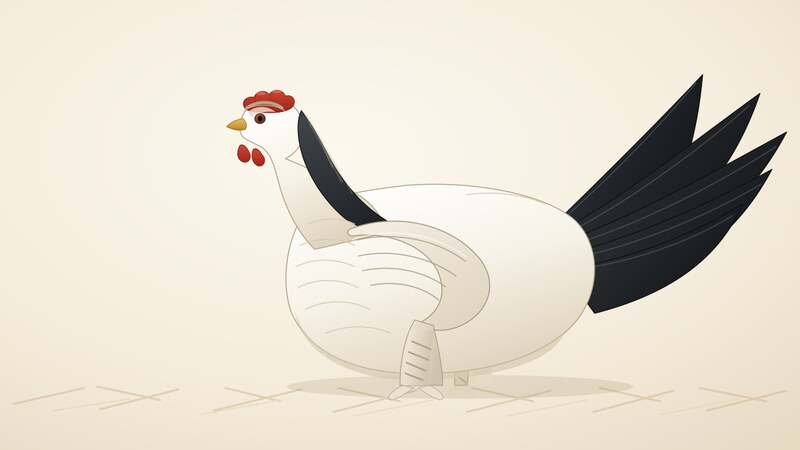
A light brahma chicken is the white bird with black neck and tail feathers. A brahma buff chicken carries the same pattern in gold. Dark hens are penciled grey-black, and a brahma chicken rooster wears a black-and-white neck saddle.
| Variety | Rooster | Hen | Cockerel | Pullet | Other figures |
|---|---|---|---|---|---|
| Light | 12 lb | 9.5 lb | 10 lb | 8 lb | Cackle and Townline: hen 9.5 lb, rooster 12 lb |
| Dark and Buff | 11 lb | 8.5 lb | 9 lb | 7 lb | Livestock Conservancy: male 12 lb, female 10 lb |
Two weight sets, and that changes the plan. A Buff or Dark hen is 1 lb lighter than a Light hen. The Livestock Conservancy lists the breed at 12 lb for the male and 10 lb for the female, a third set of numbers for the same birds.
| Variety | APA admitted | Feather pattern |
|---|---|---|
| Light | 1874 | White body, black neck and tail feathers |
| Dark | 1874 | Penciled grey-black hens, black-and-white neck saddle on the rooster |
| Buff | 1924 | Buff body, black neck and tail feathers |
Only those three varieties carry the standard. The breed club also keeps Black, Mottled, Gold and Blue Darks, plus a bantam line. A bird sold as a Mottled Brahma is a club variety, so ask which list the seller is working from.
Free-range or confined?
Brahmas are heavy birds that stay close to home. The Livestock Conservancy says they do well confined, fly poorly over low fencing and range no far. That makes the house floor the number you plan from.
| Setup | Fits a Brahma? | Space per bird | Notes |
|---|---|---|---|
| Coop with run | Yes | 5 sq ft inside, 10 sq ft run | Livestock Conservancy: does well confined |
| Mobile coop | With care | same figures | Heavy bird, and it ranges no far |
| Free range by day | Yes | same figures | Oregon State's 3 sq ft is the standard-hen band in our calculator |
| Cold-climate coop | Yes | same figures | Keep vents high and open |
Our assumptions: 5 sq ft of house floor per large bird, 10 sq ft of run, 10 in of roost bar per bird, and 1 nest box per 4 birds. That is the large band in our calculator, and it sits above the 3 to 5 sq ft a standard bird needs.
| Birds | House floor (sq ft) | Run (sq ft) | Roost (in) | Nest boxes |
|---|---|---|---|---|
| 4 | 20 | 40 | 40 | 1 |
| 6 | 30 | 60 | 60 | 2 |
| 8 | 40 | 80 | 80 | 2 |
Six Brahmas need 30 sq ft of floor and 60 sq ft of run, plus 60 in of roost bar and two nest boxes. Measure the floor before you order birds, because the hen count on a label is not a measurement.
One figure does not move when the flock ranges out. Oregon State gives 3 sq ft per bird where the birds have outdoor access, and our calculator applies that band to standard hens. A 9.5 lb Brahma is a large bird. The inside floor stays at 5 sq ft each, and the run at 10 sq ft.
Our coop size calculator does the same arithmetic for any bird count. Pick Large for the 5 sq ft band, then change the flock size and read the numbers again.
Coop & run setup
Start with the roost, because a 12 lb bird lands harder than a 7 lb one. Give 10 in of bar per bird, the large-breed figure on our roost bar page. Set the bars 18 to 24 in off the floor and 10 to 12 in apart, and never above 4 ft.
Nest boxes go up a size. Penn State says to increase the nesting space for larger birds, so the hen can step in and sit down. A 12 × 12 × 12 in box is the floor for a standard hen, and 1 box per 4 birds is the rule from Oregon State. Counts and sizes are on the nesting box page.
The door needs to clear a big bird too. Our automatic door page names Brahmas with Orpingtons and says to pick the largest door you can fit. The FabStyl XL measures 10.8 × 14.2 in.
Feathers and a pea comb make this a winter bird. The Livestock Conservancy lists the breed as extremely hardy and credits the pea comb and tight feathering for that. Cold air still needs a way out, so keep the vents open and add heat rather than sealing the house. Our coop heater guide covers both.
Summer needs its own plan. The Livestock Conservancy calls the breed a poor fit for southern climates and names what it needs there: ample shade and water. A shaded patch of run and a full waterer meet both, and the waterer page sizes them by flock count.
Watch the floor as well. Mud and water stay caught in the feathering on the legs and toes, so the house floor has to dry out between days. Bedding choices and moisture control are on the bedding page.
The run follows the same rule. Our large-breed band is 10 sq ft of run for each bird, so four Brahmas need 40 sq ft and six need 60. A covered run keeps that ground dry enough for wood chips or sand, and Penn State advises putting the coop on high, well-drained ground.
The listing above says 10 to 15 birds in the title, and the feature text repeats that count for chickens, ducks, and rabbits. The main house floor is 28.3 sq ft. At 5 sq ft for a large bird, that is 5 hens. The run is 58.8 sq ft, which is 5 to 6 birds at 10 sq ft each.
Six of these birds want 30 sq ft of floor and 60 of run. The house carries 5 by our math, so the label count does not fit a six-bird flock. The chicken coop guide compares fixed houses by floor area, and the coop with run page covers the runs that come attached.
Feeding
You feed a Brahma like any other layer. University of Maine gives 14 to 16% protein for a dual-purpose flock, and our feeding guide has the switch to layer feed by week.
Amounts follow weight. Minnesota Extension gives about 3 lb of feed a week for a 6 lb hen, so six 6 lb hens eat 18 lb a week. A 9.5 lb Brahma is heavier than that hen, and the Livestock Conservancy notes that this breed eats a lot for its weight.
That weekly figure is what a feeder has to hold, so size the feeder from the bag rather than from the bird count.
Put grit and oyster shell in a separate dish and let the hens take what they need. University of Maine recommends oyster shell free choice for laying hens, whatever the calcium level in the bag.
Big birds need room at the feeder. Two feeding stations stop one hen from holding the trough while the rest wait, and a flock of six wants two waterers as well. The feeder page and the waterer page list sizes by flock number.
Water is the one thing that cannot stop. Keep it flowing in cold weather and check the waterer twice a day. A heated waterer keeps the line open through a freeze.
Hatching: broody hen or incubator?
Three sources put this breed in the broody column. Cackle Hatchery lists Brahmas as setters. Oklahoma State says they go broody and make good mothers. The Livestock Conservancy says the hens tend to sit in early summer.
That changes the plan. A sitting hen needs her own box in a quiet corner, with a door that latches, feed and water within reach, and a low ramp for the chicks. A 9.5 lb hen will not step up into a shallow tray, so the entrance has to be low and wide.
Not every keeper wants chicks. For an incubator, the setting is 21 days at 99.5 to 100°F, per Texas A&M AgriLife Extension. Once the eggs are out, the brooder setup page takes over with the week-by-week numbers.
The box above measures 38.8 × 31.4 in across and 39.1 in tall. The maker rates it for 5 standard hens or 9 bantams and calls it low and easy to access. A 9.5 lb hen needs a floor of that size to settle on a clutch.
The low plastic lodge in the frame above also has a lockable rear door and a sliding front door, so you can close the box on a sitting hen and still get in to feed her.
The 1 box per 4 birds rule still applies to the rest of the flock. Four birds need one box, six need two. A broody hen takes one of them for herself while the others keep laying.
Compared with similar breeds
The Orpington is the closest match in size and temper. Its hen weighs 8 lb against 9.5 lb for a Light Brahma, and both sit on a clutch. Read the Orpington page before you plan a mixed flock.
| Breed | Size class | Hen | Rooster | Eggs per year | Egg color | Comb | Broodiness | Sq ft each |
|---|---|---|---|---|---|---|---|---|
| Brahma (Light) | Large | 9.5 lb | 12 lb | 150 to 200 | Brown | Pea | Setter | 5 |
| Brahma (Dark, Buff) | Large | 8.5 lb | 11 lb | up to 200 | Brown | Pea | Setter | 5 |
| Orpington | Large | 8 lb | 10 lb | 150 to 280 | Light brown | Single | Setter | 5 |
| Barred Rock | Standard | 6 to 7.5 lb | 8 to 9.5 lb | about 200 | Brown | Single | Setter | 4 |
Weight is the practical difference in the coop. A 9.5 lb hen wants a bigger nest box and more roost bar than a 7 lb Barred Rock hen. Large breeds work from 5 sq ft of floor each, and standard birds work from 4.
Feathered feet narrow the field further. Cochin is the other large breed with feathered legs. The Barred Rock page covers the standard-size end of the scale.
Where to get chicks
Mail-order hatcheries sell this breed by variety, so Light, Dark and Buff are separate lines. Some of them sell a production type and an exhibition type of the same variety. Decide which one you want before you order.
Four checks on the card, then. The comb is a pea comb. The shanks and toes carry feathers. The skin and beak are yellow, and the earlobes are red. Only Light, Dark and Buff carry the association's standard.
Hens lay without a rooster. If you want fertile eggs, Cackle Hatchery pairs one rooster with 8 hens, and Townline Hatchery gives one rooster for 6 to 10.
Add the laying date to your order. Chicks start laying at 22 to 24 weeks, so a late-June order means first eggs around December or January. Measure the coop first, then order the birds.
Common Questions
How big does a Brahma chicken get?
A Light hen weighs 9.5 lb and the rooster 12 lb, by the standard weights at Oklahoma State. Dark and Buff birds step down a notch: 8.5 lb for the hen and 11 lb for the rooster. The Livestock Conservancy lists the breed at 12 lb for the male and 10 lb for the female.
What color eggs do Brahmas lay?
Brown. The Livestock Conservancy calls the shell brown and lists the egg size as medium to large. Cackle Hatchery gives the same brown shell and the same egg size for its Light line, so a brahma chicken egg comes on the large side.
How many eggs does a Brahma lay a year?
150 to 200 by the Cackle Hatchery estimate, and Townline Hatchery gives the same band. The Livestock Conservancy gives up to 200 large, medium-brown eggs a year. Most of them come between October and May. That works out to about 3 to 4 eggs a week, which is the arithmetic behind our daily egg count.
Are Brahmas good layers?
In the cold months, yes. The Livestock Conservancy lists the breed as a good winter layer and says most eggs come between October and May. The count also starts late: Townline Hatchery puts the first egg at 22 to 24 weeks.
Are Brahmas broody?
Often enough to plan for. Cackle Hatchery lists them as setters, Oklahoma State says they go broody and make good mothers, and the Livestock Conservancy says the hens sit in early summer. Give a sitting hen her own box, with a door that closes.
How much space does a Brahma need?
5 sq ft of house floor, 10 sq ft of run, 10 in of roost bar and 1 nest box per 4 birds. That is our large-breed band, and it holds when the birds range out. Oregon State gives 3 sq ft per bird where the flock has outdoor access. Our calculator applies that band to standard hens, so a Brahma flock stays on the large figures.
Read next
- HubChicken breeds
- BreedOrpington chicken
- BreedBarred Rock chicken
- ListBest egg laying chickens
- CalculatorChicken coop size calculator
- GuideNesting boxes for chickens
- DataHow many eggs a day
- GuideBrooder setup
Sources
- Oklahoma State University, Breeds of Livestock: Brahma Chickens: breeds.okstate.edu. Standard weights Light: cock 12 lb, hen 9.5 lb, cockerel 10 lb, pullet 8 lb. Dark and Buff: cock 11 lb, hen 8.5 lb, cockerel 9 lb, pullet 7 lb. Varieties Light, Dark, Buff. Yellow skin, brown shell. Go broody and make good mothers. Pea comb with red wattles and earlobes, profuse feathering, feathered shanks and toes. Slow growth, long time to maturity.
- The Livestock Conservancy, Cochin Chicken: livestockconservancy.org. The feathering extends down the legs to the feet and toes, with only the inner two toes bare. Cochin is the other large breed here with feathered legs.
- The Livestock Conservancy, Brahma Chicken: livestockconservancy.org. Brown eggs, medium to large. Male 12 lb, female 10 lb. Calm, docile. Up to 200 large, medium-brown eggs a year, most from October to May. Hens go broody in early summer. Extremely hardy, credited to the pea comb and tight feathering. Southern climates need shade and water. Does well confined, poor fliers, ranges no far. Yellow beak, red earlobes, red-brown eyes, a wide head with a heavy brow, up to 30 in tall. Eats a lot for its weight.
- Cackle Hatchery, Light Brahma: cacklehatchery.com. Asiatic class. Hen 9.5 lb, rooster 12 lb, pullet 8 lb, cockerel 10 lb. Brown shell, medium-large egg size, 150 to 200 eggs a year as an estimate. Docile. Broody, a setter. 8 females to 1 male. Roost height 2 to 4 ft. APA recognized in 1874. Production type and exhibition type lines.
- Townline Hatchery, Light Brahma: townlinehatchery.com. Rooster 12 lb, hen 9.5 lb. About 150 to 200 light brown eggs a year, and known as good winter layers. Mature around 22 to 24 weeks. One rooster for 6 to 10 hens.
- The American Brahma Club: americanbrahmaclub.com. The pea comb and beetle brow that separate Brahmas from Cochins. Club varieties Black, Mottled, Gold and Blue Darks, plus a bantam line, none of them standard varieties. Docile and curious temperament.
- American Poultry Association, Recognized Breeds and Varieties (archived 2012): web.archive.org. Brahma Light 1874, Dark 1874, Buff 1924, Asiatic class. Varieties and admission years only, no weights.
- Oregon State University Extension, EC 1644 Backyard Chicken Coop Design, 2014, reviewed 2023: extension.oregonstate.edu. 3 sq ft per bird with outdoor access, a band our calculator applies to standard hens. 5 to 10 in of roost per bird. One nest box per 4 birds. Box 12 in on each side.
- Penn State Extension, Small Scale Poultry Housing, updated 2026: extension.psu.edu. Increase the nesting space for larger birds. Perch no higher than 4 ft.
- University of Minnesota Extension, Raising chickens for eggs, reviewed 2025: extension.umn.edu. 3 to 5 sq ft of indoor space per bird. About 3 lb of feed a week for a 6 lb hen.
- University of Maine Cooperative Extension, Bulletin #2222 Nutrition for Backyard Chicken Flocks in Maine: extension.umaine.edu. Layer feed at 14 to 16% protein. Oyster shell free choice for laying hens.
- Texas A&M AgriLife Extension, POSC-PU-018 Incubating and Hatching Eggs, 2022: agrilife.org. 21 days at 99.5 to 100°F.
- Coop size, run area, roost and boxes for 4, 6 and 8 birds: our math, read 2026-11-02.
- Coop and box size, floor area, run area, perches, capacity, doors and material: maker listings on Amazon, ASIN B0HSS77D7N and B0BHT7VGCX, read 2026-11-26 and 2026-11-04.
How we pick and check numbers: How we research.