ISA Brown Chicken: 470 Eggs in 100 Weeks, and What 4.35 Pound Hens Need
Coopgauge is reader-supported. When you buy through links on this page, we may earn a commission.
Two egg counts follow the ISA Brown chicken. One covers a commercial laying cycle. The other covers a first year. The floor you build depends on which count you trust.
An ISA Brown is a brown-egg cross from the French Institut de Sélection Animale. It is not an APA standard breed. At 100 weeks the North American guide puts the hen at 1975 g, which is 4.35 lb.
Eggs per hen housed from week 18 to week 100 read 470 in that guide, 476 on the cage product page and 470 on the alternative-systems page. Wikipedia puts the first year at about 300 eggs. That is a different window, so it stays on its own line.
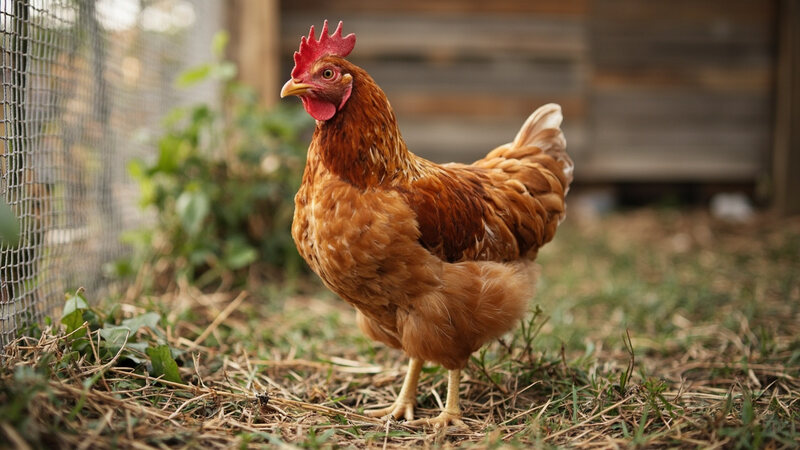
The bird suits a yard that wants brown eggs from a light hen, near 4 lb, not a 6.5 lb Rhode Island Red. Labels that read isla brown chickens or isobrown chickens name this same cross.
- Size class
- Commercial light-layer cross, not an APA standard class
- Weight range
- North American guide: 1438 to 1512 g at 18 weeks (3.17 to 3.33 lb), 1835 g at 30 weeks (4.05 lb), 1975 g at 100 weeks (4.35 lb). Cage and alternative product pages: 1950 g. Wikipedia: hen 2 kg (4.40 lb)
- Eggs per hen housed
- 470 by week 100 in the North American guide, 476 on the cage page, 470 on the alternative-systems page. Wikipedia: about 300 in the first year
- Egg color
- Brown; the product pages score shell color at lab 11
- Egg weight
- 62.5 g on both product pages, 62.8 g average in the North American guide
- Comb type
- Single, on the Wikipedia infobox
- Broodiness
- Not listed. The published performance tables have no broodiness row
- Space per bird
- 4 sq ft inside and 8 sq ft of run on our backyard rule. Commercial litter density is a different number, in the table below
Weights, egg counts, egg weight and the 145 day mark: ISA Brown Commercial Management Guide, North American Version. The 476, 145 days, 62.5 g, 1950 g and lab 11: ISA Brown cage product page. The 470, 150 days, 122 g a day and 1950 g: ISA Brown in alternative systems. The 2 kg, the single comb and the first-year count: Wikipedia, ISA Brown. Space: our calculator.
The four sources do not share a window, so the table keeps them apart. A yearly range would hide the difference.
| Source | Window | Eggs | 50% lay | Peak | Egg weight |
|---|---|---|---|---|---|
| North American guide | 18 to 100 weeks | 470 | 145 days | 97% | 62.8 g |
| Cage product page | 18 to 100 weeks | 476 | 145 days | 97% | 62.5 g |
| Alternative-systems page | 18 to 100 weeks | 470 | 150 days | 97% | 62.5 g |
| Wikipedia | first year of laying | about 300 | not given | not given | not given |
Half the flock is in lay at 145 days on the cage page and in the guide. The alternative-systems page puts that mark at 150 days. Peak production is 97% on all three company tables.
The guide also splits the cycle into points. At 60 weeks the hen housed count is 260 eggs and the rate is 90%. At 72 weeks it is 330 eggs and 85%. At 100 weeks it is 470 eggs and 67%.
The cage product page also prints a line of up to 500 first quality eggs. That line sits outside the table, so it is not the 476. The alternative-systems page does not print it.
Page 6 of the guide draws the breeding scheme as four pure lines, A, B, C and D. The parents are an A by B cross and a C by D cross. Commercial chicks come from crossing those two parent lines again.
Wikipedia says the cross is thought to include Rhode Island Red and Rhode Island White, among other breeds, and that the list is a trade secret. That is a guess, not a published parent formula. The same page dates the cross to 1978.
Free-range or confined?
A commercial density and a backyard density answer different questions. The guide's litter figure is the one people copy onto a coop box. It was written for a barn, not a yard.
Our assumptions for the two tables below. Give 4 sq ft of coop floor per standard hen. Give 8 sq ft of run. Give 8 in of roost bar each, set 18 to 24 in off the floor. Give 1 nest box per 4 hens.
The 3 sq ft row applies only when the flock has outdoor access all day. Oregon State gives that figure for birds with a run or a range. It is the exception, not the default.
| Setup | Space per bird | Where the number comes from |
|---|---|---|
| Backyard coop with a run | 4 sq ft inside, 8 sq ft of run | Our calculator, for a standard hen |
| Out all day, shut in at night | 3 sq ft inside | Oregon State, birds with outdoor access |
| Commercial litter floor | 6 birds/m², 1.8 sq ft each | Guide, adult space requirements |
| Litter and slats | 8 birds/m², 1.3 sq ft each | Same table |
| All slats | 9 birds/m², 1.2 sq ft each | Same table |
| Cage | 450 cm², 69.8 sq in each | Same table |
The 1.8 sq ft row is a barn density. A 4.35 lb hen in a yard still takes the 4 sq ft row. Copying the barn number onto a backyard floor packs the house more than twice as tight.
| Hens | Coop floor | Run | Roost bar | Nest boxes |
|---|---|---|---|---|
| 4 | 16 sq ft | 32 sq ft | 32 in | 1 |
| 6 | 24 sq ft | 48 sq ft | 48 in | 2 |
| 8 | 32 sq ft | 64 sq ft | 64 in | 2 |
Four hens need a 4 × 4 ft house and a 4 × 8 ft run. Six need 24 sq ft inside and 48 sq ft of run. Divide any floor by 4 and the result is the bird count that floor holds.
The coop size calculator runs the same arithmetic and adds the roost bar and the boxes. Daytime ranging is covered on the free-range page.
Coop & run setup
Give each hen 8 in of roost bar. That is our own figure, the one the calculator uses. Oregon State allows 5 to 10 in of pole per bird, so 8 in sits inside that range.
Set the bar 18 to 24 in off the floor, and never above 4 ft. Penn State gives both the height and the limit. Heights and spacing are on our roost bar page.
Nest boxes come next, and the count depends on which table you read. A backyard flock gets 1 box per 4 hens, about 12 × 12 × 12 in. Oregon State gives that size and that count. Penn State starts a flock of 4 with 2 boxes.
The guide counts differently. It wants 1 individual nest for every 5 to 6 birds, or 1 m² of collective nest for 120 birds. Those are barn fittings. A yard still uses 1 box per 4 hens.
A 4.35 lb hen uses a standard box. The large box built for an 8 lb bird is more than this hen needs. Box sizes are on our nesting box page.
Wheels change the grass, not the floor math. A house you can roll still has to hold 4 sq ft per hen on the day you stop rolling it.
The label says 4 to 8 chickens. The resting area is 8.84 sq ft. Divide that by 4 sq ft per hen and the floor holds 2 hens.
The run on the same listing is 17.69 sq ft. Divide by 8 sq ft of run per hen and you get 2 hens again. The label's 4 is the number that fails.
Check the 8.84 sq ft resting area on the listing. Compare it with 4 sq ft per 4.35 lb hen. Then measure your own floor the same way.
The house has 2 nesting boxes with a PVC liner and 3 perches. Four hens want 32 in of roost bar and 1 box. The listing gives a perch count, not a length, so measure the bars before the birds arrive.
Feeding
The guide's growing diets, on the 18 to 24°C column, change by age. Starter runs 0 to 4 weeks at 20.5% crude protein. Grower runs 4 to 10 weeks at 19%. Pullet feed runs 10 to 16 weeks at 17%.
Pre-lay covers 112 days to 2% lay, also at 17% on that column. The hotter column shifts the weeks and the protein, so read the column that matches the house.
Once the flock hits 2% lay, protein follows intake instead of age. From 2% lay to 28 weeks, 110 g a day calls for 17.7% and 115 g a day calls for 17.0%. From 29 to 55 weeks those two intakes call for 17.3% and 16.5%.
A backyard bag reads differently. Our feeding guide uses a layer feed near 16% protein, and Minnesota Extension puts a 6 lb hen at 3 lb of feed a week. Neither number was written for a 4.35 lb hen.
The guide's own intake during lay is 113 g a day, which it also prints as 24.9 lb per 100 birds. The cage page says 112 g a day. The alternative-systems page says 122 g a day.
Keep the three apart. Do not scale the 6 lb hen's weekly figure down to get one of them.
Calcium in the guide's laying diets runs 4.1 to 4.2% from 17 to 28 weeks, 4.2 to 4.4% from 29 to 55 weeks, and 4.5 to 4.7% after 56 weeks.
In a yard, oyster shell goes in its own dish, free choice, separate from the grit. Amounts are on the grit and oyster shell page.
The feeder size follows from the 113 g figure, not from the 6 lb hen.
Six hens at 113 g a day eat 678 g, about 1.5 lb. Ten days of that is 15 lb. Fourteen days is 21 lb.
The feeder holds 30 lb, so it covers that stretch with room left. The lid locks, and the stand adjusts for height. Six ports feed the flock at once.
Check the 30 lb capacity on the listing. Compare it with 6 hens at 113 g a day. A flock of 4 eats less, so the same box lasts longer.
Hatching: broody hen or incubator?
The published performance tables carry no broodiness row. Nothing on those pages says how often this hen sits, so the page leaves the field blank rather than filling it in.
The next generation is the harder limit. Commercial chicks are a second cross of the A by B and C by D parent lines. Chicks from those hens will not come back as the parent table describes them.
That is a breeding point, not a housing one. A pen of this cross will not reproduce the weights or the egg counts on the card.
An incubator is the other route, and the settings live on one page. Our hatching page gives 21 days at 99.5°F, and the day-by-day schedule sits there.
Once the chicks are out, heat and floor space move to the brooder setup page. Week-by-week figures are there, not here.
Compared with similar breeds
Three birds get named next to the ISA Brown, and only two of them have a page here. Read the weight column first. A 4.35 lb hen and a 6.5 lb hen do not share a floor figure, even when both lay brown eggs.
| Breed | Hen weight | Egg count and window | Egg color | Standard breed |
|---|---|---|---|---|
| ISA Brown | 4.35 lb at 100 weeks | 470 eggs, weeks 18 to 100 | Brown | No |
| Rhode Island Red | about 6.5 lb | 200 to 280 brown eggs a year | Brown | Yes, since 1904 |
| Leghorn | 4.5 lb | 250 to 300 white eggs a year | White | Yes, since 1874 |
| Golden Comet | not on this site | not on this site | not on this site | not on this site |
The curve is the point of the chart. The count climbs through week 100, so 470 is not a count for one year. The cage page's 476 and the alternative page's 470 are summaries of that same window, not extra years.
Wikipedia's 300 belongs to the first year only. It sits under the chart instead of on the line, because the window does not match.
Weight is where the Rhode Island Red pulls away. Its hen runs about 6.5 lb against 4.35 lb here, and its published count is 200 to 280 brown eggs a year.
Both lay brown. Only the Red is a standard breed, admitted in 1904. The comparison is on the Rhode Island Red page.
The Leghorn is the close one on weight, at 4.5 lb, and it lays 250 to 300 white eggs a year. Same light frame, different shell. That count is a yearly one, which the ISA Brown tables are not. Details are on the Leghorn page.
Golden Comet is the other brown-egg cross people ask about. This site has no page for it, so the row stays empty rather than borrowing a number. A ranking of layers by eggs per year is a different page, the best egg laying chickens list, and this page does not redo it.
Where to get chicks
There is no APA class to check this bird against. No standard weight, no color table, no comb rule from the association. The card above is a company table, not a breed standard.
Two spellings turn up on labels. Isla brown chickens and isobrown chickens are misspellings of the same cross, not separate breeds.
Hubbard Brown is an older name. Wikipedia notes that the ISA Group merged with Merck in 1997 and traded for a time as Hubbard ISA. An old name is not a current specification.
Three lines on the label decide the order. The strain name should read ISA Brown. The egg color should read brown. The weight class should read light, near 4 lb, not 6.5 lb. A box that fails one of the three is a different bird.
Measure the house before the count. Four hens need 16 sq ft inside. A label that promises more birds than the floor holds fails the same test as the coop above.
Eggs do not need a rooster. The next generation does, and this cross will not give it. Commercial chicks are a second cross of four lines, so the chicks they produce do not come back as the parent table.
Common Questions
How many eggs does an ISA Brown chicken lay a year?
The published counts are not yearly counts. The North American guide gives 470 eggs per hen housed from week 18 to week 100, the cage product page gives 476 for the same window, and the alternative-systems page gives 470. Wikipedia puts the first year at about 300. Those are four figures for two different windows, so this page does not merge them into one range.
What color are ISA Brown chicken eggs?
Brown. Both product pages score the shell at lab 11, which is a color meter reading rather than a paint name, and the North American guide lists the bird as a brown egg layer. Egg weight averages 62.5 g on the product pages and 62.8 g in the guide. The tables give that average. They do not give a shade range.
What two breeds is an ISA Brown a cross of?
The guide does not name two breeds. Page 6 draws four pure lines, A, B, C and D, with commercial chicks coming from a second cross of the A by B and C by D parents. Wikipedia says the cross is thought to include Rhode Island Red and Rhode Island White, and that the full list is a trade secret. That sentence is a guess, not a parent formula.
How much does an ISA Brown hen weigh, and when does she start laying?
The guide gives 1438 to 1512 g at 18 weeks, 3.17 to 3.33 lb, then 1835 g at 30 weeks, 4.05 lb, and 1975 g at 100 weeks, 4.35 lb. Both product pages list 1950 g, and Wikipedia lists 2 kg, which is 4.40 lb. Half the flock is in lay at 145 days on the cage page and in the guide, and at 150 days on the alternative-systems page.
How long does an ISA Brown chicken live?
The guide's laying window runs from week 18 to week 100. That is a production cycle, not a lifespan, and this page does not turn it into a count of years. What the tables do show is output inside that window: 260 eggs by week 60, 330 by week 72 and 470 by week 100, with the rate falling from 90% to 67%.
How does an ISA Brown compare with a Rhode Island Red?
Weight first. An ISA Brown hen is 4.35 lb at 100 weeks, and a Rhode Island Red hen is about 6.5 lb, so the Red takes more floor for the same number of birds. Both lay brown eggs. The Red's published count is 200 to 280 eggs a year, while the ISA Brown figure of 470 covers weeks 18 to 100. The Red is a standard breed. The comparison sits on the Rhode Island Red page.
Read next
- HubChicken breeds
- BreedRhode Island Red chicken
- BreedLeghorn chicken
- ListBest egg laying chickens
- CalculatorCoop size calculator
- GuideNesting boxes
- GuideWhat to feed chickens
- GuideGrit and oyster shell
- GuideHow to hatch chicken eggs
- GuideBrooder setup
- GuideFree-range chickens
- MethodHow we research
Sources
- Institut de Sélection Animale, ISA Brown product page, cage housing table: isa-poultry.com (laying period 18 to 100 weeks; age at 50% production 145 days; peak of production 97%; average egg weight 62.5 g; eggs per hen housed 476; average feed intake 112 g a day; body weight 1950 g; shell color lab 11; read 2026-11-13. The page also prints a line about up to 500 first quality eggs, which sits outside the table and is kept separate here)
- Institut de Sélection Animale, ISA Brown in alternative systems: isa-poultry.com (18 to 100 weeks; 150 days to 50% production; peak 97%; average egg weight 62.5 g; 470 eggs per hen housed; average feed intake 122 g a day; body weight 1950 g; shell color lab 11; read 2026-11-13)
- ISA Brown Commercial Management Guide, North American Version: isa-poultry.com (page 5: body weight 1438 to 1512 g at 18 weeks, 1835 g at 30 weeks, 1975 g at 100 weeks, printed as 3.17 to 3.33 lb, 4.05 lb and 4.35 lb; hen housed production 260 eggs at 60 weeks, 330 at 72 weeks, 470 at 100 weeks; 50% lay at 145 days; peak 97%; production rate 90%, 85% and 67% at those three points; average egg weight 62.8 g; average feed consumption during lay 113 g a day, also printed as 24.9 lb per 100 birds. Page 6: breeding scheme of four pure lines A, B, C and D, parents A by B and C by D, commercial chicks from a further cross. Page 23: adult space requirements, cages 450 cm² or 69.8 sq in per bird, litter 6 birds per m² or 1.8 sq ft, litter and slats 8 birds per m² or 1.3 sq ft, all slats 9 birds per m² or 1.2 sq ft. Page 24: one individual nest for 5 to 6 birds, or 1 m² of collective nest for 120 birds. Page 62: growing diets at 18 to 24°C, starter 0 to 4 weeks at 20.5% crude protein, grower 4 to 10 weeks at 19%, pullet 10 to 16 weeks at 17%, pre-lay from 112 days to 2% lay at 17%. Page 64: from 2% lay to 28 weeks, 17.7% crude protein at 110 g a day and 17.0% at 115 g a day; from 29 to 55 weeks, 17.3% at 110 g and 16.5% at 115 g. Page 65: calcium 4.1 to 4.2% from 17 to 28 weeks, 4.2 to 4.4% from 29 to 55 weeks, 4.5 to 4.7% after 56 weeks)
- Wikipedia, ISA Brown: en.wikipedia.org (hen 2 kg or 4.40 lb; brown eggs; single comb; about 300 eggs per hen in the first year of laying; developed in 1978 by the Institut de Sélection Animale; thought to include Rhode Island Red and Rhode Island White among other breeds, with the list a trade secret; other names include Hubbard Brown, from the 1997 merger of the ISA Group with Merck that formed Hubbard ISA. The page carries a needs-more-citations notice, so it is not the first source for any figure above)
- Oregon State University Extension, EC 1644 Backyard chicken coop design (2014, reviewed 2023): extension.oregonstate.edu (3 sq ft per bird with outdoor access; 5 to 10 in of roost per bird; 1 nest box per 4 birds; box 12 × 12 × 12 in)
- Penn State Extension, Small Scale Poultry Housing (updated 2026): extension.psu.edu (roost 18 to 24 in high and never over 4 ft; a flock of 4 starts with 2 nest boxes)
- University of Minnesota Extension, Raising chickens for eggs (reviewed 2025): extension.umn.edu (3 lb of feed a week for a 6 lb hen)
- Comparison rows: Rhode Island Red and Leghorn breed pages on this site, which cite Cackle Hatchery and The Livestock Conservancy (Rhode Island Red hen about 6.5 lb, 200 to 280 brown eggs a year, APA 1904; Leghorn hen 4.5 lb, 250 to 300 white eggs a year, APA 1874)
- Mobile chicken coop on wheels, resting area 8.84 sq ft, run 17.69 sq ft, 2 nesting boxes with a PVC liner, 3 perches, 5 access doors, 83.3 × 31.1 × 41.6 in, wider metal wheels and a handle, label 4 to 8 chickens: maker listing on Amazon, ASIN B0H45N2ZWS, read 2026-11-13 (2 hens is our division of 8.84 sq ft by 4 sq ft, and of 17.69 sq ft by 8 sq ft)
- 30 lb galvanized metal chicken feeder, 6 no-waste ports, locking lid, adjustable-height stand, riveted side handles, 16.1 × 6.3 × 12.2 in, 9.48 lb: maker listing on Amazon, ASIN B0DNXGNBYB, read 2026-11-13 (15 lb and 21 lb are our arithmetic from 6 hens at 113 g a day)
How we pick and check numbers: How we research.