Cost to Raise Chickens: Monthly Costs, One-Time Setup and Eggs or Meat
Coopgauge is reader-supported. When you buy through links on this page, we may earn a commission.
The cost to raise chickens comes in two bills: one on day one for the coop, the run and the gear. The other is every month for feed, water and heat. A 6 lb standard hen eats about 3 lb of feed in a week, so 12 lb a month. At her peak she lays 6 eggs a week, which is 6 lb of feed behind every dozen eggs. Every figure here is a quantity, and the calculator multiplies it by the price you pay.
A standard hen eats about 3 lb of feed in a week (Minnesota Extension) and drinks 0.06 gal a day in mild weather (Kentucky). A month is 4 weeks.
How the numbers work
Every number here is a quantity you can check: pounds, gallons, kilowatt-hours, square feet and days. The card below holds the model in twelve rows.
Money is one step: multiply the quantity by the unit price you pay. The calculator above does that with your numbers.
- Feed a week
- 3 lb
- Feed a month
- 12 lb
- Water a day
- 0.06 gal mild, 0.11 gal hot
- Eggs a week
- 6 at the peak
- Feed a dozen
- 6 lb (our math)
- Coop floor
- 4 sq ft
- Run a hen
- 8 sq ft
- Roost a hen
- 8 in
- Nest boxes
- 1 per 4 hens
- Heater panel
- 140 to 200 W
- Meat bird
- 15 lb of feed
- Starter, 6 weeks
- 2 lb a chick
Feed and eggs: Minnesota Extension. Water: Kentucky 12.1. Space: our calculator. Panel watts: listings. Meat: UMaine #2214.
Our assumptions
- A month of feed and water is 4 weeks, 28 days. A month of electricity is 30 days.
- One hen here is a 6 lb standard hen that eats about 3 lb a week.
- Six eggs a week is the peak rate, so it is a ceiling. Real counts fall in winter and with age.
- Electricity figures are ceilings: panel watts times 24 hours. A thermostat lowers the real meter.
- Water is 0.06 gal a hen a day in mild weather and 0.11 gal in hot weather. The 5.55 gal per 100 hens a day figure is a separate calculation, and the two never mix here.
- Every money figure comes from multiplying a quantity by the price you enter in the calculator.
- Where a source prints nothing, the cell says so.
Read the card as one set of rules, not twelve separate facts. Every table comes out of it, and each table note names the source of its rows.
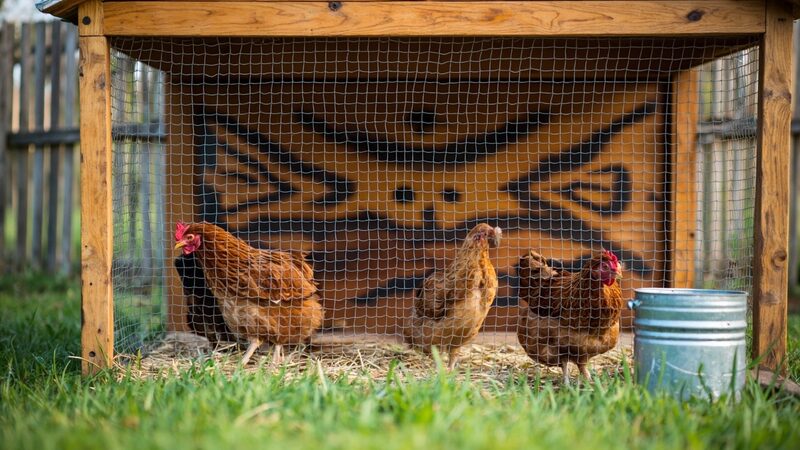
Monthly running costs
Start with the hen. Three pounds a week times four weeks is 12 lb a month. Six eggs a week times four weeks is 24 eggs, or 2 dozen. The table puts that in three columns: one hen, a flock of six, and a flock for a year.
| Item | One hen a month | Six hens a month | Six hens a year |
|---|---|---|---|
| Feed | 12 lb | 72 lb | 864 lb |
| 25 lb bags | half a bag | 3 | 35 |
| Water, mild | 1.7 gal | 10.1 gal | 121 gal |
| Water, hot | 3.1 gal | 18.5 gal | 222 gal |
| Eggs at the peak | 2 dozen | 12 dozen | Not stated |
| Feed a dozen eggs | 6 lb | 6 lb | — |
The dozen row is the one worth keeping. 12 lb a month divided by 2 dozen is 6 lb of feed behind every dozen eggs. In a slow month the hen eats the same and lays fewer, so the feed a dozen costs more. That is a ratio, not a verdict.
The ratio holds for four hens or for twelve: every column scales with the flock.
The feed page has the bag sizes. The eggs a day page carries the daily rhythm behind the peak rate.
Winter heat
Winter heat depends on a choice instead of a bird. A panel is sold in watts, and watts turn into kilowatt-hours by the hours you run it. The table runs the three panel sizes on this site at two schedules, and divides the flock total by six.
| Heat source | Full load | Six hens, 12 h | Six hens, 24 h | Each hen, 24 h |
|---|---|---|---|---|
| 140 W panel | 3.4 kWh a day | 51 kWh | 102 kWh | 17 kWh |
| 150 W panel | 3.6 kWh a day | 54 kWh | 108 kWh | 18 kWh |
| 200 W panel | 4.8 kWh a day | 72 kWh | 144 kWh | 24 kWh |
| Heated waterer, 100 W | 2.4 kWh a day | 36 kWh | 72 kWh | 12 kWh |
Read it as a ceiling. A panel with a set point runs fewer hours than the schedule above, so your meter reads lower. A heated waterer is a different job: it keeps one bowl from freezing and draws the same power for four hens or twelve.
The heater page compares the panels, the heated waterer page has the cold ratings. The winter coop page has the rest of the setup.
Eggs or meat
The same pound of feed turns into different things. A hen gives back eggs over months. A meat bird gives back one weight, once, at a fixed week. The table lines the two up; the egg column runs on the peak rate.
| Item | Eggs | Meat, fast line | Meat, slow line |
|---|---|---|---|
| Feed a bird | 12 lb a month | 15 lb in 6 wk | 16 lb in 8-9 wk |
| What comes back | 2 dozen a month | 5.25 lb live | 5.25 lb live |
| Feed a unit of output | 6 lb a dozen | 2.9 lb a lb | 3 lb a lb |
| Water a bird | 1.7 gal a month | 3.6 gal | 4 to 4.5 gal |
| A flock of six | 72 lb a month | 90 lb feed, 21.6 gal | 96 lb feed, 24-27 gal |
The meat line is short: 6 weeks of feed, then the batch is done and the bill starts again. The egg line runs all year, so a dozen eggs is a monthly number you can plan around. Neither column says which is cheaper: that answer sits in your feed price.
The meat chicken page has the week clock, and the breed list has the eggs a year by breed.
One-time setup
The day-one bill buys space and gear, and every row comes from a page on this site. The floor comes before the hen count. A listing that says 4 to 6 chickens prints no floor area, and the floor decides how many fit.
| Item | 4 hens | 6 hens | 10 hens | 12 hens |
|---|---|---|---|---|
| Coop floor | 16 sq ft | 24 sq ft | 40 sq ft | 48 sq ft |
| Run | 32 sq ft | 48 sq ft | 80 sq ft | 96 sq ft |
| Roost | 32 in | 48 in | 80 in | 96 in |
| Nest boxes | 1 | 2 | 3 | 3 |
| Run cover, ½ in mesh | 60 sq ft | 80 sq ft | 120 sq ft | 140 sq ft |
| Fence | 24 ft | 28 ft | 36 ft | 40 ft |
| Bedding at 4 in | 5.3 cu ft, 2 bags | 8 cu ft, 2 bags | 13.3 cu ft, 4 bags | 16 cu ft, 4 bags |
| Feeder | 25 lb, 15 d | 25 lb, 10 d or 50 lb, 19 d | 50 lb, 11 d | 50 lb, 10 d |
| Waterer | 5 gal, 22 d | 5 gal, 15 d | two 5 gal, 18 d | two 5 gal, 15 d |
The coop in the box lists 4 to 6 chickens, and it prints no floor area. Measure the house and the run, then apply this page's rule: a standard hen needs 8 sq ft of run and 4 sq ft of floor. Six hens need 24 sq ft inside. Add 48 sq ft of run. The run is not floor space: a hen that spends the day outside still needs somewhere to sleep and to lay.
Measure the run the same way, inside the posts and without the ramp.
The box holds a RUNSHED 80-inch coop. It stands 79.9 in long, 51.8 in wide, 38.4 in high for house and run together, so the floor inside is smaller than the outside. The coop page has the rest of the gear, and the coop size calculator turns your measurement into a hen count.
Chicks or started pullets
Two ways to start the same flock. They differ in time and gear, not in a price tag. A day-old chick is 18 to 22 weeks from her first egg; a started pullet is already near it.
| Item | Six day-old chicks | Six started pullets |
|---|---|---|
| Feed to first egg | 12 lb starter, total Not stated | layer feed from day one |
| Brooder floor | 3 sq ft, then 6 sq ft | none |
| Heat | 22 W plate, 22 kWh | none |
| Feeder | 1 in a chick to 4 wk | 25 lb, 10 d |
| Waterer | 1 qt jar, 16 chicks | 5 gal, 15 d |
| First egg | 18-22 wk old | already laying |
The chick route adds 18 to 22 weeks, 12 lb of starter feed, a corner of the house turned into a brooder and about 22 kWh of heat. The pullet route adds none of those. The chick starter feed page lists the protein by week, and the brooder setup page the space and the plate.
Where the waste goes
Some of the feed never reaches a bird, and three parts of the setup decide how much. Here is where a flock's feed goes, and which parts to measure twice.
| Item | Amount | What it means |
|---|---|---|
| Feed spilled by a feeder | 10% of 18 lb a week | 2 lb a week, 94 lb a year, four 25 lb bags |
| Bag finished in a month | 48, 72, 120, 144 lb a month | 50, 50, 100, 100 lb bags |
| Bedding in the coop | 4 in to start, 10 in by winter | a clean-out a year, 40% manure |
| Floor per hen | 4 sq ft standard, 5 large, 2 bantam | 3 sq ft if the flock ranges out |
The bag row works in one direction. Buy a bag your flock finishes inside a month in summer. The same bag lasts longer in winter, when UMaine allows two months.
Three parts are worth measuring twice. The netting and the latches hold the flock in and keep predators out, and the cover above stops losses from above. The waterer decides how much water reaches the birds, so a dripping valve loses more than the flock drinks. The winter panel decides whether the flock needs heat.
The feeder page has the fill times, the waterer page the capacities. The predator-proof coop page has the latches, and the run cover page the mesh.
Common Questions
How much does it cost to raise chickens?
It splits in two. On day one the coop, the run, netting, bedding, a feeder and a waterer. Then feed every month, and electricity in winter. This page gives the quantities: 12 lb of feed a hen a month. Multiply by your price.
How much per month for 6 chickens?
Six standard hens eat 72 lb of feed a month, three 25 lb bags. They drink 10.1 gal a month in mild weather, 18.5 gal in hot. A 200 W panel run 12 hours a day adds 72 kWh a month. Fill in your prices.
How much feed does one chicken eat?
About 3 lb a week for a 6 lb hen, from Minnesota Extension. Counted as 4 weeks, a month is 12 lb. Six hens eat 18 lb a week and 72 lb a month, so a 25 lb bag lasts 10 days.
How much does it cost to raise chickens for eggs?
Work in feed and let your feed price do the rest. A hen eats 12 lb a month and lays 2 dozen eggs a month at the peak rate. 6 lb of feed sits behind every dozen. In a slow month she lays fewer, so a dozen costs more.
How much does it cost to raise chickens for meat?
A fast meat bird eats 15 lb of feed to reach about 5.25 lb of live weight at 6 weeks, roughly 2.9 lb of feed for each lb of live weight. A slower line takes 16 lb over 8 to 9 weeks. Six birds need 90 lb of feed.
Are day-old chicks cheaper than started pullets?
Compare time and quantities instead of prices. Six day-old chicks need 12 lb of starter feed and a brooder floor of 3 sq ft rising to 6 sq ft. Add 22 kWh of heat, and 18 to 22 weeks to the first egg. A pullet is near that point.
Read next
Sources
- Minnesota Extension, Raising chickens for eggs : extension.umn.edu
- UMaine Extension, Bulletins #2222, #2214, #2219 : #2222, #2214, #2219
- Missouri Extension, G8351 : extension.missouri.edu
- Kentucky, Poultry Manual, Table 12.1 : afs.mgcafe.uky.edu
- Oregon State Extension, EC 1644 : extension.oregonstate.edu
- Penn State Extension, Small Scale Poultry Housing : extension.psu.edu
- Kentucky, ASC-242 : publications.ca.uky.edu
- Maker listings on Amazon: panel watts, waterer watts, the 22 W plate, the coop in the box, ASIN B0H2DW68D8
- Our math: the monthly and yearly quantities, 6 lb of feed a dozen, the kWh table, the bag sizes, the bedding volume, 2.9 lb a lb live
All pages read 2026-11-20. How we pick and check numbers: How we research.