Frizzle Chicken: Weights, Egg Colors and the 1:2:1 Breeding Math
Coopgauge is reader-supported. When you buy through links on this page, we may earn a commission.
Every card that says Frizzle leaves out the part that decides the bird. The word after it names the breed, and that breed sets the weight, the egg count and the roost height.
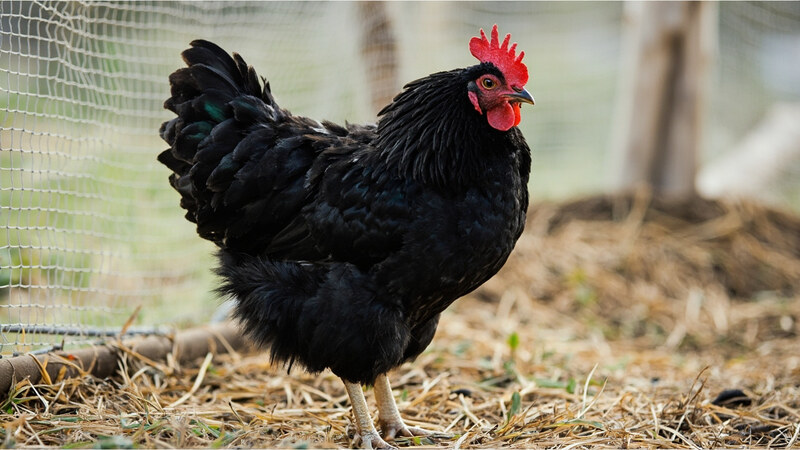
A frizzle chicken is a plumage variety with curled feathers, not a breed of its own in the United States. The association's large form has a 6 lb hen, and the bantam form a 20 to 24 oz hen. The eggs are white or tinted.
A flock lays about 100 to 200 a year, because the count comes from the host breed. So a frizzle suits keepers who want the look rather than the top egg count. Measure the host breed first. Then you buy the birds.
- Size class
- A plumage variety in the United States; Heavy: Soft feather in Great Britain and Australia, with an association large form and a bantam form
- Weight range
- Association weights: cock 8 lb, cockerel 7 lb, hen 6 lb, pullet 5 lb; bantam cock 24 to 28 oz, bantam hen 20 to 24 oz
- Eggs per year (range)
- By host breed: Silkie 100 to 120, Cochin 150 to 200, Polish 150 to 200. A frizzle has no count of its own
- Egg color
- White or tinted
- Comb type
- Single, medium and erect; clean legs, four toes
- Feather colors
- White, Black, Blue, Buff, Cuckoo, Spangle, Pile, Columbian, Red, Brown-red, Silver and Gold duckwing, Mottled, Crele
- Cold & heat tolerance
- Curled feathers insulate badly in cold, heat and wet; heat leaves faster, so a dry hot climate suits the bird
- Temperament
- Follows the host breed: Cochin docile, Polish active
- Broodiness
- The Frizzle is often broody; a Silkie carrier is very broody, a Polish carrier a non-setter
- Space per bird
- Large form (6 lb hen), standard rate: 4 sq ft inside and 8 sq ft of run. Bantam form (20 to 24 oz hen), bantam rate: 2 sq ft and 4 sq ft
Weights, comb, colors, egg color and the scale of points: the Frizzle Society of Great Britain. Variety or breed status, the feather behaviour, flight and brooding: Cackle Hatchery. Host breed figures: Townline Hatchery, Cackle Hatchery and The Livestock Conservancy. Space: our calculator and Penn State.
| Bird | Size | Hen weight | Eggs a year | Egg color | Broodiness | Roost | Source |
|---|---|---|---|---|---|---|---|
| Frizzle, association standard | Association large and bantam forms | 6 lb large form, 20 to 24 oz bantam form | 100 to 200, by host breed | White or tinted | Often broody | Low, the bird does not fly | Frizzle Society; Cackle |
| Frizzle Silkie, the sizzle | Bantam | 2 to 2.5 lb | 100 to 120 | Cream or tinted | Very broody | 1 ft off the floor | Townline; Oregon State |
| Frizzle Polish | Standard | 4.5 lb | 150 to 200 | White | Non-setter | 2 to 4 ft, the host flies | Cackle; Livestock Conservancy |
| Frizzle Cochin | Large breed, 8.5 lb hen | 8.5 lb | 150 to 200 | Brown | Very broody | Low, the host does not fly | Livestock Conservancy |
That table is the reason this page exists. One word on the card decides four numbers for you.
The Frizzle Society of Great Britain scores the bird on a 100 point scale, and curl carries the most weight of any item on it.
Free-range or confined?
Start with space. The host breed sets it. Here are our assumptions for both tables below.
A 6 lb frizzle hen in the large form takes the standard rate: 4 sq ft of coop floor and 8 sq ft of run. A 20 to 24 oz bantam hen takes the bantam rate: 2 sq ft and 4 sq ft.
That is the plan on our coop size calculator. Penn State gives 8 sq ft of run for a laying hen and 4 sq ft for a bantam. The calculator's large breeds tier is for the 8.5 lb Cochin carrier, not for a 6 lb hen.
Roost bar length is 8 in per standard bird and 4 in per bantam. Nest boxes are 1 for every 4 birds.
| Setup | Fits a frizzle? | Space per bird | Notes |
|---|---|---|---|
| Fixed coop with a covered run | Best fit | 4 sq ft inside, 8 sq ft run | Roof the run, curled feathers handle wet badly |
| Yard by day, locked up at night | With care | 3 sq ft inside | Oregon State's figure when the flock has yard access |
| Mobile coop on wheels | Works | 4 sq ft inside, 8 sq ft run | Roll it to shade and fresh grass |
| No run at all | Not our default | 8 to 10 sq ft inside | Oregon State's figure for a flock with no outdoor space |
| Birds | Coop floor | Run | Roost bar length | Nest boxes |
|---|---|---|---|---|
| 4 bantam form, 20 to 24 oz | 8 sq ft | 16 sq ft | 16 in | 1 |
| 6 bantam form, 20 to 24 oz | 12 sq ft | 24 sq ft | 24 in | 2 |
| 4 large form, 6 lb | 16 sq ft | 32 sq ft | 32 in | 1 |
| 6 large form, 6 lb | 24 sq ft | 48 sq ft | 48 in | 2 |
Six frizzle hens in the large form take 24 sq ft of floor and 48 sq ft of run. Six bantams take 12 sq ft and 24 sq ft.
You can check that yourself. Divide your floor area by 4 for a 6 lb hen, and by 2 for a bantam. The answer is the bird count your floor holds.
Coop & run setup
Start with the feathers. They set the whole setup. Cackle Hatchery is blunt about it: curled feathers handle hot, cold and wet badly. The same bird sheds heat faster, so a dry hot climate suits it better than a damp one.
That makes the run roof your first decision. Keep the bedding dry, put shade over the run in summer, and block the wind at the door in winter. Our winter chicken coop page covers that structure.
Next the roost. Cackle says a frizzle does not fly. It needs a low bar. Bar length and bar height are two different numbers, and the roost bar page keeps them apart.
Length is 8 in per standard bird and 4 in per bantam. You give a standard bird 8 in of bar, and a bantam 4 in. Height is the number a frizzle flock wants lower. Penn State sets it at 18 to 24 in off the floor for standard birds, and you never set a bar above 4 ft. A bantam bar sits lower, 12 to 18 in up. Oregon State puts a Silkie pole at 1 ft.
Nest boxes follow the same count as any flock: 1 for every 4 birds, each about 12 × 12 × 12 in. A bantam frizzle fits a smaller box. Keep the box lower than the roost. The nesting box page has the layouts.
The ramp needs a gentle slope. Penn State asks for slats 3 in apart or a textured surface, because a curled bird grips the ramp less well than a straight feathered one.
The coop in the box is a mobile unit on wheels, and the label says 4 to 6 chickens. Check the 82.4 by 25.8 in footprint on the listing before you believe the number.
That footprint is 14.8 sq ft for the house and the run together. Divide it by 4 sq ft of house floor per 6 lb hen and it fits 3 hens. Divide it by 8 sq ft of run per bird and it fits 1 bird. We round down, because half a hen has no floor.
The label only holds if the birds spend the day in the yard. Oregon State gives 3 sq ft per bird when a flock has yard access, and 14.8 sq ft divided by 3 gives 4. So the count on the box is a free-range count.
Wheels suit a frizzle flock well. Move the unit to shade and fresh grass rather than adding roof area, and you answer the same problem from the other side.
Feeding
Feed follows the same three stages as our other breed pages. Starter feed first, then grower, then a complete layer feed when the first egg arrives.
University of Maine allows the switch up to 2 weeks before laying starts. Its layer feed runs 14 to 16% protein for dual-purpose birds. Our feeding guide splits the same way.
The amount follows the weight. Minnesota Extension puts a 6 lb hen at 3 lb of feed a week, so a 6 lb frizzle hen eats about the same. A 20 to 24 oz bantam hen eats about 0.7 lb a week, our arithmetic on that same rate.
Four bantams eat about 2.8 lb a week between them. Six 6 lb hens eat about 18 lb. Size your feeder on that number, not on the bird count. The feeder page compares the sizes.
Grit and oyster shell get their own dishes, and both stay free choice. The grit and oyster shell page covers the pair.
Feeder space follows size as well. Penn State gives 1 in per bantam and 3 to 4 in per standard hen. One nipple drinker serves 6 to 8 birds. The waterer page compares the plain sizes.
Hatching: broody hen or incubator?
Broodiness decides your route here. The Frizzle breed often goes broody, Wikipedia says, and it is called a good layer of white or tinted eggs. A Silkie carrier is very broody. A Polish carrier is a non-setter. A Cochin carrier sits too.
If you breed, the ratio does the arithmetic. F is one autosomal gene with incomplete dominance, and the mutation sits in KRT75, per Ng and colleagues in PLOS Genetics in 2012.
| Pairing | Offspring | What you see | Feather result | Source |
|---|---|---|---|---|
| Frizzle × smooth, Ff × ff | 50% frizzled, 50% smooth | Half the chicks curl | No over-frizzled chicks | Cackle; My Pet Chicken |
| Frizzle × frizzle, Ff × Ff | 25% smooth, 50% frizzled, 25% over-frizzled | One chick in four curls hard | Brittle quills, poor insulation | Wikipedia; My Pet Chicken |
| Frizzle cock × smooth hen, kept in the flock | 50% frizzled, 50% smooth | Half the chicks curl, season after season | Breeders keep smooth hens in the flock | Cackle Hatchery |
My Pet Chicken puts the rule in one line. Frizzles do not breed true, and never will. Cackle answers from the other side, and keeps smooth hens in the flock so the over-frizzled birds stay rare.
An over-frizzled bird is called a frazzle. Wikipedia describes its feathers as brittle, like a pipe cleaner. They break easily and they hold little heat. That is the feather cost of crossing two frizzles.
A sizzle is the cross Cackle describes: a frizzled cock on a Silkie hen. The plumage is stacked, silky feathers with a curl on top. My Pet Chicken keeps the two genes in separate lines for a reason, and the second generation still throws birds without the silky feathering.
If you skip the hen, use an incubator. Texas A&M AgriLife Extension gives 21 days at 99.5 to 100 °F. Our hatching page has the day by day, and the incubator page sorts the machines by egg count.
A broody hen needs a quiet box and a separate pen, with feed and water inside. The Silkie carrier sits most often, and our Silkie page has that flock.
Bought chicks need a brooder box and a heating plate. Check the 10 × 12 in heating plate on the listing before you buy the box. The maker says up to 15 chicks.
That number is small. A frizzle chick grows into a 20 to 24 oz bantam hen or a 6 lb hen in the large form, so the brooder floor and the plate height are what you size, not the adult bird.
The box in the kit also carries a feeder and a waterer, which saves two decisions. Our brooder setup page covers the weeks after, and the brooder gear page compares the boxes by size.
Compared with similar breeds
Three birds sit next to this one, and the table lines them up. Read the weight column first. It sets the floor space.
| Bird | Hen weight | Eggs a year | Egg color | Comb | Broodiness | Can it fly | Feather point | Source |
|---|---|---|---|---|---|---|---|---|
| Frizzle, association standard | 6 lb large form, 20 to 24 oz bantam form | 100 to 200 | White or tinted | Single | Often | No, keep the bar low | Curl is 25 of 100 points | Frizzle Society; Cackle |
| Frizzle Silkie, the sizzle | 2 to 2.5 lb | 100 to 120 | Cream or tinted | Walnut | Very broody | Poor | Two plumage genes | Townline; Cackle |
| Frizzle Polish | 4.5 lb | 150 to 200 | White | V under the crest | Non-setter | Yes | Crest and curl are different | Cackle; Livestock Conservancy |
| Frizzle Cochin | 8.5 lb | 150 to 200 | Brown | Single | Very broody | No | Heavy host, curled feathers | Livestock Conservancy |
| Silkie | 2 to 2.5 lb | 100 to 120 | Cream or tinted | Walnut | Very broody | Poor | Silky plumage, no curl | Townline |
| Polish | 4.5 lb | 150 to 200 | White | V under the crest | Non-setter | Good flyer | Crest, no curl | Cackle; Livestock Conservancy |
Silkie plumage and frizzle plumage are two different genes. Cackle and My Pet Chicken both separate them: silkie feathers have no hook and feel like fluff, while frizzle feathers curl outward at the ends.
A sizzle stacks the two on one bird. That is what Cackle means by a frizzled Silkie.
Polish feathers are a third thing again. The crest sits on the head and hides the comb. Our Polish page has those numbers, and the crested breeds page covers the whole crest family.
Where to get chicks
Mail hatcheries sell by plumage. Some cards say Frizzle on its own. Others add the host breed, like Frizzle Easter Egger Bantam, and that second half is the bird you are buying.
Read three lines before you order. The host breed name, the plumage marking, and whether the chicks are sexed. A card that says only Frizzle leaves the weight and the egg count open.
Local poultry breed clubs and swap meetings keep the older varieties. Breed clubs publish the standard their birds are judged against, and the scale of points above is that standard.
Hens lay without a rooster. If you want fertile eggs, you need the cock.
Measure your coop first. Six frizzle hens in the large form need 24 sq ft of floor and 48 sq ft of run. Buy the house, then the birds.
Common Questions
Is a frizzle a chicken breed?
Not in the United States. It is a plumage variety that can be shown in any breed, and the American standard has listed frizzles since 1874. Great Britain, Australia, France, Germany, Ireland and Italy do list it as a breed of its own, with a written standard and a point scale. That is why the weight, the comb and the colors on this page come from the Frizzle Society of Great Britain.
How many eggs does a frizzle chicken lay a year?
About 100 to 200, because the count comes from the host breed rather than from the curl. A Silkie carrier gives 100 to 120, and Cochin and Polish carriers give 150 to 200. The shell is white or tinted. Six 6 lb hens on the 150 egg end would lay about 17 eggs a week between them.
Can you breed two frizzle chickens together?
You can, but the ratio changes. Ff crossed with Ff gives 25% smooth, 50% frizzled and 25% over-frizzled chicks. Cross a frizzle with a smooth bird instead and you get 50% frizzled and 50% smooth, with no over-frizzled chicks. My Pet Chicken puts it plainly: frizzles do not breed true.
What is a sizzle chicken?
A frizzled cock crossed with a Silkie hen. Cackle Hatchery calls the result a frizzled Silkie, and it carries both plumages: the silky feathers of the Silkie with the curl of a frizzle. The two are different genes, so a second generation throws birds without the silky feathering.
Can frizzle chickens live with ordinary hens?
Yes, and the host breed decides how. A frizzle is a variety of any breed, so it mixes with the breed it carries. Size the floor for the largest bird in the flock, and keep the roost low, because a frizzle does not fly.
How much space does a bantam frizzle need?
2 sq ft of coop floor and 4 sq ft of run for each bird, the bantam rate, half the standard figures. Four bantam frizzles take 8 sq ft of floor, 16 sq ft of run, 16 in of roost bar length and 1 nest box. Six of them take 12 sq ft, 24 sq ft, 24 in and 2 boxes.
Read next
- HubChicken breeds
- BreedBantam chickens
- BreedSilkie chicken
- BreedPolish chicken
- BreedCrested chicken breeds
- CalcCoop size calculator
- GearChick brooders
Sources
- The Frizzle Society of Great Britain, Frizzle breed standards, archived snapshot: web.archive.org (Heavy: Soft feather; egg color white or tinted; single comb; clean legs, four toes; cock 8 lb, hen 6 lb, pullet 5 lb; bantam cock 24 to 28 oz, hen 20 to 24 oz; the scale of points; the color list; read 2026-11-12)
- Cackle Hatchery, Breed Spotlight: Frizzle, Frazzle, and Sizzle Chickens (Gail Damerow, 2020): cacklehatchery.com (a variety in the United States, a breed in six other countries; the American standard listed frizzles in 1874; curl is inherited; frizzle crossed with smooth gives about 50% frizzled; curled feathers handle hot, cold and wet badly and shed heat faster; the bird does not fly; the over-frizzled bird is the frazzle; breeders keep smooth hens in the flock; a sizzle is a frizzled cock on a Silkie hen; read 2026-11-12)
- My Pet Chicken, What are frizzles, sizzles, and frazzles?: mypetchicken.com (plumage types, not breeds; frizzles do not breed true; frizzle crossed with smooth gives 50% frizzle and no frazzle; a sizzle carries the silky and the frizzle plumage; read 2026-11-12)
- Ng, C. S. et al. (2012), PLOS Genetics 8(7): e1002748: journals.plos.org (one autosomal gene with incomplete dominance, the homozygous bird showing the heavier form; the KRT75 deletion of 69 bp; read 2026-11-12)
- Wikipedia, Frizzle, breed entry and plumage entry: en.wikipedia.org (nine European countries and Australia list it as a breed, the United States does not; white or tinted eggs; single comb, clean legs; the Ff × Ff split of 25% smooth, 50% frizzled, 25% over-frizzled; brittle feathers; reared for exhibition; frequently broody; the hosts Cochin, Pekin, Polish, Silkie, Plymouth Rock and Buff Orpington; read 2026-11-12)
- The Livestock Conservancy, Cochin breed facts: livestockconservancy.org (cock 11 lb, hen 8.5 lb; 150 to 200 brown eggs a year when the hen is not sitting; very broody; does not fly, needs a low roost; wants shade and a cool spot in hot weather; docile; read 2026-11-12)
- Townline Hatchery, White Silkie Bantam breed facts: townlinehatchery.com (hen 2 to 2.5 lb; 100 to 120 eggs a year; very broody; not for hot climates; read 2026-11-12)
- Cackle Hatchery, White Crested Black Polish breed facts: cacklehatchery.com (hen 4.5 lb, rooster 6 lb; about 150 eggs a year; white shell; non setters; roost 2 to 4 ft; read 2026-11-12)
- Penn State Extension, Small Scale Poultry Housing (updated 2026): extension.psu.edu (8 sq ft of run for a laying hen and 4 sq ft for a bantam; 6 in of roost for a standard bird and 4 in for a bantam; 18 to 24 in up and never over 4 ft, bantams 12 to 18 in; nests 12 × 12 in; 3 in of feeder space for a standard hen and 1 in for a bantam; 1 nipple per 6 to 8 birds; ramp slats 3 in apart)
- Oregon State University Extension, EC 1644 Living Land Backyard Chicken Coop Design: extension.oregonstate.edu (3 sq ft per bird with yard access and 8 to 10 sq ft without; 5 to 10 in of roost per bird; 1 nest box per 4 birds, each 12 × 12 × 12 in; a Silkie pole 1 ft off the ground)
- University of Minnesota Extension, Raising chickens for eggs: extension.umn.edu (3 lb of feed a week for a 6 lb hen; the feed and footprint figures worked out from it are ours)
- University of Maine Cooperative Extension, Bulletin #2222: extension.umaine.edu (layer feed at the first egg, up to 2 weeks before laying starts; 14 to 16% protein for dual-purpose birds)
- Texas A&M AgriLife Extension, POSC-PU-018 Incubating and Hatching Eggs (2022): agrilife.org (21 days at 99.5 to 100 °F)
- This site's roost bar page: chicken roost bar (8 in of bar per standard hen and 4 in per bantam, our planning figures, and the length and height kept apart; read 2026-11-12)
- Mobile chicken coop with run for 4 to 6 birds, 82.4 × 25.8 × 44.1 in, 2 sectionable nesting boxes, waterproof asphalt roof, wheels: maker listing on Amazon, ASIN B0DPQK9Z6Y, read 2026-11-12
- Brooder box with a 10 × 12 in heating plate, feeder, waterer, pad and storage bag, up to 15 chicks: maker listing on Amazon, ASIN B0BYYXY3ML, read 2026-11-12
How we pick and check numbers: How we research.