Ayam Cemani Chicken: Black Plumage, 4 Pound Hens and 80 to 120 Cream Eggs a Year
Coopgauge is reader-supported. When you buy through links on this page, we may earn a commission.
Ayam Cemani hens weigh about 4 lb and lay 80 to 120 cream eggs a year. Plumage, skin, legs and comb are black. The catch is the numbers: three written standards, three sets of weights and comb counts.
The American Poultry Association does not list this breed. Pick one standard, then measure your birds against it.
- Size class
- Light breed; standard size class on our calculator
- Weight range
- Hen 4 lb, rooster 5 lb on the American standard; hen 1.5 to 2.0 kg, rooster 2.0 to 2.5 kg on the German standard; hen 1.2 to 2.5 kg, rooster 1.8 to 3.0 kg on the South African standard
- Eggs per year (range)
- About 80 to 120 on the Cackle card; 60 to 100 on the Roost breed page; about 60 to 120, mostly 80 to 100, on the Incubator Warehouse profile
- Egg color
- White tinted to cream (ACBA); cream to white (SASPO); cream to pinkish (Roost page)
- Comb type
- Single and black, five points on the American standard, four to six on the German, five to seven on the South African
- Feather colors
- Black only; dense black with a beetle-green sheen, and any white in wings or tail is a disqualification
- Cold & heat tolerance
- Tropical origin, heat tolerant; cold rated 2 out of 5 and heat 5 out of 5 on the Roost breed page
- Temperament
- Docile on the Cackle card, active and friendly on the Roost breed page
- Broodiness
- Occasional, and the South African standard lists non-sitters
- Space per bird
- 4 sq ft inside, 8 sq ft of run (our calculator)
Weights, comb, egg color and the disqualifications: the American breeders association standard, the German standard as quoted by Open Poultry Standards, and the South African SASPO standard. Egg counts, temperament, climate, broodiness and the colour changes: the Cackle Hatchery breed card, the Roost Chickens breed page and the Incubator Warehouse breed profile. Space: our calculator.
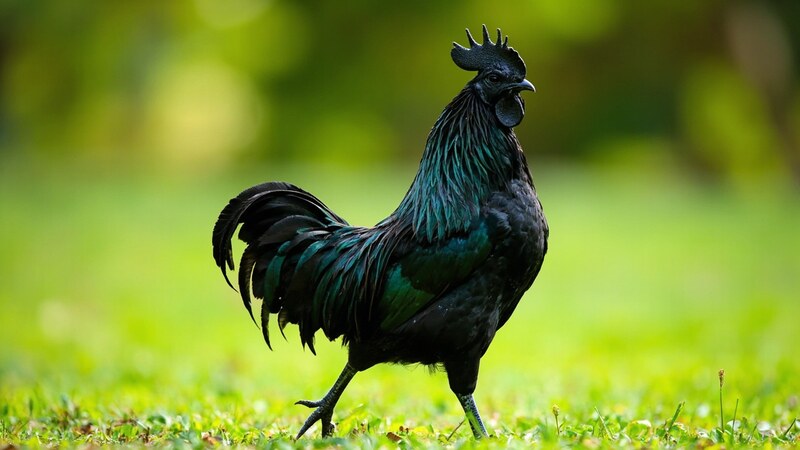
Color is why most people look at this breed. Feathers are black. So are the skin, the beak, the wattles, the ear lobes and the legs.
Two things break the all-black picture. The Cackle breed card notes pigment leakage and silver leakage in young birds. A rooster's comb and wattles may also turn mulberry color as he grows.
White in the wings or tail is a disqualification under the American standard. That is a rule about the bird, not a matter of taste.
The eggs are not black. Neither is the blood. The same breed card says the hens lay cream or light tan eggs. It also says their blood is normally colored, not black.
Now the numbers. They do not agree. Three standards each set a hen weight. Three breed listings each set an egg count.
| Standard | Class and origin | Hen | Rooster | Young birds | Comb | Egg color | Notes |
|---|---|---|---|---|---|---|---|
| ACBA, American breeders association | Recorded as a Javanese breed in the 1920s | 4 lb | 5 lb | Pullet 3 lb, cockerel 4 lb | Single, five points, deep serrations | White tinted to cream | Ornamental breed, not known to be prolific; non-black plumage and pink in the mouth disqualify |
| German standard, as quoted by Open Poultry Standards | — | 1.5 to 2.0 kg | 2.0 to 2.5 kg | Pullet 1.2 to 1.5 kg, cockerel 1.6 to 1.8 kg | Single, four to six points | White tinted to cream | Not listed by the Australian standards body; minimum incubation egg weight 40 g; kept mostly as an ornamental breed |
| SASPO, South Africa, February 2019 | Asian, Indonesia; Asian Hard Feather, light breed | 1.2 to 2.5 kg | 1.8 to 3.0 kg | Pullet up to 1.8 kg, cockerel up to 2.7 kg | Single, black, five to seven points | Cream to white, non-sitters | Scored out of 100: skin color 30, plumage 20, type 15, condition 15, head 10, legs 10 |
Read the comb column first. Five points is the American figure. Four to six points is the German figure. Five to seven points is the South African one.
Half the score sits in plain sight. You can check it in a minute, standing at the coop door.
The South African standard gives skin color 30 points and plumage 20 out of 100. The rest covers type, head, legs and condition.
We plan this page on the American standard. It is written for the same market as our other breed pages. You get the same floor numbers here as on those pages.
A 4 lb hen is a standard bird, so she takes 4 sq ft of coop floor and 8 sq ft of run.
One note on eggs. Our egg count pages use the Livestock Conservancy comparison chart, and that chart has no row for this breed.
Free-range or confined?
Space comes first. The size class settles it. A 4 lb hen is a standard bird on our calculator, not a large one.
Our assumptions for both tables below. Give 4 sq ft of house floor per standard hen. Give 8 sq ft of run. Give 8 in of roost bar and 1 nest box per 4 hens.
| Setup | Fits an Ayam Cemani? | Space per bird | Notes |
|---|---|---|---|
| Coop with run | Good | 4 sq ft inside, 8 sq ft run | Run needs a top; this breed flies |
| Mobile coop on wheels | Good, for a small flock | same figures | Wheels move the run to fresh grass |
| Free range by day | Good | 3 sq ft inside | Oregon State gives 3 sq ft with outdoor access; night housing still counts |
| No outdoor access | Not our default | 8 to 10 sq ft inside | Oregon State figure for a flock with no run |
One row needs a note for this breed. The Cackle card calls them docile, and the Roost breed page calls them active and friendly. The Incubator Warehouse profile asks for tall fencing and a covered run.
So the run is part of the setup, not an extra. Net the top. Keep the fence high enough that a bird cannot sit on top of it. Our chicken run ideas page has the shapes that work.
The coop you are weighing up comes down to one number. Take the floor area and divide it by 4. The answer is the bird count your floor holds.
The coop size calculator does the same arithmetic with the run, the roost and the boxes.
| Hens | House floor | Run | Roost bar | Nest boxes |
|---|---|---|---|---|
| 4 | 16 sq ft | 32 sq ft | 32 in | 1 |
| 6 | 24 sq ft | 48 sq ft | 48 in | 2 |
| 8 | 32 sq ft | 64 sq ft | 64 in | 2 |
Six hens is the flock size we keep coming back to. Six Ayam Cemani need 24 sq ft of house floor and 48 sq ft of run. Add 48 in of roost bar and 2 nest boxes.
One figure changes when the flock ranges free. Oregon State gives 3 sq ft per bird with outdoor access. Six hens then drop to 18 sq ft inside. The run still wants 48 sq ft.
Coop & run setup
Measure the door opening against the comb, not the body. The American standard asks for a single comb with five points. Deep serrations on top of that.
The comb is the part that has to clear the frame when you close the door.
Our automatic door page measures three openings. They are 8.2 × 9.6 in, 9.45 × 10.91 in and 10.8 × 14.2 in.
A 4 lb hen fits the first one. A rooster with a full five-point comb needs the 10.8 × 14.2 in opening.
Give each bird 8 in of roost bar. Oregon State allows 5 to 10 in per bird, so our figure sits inside that range.
Set the bar 18 to 24 in off the floor. Never above 4 ft. That is the Penn State rule.
For the boxes, plan 1 per 4 hens. Each one about 12 × 12 × 12 in.
Penn State wants at least 4 ft between the boxes and the roost.
Now the run, which matters more here than on most breeds. The breed profile calls these birds active and agile. It asks for tall fencing and a covered run. Our free range page covers the fencing side.
Cold weather is a question of structure, not of the bird. This is a tropical breed, so keep the house dry and free of drafts.
Leave the vent high. Keep the roost out of the airflow below it. Lay down 4 to 6 in of bedding.
One last job for the night. Kentucky ID-245 tells you to shut the birds in and latch the door after dark. Do that with this breed too.
The listing title says 6 to 8 chickens. The feature text repeats that count. It hangs 41.2 sq ft on the house, with four perches and six nesting boxes. It gives a 28 sq ft enclosed run with two perches.
Now run our floor math on it. A 4 lb hen takes 4 sq ft inside, so 41.2 sq ft holds 10. She takes 8 sq ft of run, so 28 sq ft holds 3.
The run is the limiter here, not the house. The title count runs 3 to 5 birds past it. Check the 41.2 sq ft house and its 28 sq ft run on the listing.
Then measure your own run the same way. On this breed the run sets the flock size, and the house floor is the number you check second.
Feeding
Feed follows the same pattern as our other breed pages. Starter feed first, then grower.
Then a complete layer feed with 14 to 16% protein once the first egg arrives. University of Maine allows that switch up to 2 weeks before laying starts.
This is a light breed, so the starter runs higher in protein. University of Maine gives light breeds 20 to 22% protein until 6 weeks.
Now the amount, and this part is our arithmetic. Minnesota Extension puts a 6 lb hen at 3 lb of feed a week. Scale that to a 4 lb hen. You get about 2 lb a week.
Six hens eat roughly 12 lb of feed a week between them. That is the number to size a feeder around. Not the number of birds.
Keep grit and oyster shell in their own dishes, free choice. Let each hen take what she needs. Keep scratch to a handful, the amount your flock clears in 20 to 30 minutes.
Water is the bigger number in hot weather. The Kentucky poultry water table gives 5.55 gallons a day for 100 layer hens at 68 °F. At 89.6 °F it gives 10.57 gallons.
Our count from those two figures is 0.06 gallon a hen in mild weather. It is 0.11 gallon in hot weather. Six hens drink 0.36 to 0.66 gallon a day.
A 2 gallon waterer lasts about three days when it is hot, so you refill it twice a week. Shade it and change it every day. Our chicken waterer page compares the sizes.
The breed is tropical, and the Cackle card lists it as heat tolerant. So the hot weather plan is equipment, not guesswork. Shade over the run. Cool water replaced every day. Air moving through the house.
The feeder in the box holds 30 lb behind a locking lid. It has 6 feeding ports on the front.
Six Ayam Cemani hens eat about 12 lb a week. That is two and a half weeks of feed in one fill.
Check the 30 lb capacity on the listing. Compare it with the 12 lb a week your six hens use. Then pick the capacity from that number.
Two details matter in the yard. The galvanized body is weatherproof. The hinged lid locks shut, so the feed stays dry.
The ports keep the birds from throwing feed on the ground. That cuts the waste you buy twice.
The stand adjusts in height, so one feeder works for pullets and for full-size hens.
Hatching: broody hen or incubator?
Three sources say this is not a dependable setting bird. The Cackle card lists broodiness as occasional. The same card says these hens are not usually known as dependable setters.
Wikipedia calls the hens poor setters. They rarely hatch their own brood. The South African standard goes further. It marks the egg color line as non-sitters.
So plan on an incubator. Texas A&M gives a 21-day cycle at 99.5 to 100 °F. Humidity runs 55 to 60%, with 5 turns a day.
Day 18 changes the settings. The hatch stage runs 65 to 70% humidity. The eggs are small, which matters when you pick the tray.
The German standard sets a minimum incubation egg weight of 40 g. Wikipedia gives about 45 g for the average egg.
Five hens give you 25 to 35 eggs for one cycle, our count from the 80 to 120 range. One 24-egg tray takes most of that batch. Our hatching page walks the cycle. The incubator page compares machines by egg count.
A hen may sit now and then. But three sources in a row do not call her a setter. If you want chicks, budget for the machine.
Compared with similar breeds
Three birds sit near this one, and the table puts the numbers side by side. Read the weight column first. That column tells you how much space each bird needs.
| Breed | Hen | Rooster | Eggs a year | Egg color | Comb | Broodiness | Sq ft each | Standard |
|---|---|---|---|---|---|---|---|---|
| Ayam Cemani | 4 lb | 5 lb | 80 to 120 | Cream to white tinted | Single, five points | Occasional | 4 | Three standards, no APA listing |
| Silkie | 2 to 2.5 lb | 2.5 to 3 lb | about 100 to 120 | Cream, small | Walnut | Very broody | 2 | APA since 1874 |
| Leghorn | 4.5 lb | 6 lb | 250 to 300 | White | Single, tall | Non-setter | 4 | APA standard |
| Marans | 6.5 to 7 lb | 8 to 9 lb | about 180 to 200 | Dark brown | Single | Setter to variable | 4 | APA standard |
The Silkie is the closest look-alike in our breed list. Both birds have black skin. The Silkie is a bantam at 2 to 2.5 lb.
So it takes 2 sq ft each. It lays small cream eggs at about 100 to 120 a year. It goes broody often.
The Leghorn is the opposite trade. It lays 250 to 300 white eggs a year, so it earns its space in the flock. It asks for the same 4 sq ft of floor.
The Marans is heavier at 6.5 to 7 lb and lays dark brown eggs. It is a large fowl bird on a standard size floor of 4 sq ft. It sits far more often than this one.
Four published hen weights sit on one axis below. They overlap only in the middle. That spread is why we name the standard first, before we quote a number.
Where to get chicks
Breeders keep this one in small numbers. Cackle Hatchery lists it on its own page and marks it rare. Incubator Warehouse keeps a breed profile for it.
So the channel is specialist hatcheries and breeders who keep the line you want.
Read the card before you order. The comb count on it is the first line, because it tells you which standard the line follows.
Then four checks, all of them visible when the bird stands in front of you:
- Skin and legs, black to dark grey, with four toes. The South African standard scores that skin 30 points out of 100.
- The mouth and the tongue, both black. Pink inside the mouth is a disqualification. A mouth that is not black counts as a defect.
- The toenails, which should be black. Anything else is a defect in the same standard.
- The wings and the tail, checked for white. Non-black plumage disqualifies the bird. The Cackle breed card notes silver leakage in young birds as well.
Two warnings before you count the birds. Chicks hatch black, so that is not a test on its own. A rooster's comb and wattles may turn mulberry color as he grows. The same card explains it.
The mating ratio is simple. The Cackle card gives 1 rooster for 8 hens. The Incubator Warehouse profile gives 1 for 8 to 12. You do not need a rooster for eggs at all.
Last thing. Measure the coop before you order the birds. Six Ayam Cemani hens need 24 sq ft of floor and 48 sq ft of run. Buy the house first. Then the birds.
Common Questions
How many eggs does an Ayam Cemani lay a year?
The Cackle breed card gives about 80 to 120 eggs a year. The Roost breed page says 60 to 100, and the Incubator Warehouse profile says about 60 to 120, with most of its birds in the 80 to 100 band. Our egg count pages use the Livestock Conservancy comparison chart, and that chart has no row for this breed, so read the number on the card that arrives with your birds.
What color are Ayam Cemani eggs, and are they really black?
Not black. The American standard describes the shell as white tinted to cream, and the South African standard writes cream to white. The Roost breed page adds cream to pinkish. The hatchery card is blunt about it: the hens do not lay black eggs, they lay cream or light tan. Their blood is normally colored too, not black.
How much does an Ayam Cemani hen weigh?
About 4 lb for a hen and 5 lb for a rooster on the American standard. The German standard gives 1.5 to 2.0 kg for a hen and 2.0 to 2.5 kg for a rooster. The South African standard is wider still, at 1.2 to 2.5 kg for a hen and 1.8 to 3.0 kg for a rooster. Four pounds puts this bird in the standard size class, which is 4 sq ft of floor each on our calculator.
Do Ayam Cemani hens go broody?
Not reliably. The Cackle card lists broodiness as occasional, Wikipedia calls the hens poor setters that rarely hatch their own brood, and the South African standard marks the egg line as non-sitters. Plan on an incubator at 99.5 to 100 °F for 21 days with 55 to 60% humidity, and expect 5 to 7 eggs from each hen in one cycle, our count from the 80 to 120 range.
Can you keep Ayam Cemani in cold weather?
This is a tropical breed, and the Cackle card lists it as heat tolerant. The Roost breed page rates it 5 out of 5 for heat and 2 out of 5 for cold, so work on the house. Keep it dry, block the drafts, leave the vent high, lay down 4 to 6 in of bedding, and keep the roost out of the airflow. A dry house and deep bedding do more for you than any lamp.
What is the difference between an Ayam Cemani and a Silkie?
Both have black skin. The Silkie is a bantam at 2 to 2.5 lb, so it takes 2 sq ft each, lays small cream eggs at about 100 to 120 a year, and goes broody often. The Ayam Cemani is a standard bird at 4 lb, takes 4 sq ft each, lays 80 to 120 eggs, and only occasionally sits. One is a layer and a sitter, the other a layer and a show bird.
Read next
- HubChicken breeds
- ListBest egg laying chickens
- DataEgg color chart
- DataNesting boxes
- GuideWinter chicken coop
- GuideFree range chickens
- GearChicken coops with run
- GearChicken feeders
- FeedChick starter feed
Sources
- Ayam Cemani Breeders Association, Standard of Perfection: ayamcemani.us (standard weights cock 5 lb, hen 4 lb, cockerel 4 lb, pullet 3 lb; single comb with five points and deep serrations, comb not touching the neck line; tail carried at 45 degrees; egg shell white tinted to cream; recorded as a Javanese breed in the 1920s; four toes, black legs and black toenails; described as an ornamental breed and not known to be a prolific layer; disqualifications for non-black plumage and pink in the mouth, defects for a non-black or non-grey mouth, uneven plumage and non-black toenails)
- SASPO, Ayam Cemani Breed Standard, February 2019: saspo.org.za (origin Asia, Indonesia; Asian Hard Feather, light breed; large type cock 1.8 to 3.0 kg, hen 1.2 to 2.5 kg, cockerel up to 2.7 kg, pullet up to 1.8 kg; single black comb with 5 to 7 points; skin black to dark grey; plumage dense black with a slight beetle-green sheen; egg colour cream to white, marked non-sitters; scored out of 100 as type 15, head, beak and eyes 10, colour 20, skin colour 30, legs and feet 10, condition 15)
- Open Poultry Standards, Ayam Cemani: openpoultrystandards.com (German standard weights cock 2.0 to 2.5 kg, hen 1.5 to 2.0 kg, cockerel 1.6 to 1.8 kg, pullet 1.2 to 1.5 kg; comb with 4 to 6 points; minimum incubation egg weight 40 g; US standard egg colour white tinted to cream; Dutch scoring table with plumage colour 20, skin colour 30, type 15, legs and feet 10, head 10, condition 15; the breed is primarily regarded as an ornamental breed rather than a high-production laying breed; not listed by the Australian standards body)
- Cackle Hatchery, Ayam Cemani breed card: cacklehatchery.com (listed on its own hatchery page as a rare breed; egg shell cream; about 80 to 120 eggs a year; broodiness occasional and not usually known as dependable setters; mating ratio 1 to 8; roost height high; origin Indonesia; docile; heat tolerant; pigment leakage and silver leakage in young birds, and a rooster's comb and wattles may turn mulberry colour; the hens do not lay black eggs but cream or light tan ones, and their blood is normally colored, not black)
- Roost Chickens, Ayam Cemani breed page: roostchickens.com (60 to 100 eggs a year; cream to pinkish eggs; 3.5 to 4.5 lb; active and friendly; broodiness low; cold rated 2 out of 5 and heat 5 out of 5; a Javan origin; kept mainly as an ornamental breed)
- Incubator Warehouse, Ayam Cemani breed profile: incubatorwarehouse.com (hen 4 to 4.5 lb and rooster 5.5 to 7 lb; about 60 to 120 eggs a year, mostly 80 to 100; egg weight about 45 g; first eggs at 5 to 7 months; mating ratio 1 to 8 to 12; about 4 sq ft of coop space per bird; chicks black on hatching; not listed by the American Poultry Association; active and agile, with tall fencing and a covered run needed)
- Wikipedia, Ayam Cemani: en.wikipedia.org (weights cock 2.0 to 2.5 kg and hen 1.5 to 2.0 kg; black skin; single comb; average egg weight about 45 g; hens are poor setters and rarely hatch their own brood; the claim that the blood is black is false information)
- Silkie, Leghorn and Marans rows: Silkie, Leghorn and Marans breed pages on this site, which carry the sources for their own rows
- Oregon State University Extension, EC 1644 Backyard chicken coop design: extension.oregonstate.edu (3 sq ft per bird with outdoor access and 8 to 10 sq ft without it; 5 to 10 in of roost per bird; 1 nest box per 4 birds; box 12 × 12 × 12 in)
- Penn State Extension, Small Scale Poultry Housing: extension.psu.edu (roost 18 to 24 in high and never over 4 ft; nest boxes at least 4 ft from the roost; 8 sq ft of run per laying hen)
- Minnesota Extension, Caring for chickens in cold weather: extension.umn.edu (bedding 4 to 6 in of straw or shavings on the coop floor)
- University of Minnesota Extension, Raising chickens for eggs: extension.umn.edu (3 to 5 sq ft of indoor space per bird; 3 lb of feed a week for a 6 lb hen)
- University of Maine Cooperative Extension, Bulletin #2222 Nutrition for Backyard Chicken Flocks in Maine: extension.umaine.edu (light breeds get a starter of 20 to 22% protein until 6 weeks; layer feed with 14 to 16% protein for egg birds; switch to layer feed up to 2 weeks before laying; scratch cleared in 20 to 30 minutes)
- Texas A&M AgriLife Extension, POSC-PU-018 Incubating and Hatching Eggs: agrilife.org (21 days at 99.5 to 100 °F, 55 to 60% humidity and 5 turns a day; the eggs move to the hatcher on day 18 at 98.5 °F, and the hatch stage calls for 65 to 70% humidity)
- University of Kentucky Extension, ID-245: publications.mgcafe.uky.edu (shut the birds in a closed building at night with the doors latched)
- University of Kentucky Extension, Poultry chapter 12, water use table: afs.mgcafe.uky.edu (layer hens 5.55 gallons per 100 birds a day at 68 °F and 10.57 gallons at 89.6 °F; the per-hen and six-hen water counts, the flock size table, the feed arithmetic and the eggs per hen in one cycle are our own)
- 118-inch walk-in wooden chicken house with run, 41.2 sq ft house with four perches and 28 sq ft enclosed run: maker listing on Amazon, ASIN B0GQM5B1QV, read 2026-11-26
- 30 lb galvanized chicken feeder with 6 no-waste ports, adjustable height and locking lid: maker listing on Amazon, ASIN B0DNXGNBYB, read 2026-11-11
How we pick and check numbers: How we research.