Cream Legbar Chicken: Blue and Green Eggs, 5 Pound Hens and Chicks You Can Sex at Hatch
Coopgauge is reader-supported. When you buy through links on this page, we may earn a commission.
A cream legbar chicken fits your flock or it does not, and two numbers decide it. The hen weighs about 5.0 lb and lays 180 to 200 eggs a year.
The shells are blue or green, and the chicks can be sexed on the day they hatch. The catch is the name. The American Poultry Association does not list it.
The Rare Breed Survival Trust and the Cackle Hatchery card agree on the egg count. Five directories handle the name differently, so we give you each one rather than a merged answer.
The Poultry Club of Great Britain treats the Cream Legbar as a color variety of the Legbar. The Rare Breed Survival Trust treats it as a breed in its own right, standardized in 1958.
The Autosexing Breeds Association lists it as a soft feather light breed, large fowl only.
So we work from the numbers. Every figure names its source. Our egg color chart already sorts shells by breed. Here we stay with the bird: weight, egg count, comb, hatch-day sexing, and floor space.
- Size class
- Soft feather light on the Poultry Club of Great Britain listing; large fowl only on the Autosexing Breeds Association list; a standard bird on our calculator
- Weight range
- Hen 2.0 to 2.7 kg and rooster 2.7 to 3.4 kg on Wikipedia, about 4.4 to 6.0 lb and 6.0 to 7.5 lb by our conversion; the Cackle card gives a 5.0 lb hen and a 7.5 lb rooster
- Eggs per year (range)
- About 180 to 200 on the Cackle card, and 180 to 200 depending on strain at the Rare Breed Survival Trust; Wikipedia says 180 or more
- Egg color
- Blue or green; the Rare Breed Survival Trust adds olive for some strains, and the Cackle card adds blue-green
- Egg size
- Medium to large on the Cackle card
- Comb type
- Single and large; the Rare Breed Survival Trust notes a small feathered crest behind the comb
- Feather colors
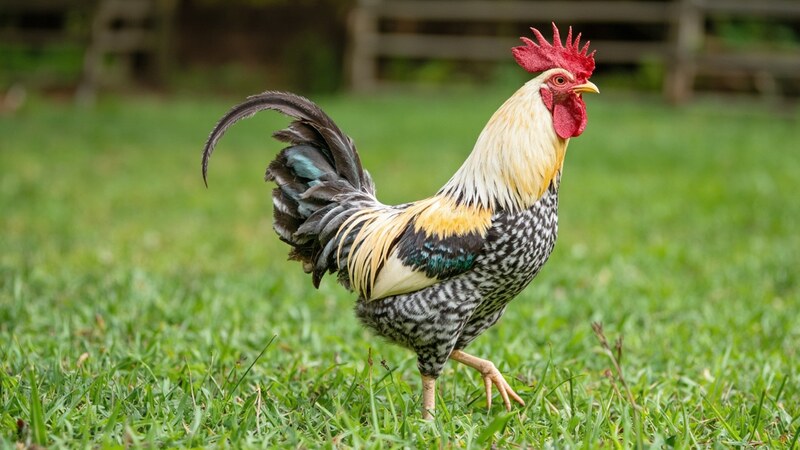
- Rooster: cream neck and saddle, grey breast, grey legs and wings, barred body. Hen: cream neck, salmon breast, grey barred body
- Cold & heat tolerance
- Cold hardy and heat tolerant on the Cackle card; the Rare Breed Survival Trust calls the breed hardy
- Temperament
- Active on the Cackle card; the Rare Breed Survival Trust lists the breed as active and a frugal eater
- Broodiness
- Rarely broody; the Cackle card marks it occasional
- Space per bird
- 4 sq ft inside and 8 sq ft of run (our calculator)
Weights, comb, egg color and the classification lines: Wikipedia's Legbar entry. Egg count, egg size, climate, temperament and broodiness: the Cackle Hatchery breed card. Appearance, hatch-day sexing, hardiness and the standard warning: the Rare Breed Survival Trust page. Size class and color varieties: the Autosexing Breeds Association list. Space: our calculator.
| Chick | Look at | Feather marks | Source |
|---|---|---|---|
| Pullet | The body feathering | Clear light and dark stripes across the body | Rare Breed Survival Trust |
| Cockerel | The top of the head | Pale overall, with a clear yellow spot on the head | Rare Breed Survival Trust |
Two marks do the work. A pullet carries stripes, a cockerel carries a yellow spot on the head. That is the whole hatch-day check.
No other breed page on this site has marks you can read on day one.
| Directory | How it treats the breed | Standard year | Size class | Source |
|---|---|---|---|---|
| American Poultry Association | Not listed | — | — | Wikipedia |
| Exhibition, EE | Listed, not recognised | — | — | Wikipedia |
| Poultry Club of Great Britain | A color variety of the Legbar | — | Soft feather, light | Wikipedia |
| Rare Breed Survival Trust | A breed in its own right | 1958 | — | Wikipedia and the Rare Breed Survival Trust |
| Autosexing Breeds Association | One of three color varieties, with Cream, Gold and Silver | — | Soft feather light, large fowl only | Autosexing Breeds Association |
One warning sits under all of it. The Rare Breed Survival Trust notes that many birds sold as Cream Legbars miss the standard. They have lost the dilute cream gene.
The Autosexing Breeds Association says it from the other side. Non-standard birds are often sold as the real thing.
That is why the numbers come first. A bird that matches the weight is easy to check. The egg count tells you the same. A name on a card is not a measurement.
Free-range or confined?
Start with space, and the size class settles it. A 5.0 lb hen is a standard bird on our calculator. Your floor area decides how many you keep.
Our assumptions for both tables below. Give 4 sq ft of house floor per standard hen. Give 8 sq ft of run.
Give 8 in of roost bar. Give 1 nest box per 4 hens.
| Setup | Fits a Cream Legbar? | Space per bird | Notes |
|---|---|---|---|
| Coop with run | Good | 4 sq ft inside, 8 sq ft run | Active bird, so give the run a top and a wide edge |
| Mobile coop on wheels | Good, for a small flock | same figures | Wheels move the run to fresh grass |
| Free range by day | Good | 3 sq ft inside | Oregon State's figure with outdoor access; night housing still counts |
| No outdoor access | Not our default | 8 to 10 sq ft inside | Oregon State's figure for a flock with no run |
One row needs a note for this breed. The Rare Breed Survival Trust calls the bird active. The Cackle card agrees.
An active hen walks the run edge. She forages the whole way. Your birds will work the whole edge of it. The run is part of the setup. It is not an extra.
Net the top and keep the mesh strong. Our free range page covers the daytime side. The chicken run ideas page has the shapes that work.
The arithmetic is the same here. Every breed page uses it. Take your floor area and divide it by 4. The answer is the bird count your floor holds.
The coop size calculator does that. It adds the run and the boxes.
| Hens | House floor | Run | Roost bar | Nest boxes |
|---|---|---|---|---|
| 4 | 16 sq ft | 32 sq ft | 32 in | 1 |
| 6 | 24 sq ft | 48 sq ft | 48 in | 2 |
| 8 | 32 sq ft | 64 sq ft | 64 in | 2 |
Six hens is the flock size on this page. It keeps coming back. Six Cream Legbars take 24 sq ft of house floor and 48 sq ft of run.
Add 48 in of roost bar and 2 nest boxes.
Egg numbers use the same arithmetic. 180 to 200 eggs a year works out to 3.5 to 3.8 eggs a week per hen. That is our count from dividing by 52.
Six hens lay about 21 to 23 eggs a week between them. Our eggs a day page puts a good layer at about 6 a week. This breed sits below that band.
Coop & run setup
Start with the comb. Wikipedia lists it as single and large. The Rare Breed Survival Trust adds a small feathered crest behind it.
A big single comb needs a tall opening. Measure your pop hole against the comb. Do not use the body.
Our automatic door page measures three openings. They are 8.2 × 9.6 in, 9.45 × 10.91 in and 10.8 × 14.2 in. A cream legbar rooster with a full comb wants the 10.8 × 14.2 in opening.
Roost bar is 8 in per bird. Oregon State allows 5 to 10 in per bird, so our figure sits inside that range.
Set the bar 18 to 24 in off the floor. Never above 4 ft. That is the Penn State rule.
Leave a gap between the roosts as well. The crest sits behind the comb, and a bird under another roost has no clearance. The roost bar page has the spacing detail.
For the boxes, plan 1 per 4 hens. Each one about 12 × 12 × 12 in. Penn State wants 4 ft between the boxes and the roost. Our nesting box page has the layouts.
Now the run. This is an active bird that forages along the whole edge of the space.
Give it width and a top. Check the mesh where your birds can reach it.
Cold weather is a structure question, not a bird question. Keep the bedding dry, open the vent high, and keep the roost out of the airflow below it.
Block the drafts at the door. The winter chicken coop page has the setup.
Now the coop. The number on the box is next. The listing title says 1 to 2 chickens.
The maker lists a 6.57 sq ft house and a 10.76 sq ft run. Divide 6.57 by 4 sq ft. That is 1.64 hens.
Divide 10.76 by 8 sq ft of run. That is 1.35. The run is the tighter limit, so this floor holds 1 Cream Legbar.
Check the 6.57 sq ft house on the listing. Compare it with 4 sq ft per 5 lb hen, then measure your own floor the same way.
A Cream Legbar is a standard hen, not a bantam. The title's second bird does not fit this floor at 4 sq ft.
The 67.75 × 58.75 × 42.25 in footprint gives 1 nesting box and 2 roost bars inside the house.
If you want 6 Cream Legbars, you need 24 sq ft of floor and 48 sq ft of run. Our coops with a run page has kits. They are sized for that flock.
Feeding
Feed follows the same three stages as our other breed pages. Starter feed first, then grower.
Then a complete layer feed at the first egg. University of Maine allows that switch up to 2 weeks before laying starts.
Layer feed protein depends on the bird. University of Maine's table gives 15 to 19% for egg-production birds like this one, and 14 to 16% for dual-purpose breeds. Read the label. Our feeding guide splits the same way.
Now the amount, and this part is our arithmetic. Minnesota Extension puts a 6 lb hen at 3 lb of feed. That is per week.
Scale that to a 5.0 lb Cream Legbar and you get about 2.5 lb a week. Six hens eat about 15 lb of feed a week between them.
Size the feeder around that number. Not the number of birds.
The Rare Breed Survival Trust calls the breed a frugal eater. That puts the figure on the generous side.
Give grit and oyster shell their own dishes. Keep both free choice. Let each of your hens take what she needs.
Keep scratch to a handful, the amount your flock clears in 20 to 30 minutes.
Water is the number people skip. The University of Kentucky lists 5.55 gallons per 100 laying hens a day at 68 °F. That works out to about 0.06 gallon a hen.
Six hens drink about 0.33 gallon a day in cool weather. A 3 gallon heated unit lasts about 9 days. Our chicken waterer page compares the plain sizes, and the heated waterer page covers winter.
The feeder in the box holds 30 lb. It sits behind a locking lid. It has 6 feeding ports on the front. The galvanized body stands 16.1 × 6.3 × 12.2 in.
Six Cream Legbar hens eat about 15 lb of feed a week. That is two weeks of feed in one fill.
Check the 30 lb capacity on the listing. Compare it with the 15 lb a week your six hens use, then pick the capacity from that number.
Two details matter in the yard. The hinged lid locks shut, so the feed stays dry, and the galvanized body is weatherproof.
The ports keep the birds from throwing feed on the ground. The stand adjusts in height, so one feeder works for pullets and for full-size hens.
Hatching: broody hen or incubator?
Two sources say this is not a dependable setting bird. The Rare Breed Survival Trust says it is quite unusual for them to go broody. The Cackle card marks broodiness as occasional.
So plan on an incubator. Texas A&M gives a 21-day cycle. It runs at 99.5 to 100 °F. Humidity runs 55 to 60%, with 5 turns a day.
Egg size matters for the tray. The Cackle card lists Medium to Large, so pick the tray the maker lists for that range.
Our hatching page walks the cycle, and the incubator page compares machines by egg count. The brooder setup page covers the weeks after the hatch.
This page stops at the machine settings. The rest of the process lives on those pages.
Compared with similar breeds
Three birds sit near this one, and the table puts the numbers side by side. Read the weight column first. It sets the floor space.
| Breed | Hen | Rooster | Eggs a year | Egg color | Comb | Crest | Broodiness | Sexed at hatch | Standard |
|---|---|---|---|---|---|---|---|---|---|
| Cream Legbar | 2.0 to 2.7 kg (4.4 to 6.0 lb) | 2.7 to 3.4 kg (6.0 to 7.5 lb) | 180 to 200 | Blue or green | Single, large | Small crest behind the comb | Rarely | Yes | No APA listing; a breed of its own since 1958 |
| Ameraucana | 5.5 lb | 6.5 lb | About 180 to 200 | Blue, a few light green | Pea, small wattles | — | Non setter | — | Ameraucana Alliance standard |
| Easter Egger | About 4 to 5.5 lb | 5 to 6.5 lb | About 200 to 280 | Blue, green, pink or tan | Small comb | — | Low to variable | — | Mixed heritage, no single standard |
| Olive Egger | 4.5 to 5.5 lb | 5.5 to 6.5 lb | About 180 to 220 | Olive green | Pea or single | — | Rarely | — | Crossbred, no standard |
Cream Legbar is the British one. Punnett and Pease built it at Cambridge in the early twentieth century. It is a sexing breed, with a single comb, a small crest and blue-green eggs.
Wikipedia records it as the second auto-sexing breed after the Cambar.
The Ameraucana is the American answer to the same shell color. It carries a pea comb with beards and muffs. It keeps a tail where the Cream Legbar carries a crest.
The Easter Egger is a mix rather than a breed. That is why it has no single weight or comb.
The Olive Egger is a cross. Cackle Hatchery makes its Olive Egger from a pure Cream Legbar rooster and a pure Welsummer hen. This breed is one of the parents.
Weight is where the sources disagree most. Wikipedia gives a range and the Cackle card gives a point. The gap between them is why we name the source each time.
Where to get chicks
So where do you get one? Rare breeds move through specialist hatcheries and small breeders.
Read the breed card before the order, not after it. Three sources each warn about something different.
The Rare Breed Survival Trust warns about the dilute cream gene. Many birds have lost it. That is why they miss the standard.
The Autosexing Breeds Association warns that non-standard birds are often sold as the real thing.
Cackle Hatchery keeps both the Cream and the Golden Crele color gene in its Cream Legbar flock. So the color ratio changes from hatch to hatch.
Ask which one you are getting, Cream or Crele. Then look at the chick yourself. The two marks are easy to read.
A pullet shows clear light and dark stripes across the body. A cockerel is pale overall with a yellow spot on the head.
Look at the adult bird as well. The rooster carries a cream neck and saddle. His breast and legs are grey. His body feathers are barred.
The hen carries a cream neck, a salmon breast, and a grey barred body.
The comb is single and large. Its shape tells you the standard in a glance.
Hens lay without a rooster. If you want fertile eggs, the Cackle card gives a mating ratio of 1 rooster to 12 hens.
Measure the coop before you order the birds. Six Cream Legbar hens need 24 sq ft of house floor and 48 sq ft of run.
Buy the house first, then the birds.
Common Questions
How many eggs does a Cream Legbar hen lay a year?
About 180 to 200 a year. The Rare Breed Survival Trust gives 180 to 200 depending on strain, and the Cackle Hatchery card gives the same band. Wikipedia says 180 or more. Our own count puts that at 3.5 to 3.8 eggs a week per hen, so six hens lay about 21 to 23 a week. That sits under the 6 eggs a week our eggs a day page expects from a good layer.
Are Cream Legbar eggs always blue?
No. Wikipedia lists the shell color as blue or green. The Rare Breed Survival Trust adds olive for some strains, and the Cackle card adds blue-green. The shell color depends on the strain, so expect more than one color in a flock. Our egg color chart sorts the shells by breed.
How do you tell a Cream Legbar pullet from a cockerel at hatch?
Look at two places. A pullet carries clear light and dark stripes across the body feathering. A cockerel is pale overall, with a clear yellow spot on the top of the head. That is the Rare Breed Survival Trust's description of the breed, and it is the only breed page on this site with hatch-day marks.
Is the Cream Legbar a recognized breed?
Not in the United States. The American Poultry Association does not list it, and the Exhibition registry lists it without recognizing it. The Poultry Club of Great Britain treats it as a color variety of the Legbar, while the Rare Breed Survival Trust treats it as a breed in its own right, standardized in 1958. That is why every number on this page names its source.
Do Cream Legbar hens go broody?
Rarely. The Rare Breed Survival Trust says it is quite unusual for them to go broody, and the Cackle card marks broodiness as occasional. If you want chicks, plan on an incubator. Texas A&M gives a 21-day cycle at 99.5 to 100 °F, with humidity at 55 to 60% and 5 turns a day.
How much does a Cream Legbar hen weigh, and how much room does she need?
Wikipedia gives a 2.0 to 2.7 kg hen, about 4.4 to 6.0 lb by our conversion, and the Cackle card gives about 5.0 lb. A 5.0 lb hen is a standard bird on our calculator, so she takes 4 sq ft of house floor and 8 sq ft of run. Six hens need 24 sq ft of floor and 48 sq ft of run.
Read next
- HubChicken breeds
- BreedAmeraucana chicken
- BreedEaster Egger chicken
- BreedOlive Egger chicken
- DataEgg color chart
- DataHow many eggs per day
- CalcCoop size calculator
- GearChicken coops with run
- FeedWhat to feed chickens
Sources
- Wikipedia, Legbar: en.wikipedia.org (hen 2.0 to 2.7 kg and rooster 2.7 to 3.4 kg; Cream Legbar shell color blue or green; single, large comb; classification APA no, EE listed not recognised, PCGB soft feather light; the PCGB treats the Cream Legbar as a color variety of the Legbar and the RBST as a breed; hens lay 180 or more eggs a year; bred at Cambridge by Punnett and Pease in the early twentieth century, the second auto-sexing breed after the Cambar; read 2026-11-12)
- Rare Breed Survival Trust, Cream Legbar, archived snapshot: web.archive.org (hardy, active, frugal eater, quite unusual to go broody; pullets show clear light and dark stripes and cockerels are pale with a yellow spot on the head; 180 to 200 blue, green or olive eggs a year depending on strain; cream neck and saddle with a grey breast, grey legs and barred body in the rooster, cream neck with a salmon breast and a grey barred body in the hen, and a small feathered crest behind the comb; many birds sold as Cream Legbars do not meet the standard because they have lost the dilute cream gene; standardized in 1958; read 2026-11-12)
- Cackle Hatchery, Cream Legbar breed facts: cacklehatchery.com (shell color blue and green, with some hens laying blue-green or greenish; about 180 to 200 eggs a year; egg size medium to large; broodiness occasional; hen about 5.0 lb and rooster about 7.5 lb; mating ratio 1 to 12; cold hardy and heat tolerant; active; origin UK; the flock carries both the Cream and the Golden Crele color gene, so the color ratio changes from hatch to hatch; read 2026-11-12)
- Autosexing Breeds Association, The Autosexing Breeds, archived snapshot: web.archive.org (Cream Legbar bred from the Brown Leghorn, the Barred Plymouth Rock and the Araucana; soft feather light; large fowl only; color varieties Cream, Gold and Silver; shells blue, green or olive; non-standard birds are often sold as the real thing; read 2026-11-12)
- Cackle Hatchery, Olive Egger breed facts: cacklehatchery.com (Olive Egger bred from a pure Cream Legbar rooster and a pure Welsummer hen; read 2026-11-12)
- Oregon State University Extension, EC 1644 Living Land Backyard Chicken Coop Design: extension.oregonstate.edu (3 sq ft per bird with outdoor access and 8 to 10 sq ft without it; 5 to 10 in of roost per bird; 1 nest box per 4 birds; box 12 × 12 × 12 in)
- Penn State Extension, Small Scale Poultry Housing: extension.psu.edu (roost 18 to 24 in high and never over 4 ft; nest boxes at least 4 ft from the roost; 8 sq ft of run per laying hen)
- University of Minnesota Extension, Raising chickens for eggs: extension.umn.edu (3 to 5 sq ft of indoor space per bird; 3 lb of feed a week for a 6 lb hen)
- University of Maine Cooperative Extension, Bulletin #2222 Nutrition for Backyard Chicken Flocks in Maine: extension.umaine.edu (layer feed with 15.0 to 19.0% crude protein for egg-production birds and 14.0 to 16.0% for dual-purpose birds; switch to layer feed up to 2 weeks before laying; scratch cleared in 20 to 30 minutes)
- Texas A&M AgriLife Extension, POSC-PU-018 Incubating and Hatching Eggs: agrilife.org (21 days at 99.5 to 100 °F, 55 to 60% humidity and 5 turns a day)
- University of Kentucky Extension, Poultry chapter 12, water use table: afs.mgcafe.uky.edu (layer hens 5.55 gallons per 100 birds a day at 68 °F; the pound conversions of the kilogram weights at 2.2 lb per kg, the weekly egg rate, the feed per hen per week and the water for six hens are our own arithmetic)
- This site's waterer pages: chicken waterers and heated chicken waterers (about 0.33 gallon a day for six hens in cool weather, and about 9 days on a 3 gallon heated unit, our arithmetic on the Kentucky figure)
- This site's automatic door page: automatic chicken coop doors (openings of 8.2 × 9.6 in, 9.45 × 10.91 in and 10.8 × 14.2 in, from the maker listings on that page)
- This site's eggs a day page: how many eggs per day (a good layer gives about 6 eggs a week in her first two years, from Minnesota Extension)
- PawHut wooden chicken coop with run for 1 to 2 chickens, 6.57 sq ft house, 10.76 sq ft run, 1 nesting box, 2 roost bars, 67.75 × 58.75 × 42.25 in: maker listing on Amazon, ASIN B0C4KDTJY5, read 2026-11-13 (1.64 and 1.35 are our division of those two areas by 4 sq ft and 8 sq ft)
- 30 lb galvanized chicken feeder with 6 no-waste ports, adjustable height and locking lid, 16.1 × 6.3 × 12.2 in: maker listing on Amazon, ASIN B0DNXGNBYB, read 2026-11-12
- Ameraucana, Easter Egger and Olive Egger rows: Ameraucana, Easter Egger and Olive Egger breed pages on this site, which carry the sources for their own rows
How we pick and check numbers: How we research.